
Table Trac’s Casino Management Platform: Recurring Revenue, Innovation Risk, and the Dynamics of a Niche Gaming Technology Provider
With a broad international footprint and robust patent portfolio, Table Trac leverages recurring revenue from maintenance and support contracts, but faces volatile order flows, intense competition, and the constant threat of technological obsolescence in the casino management systems market.
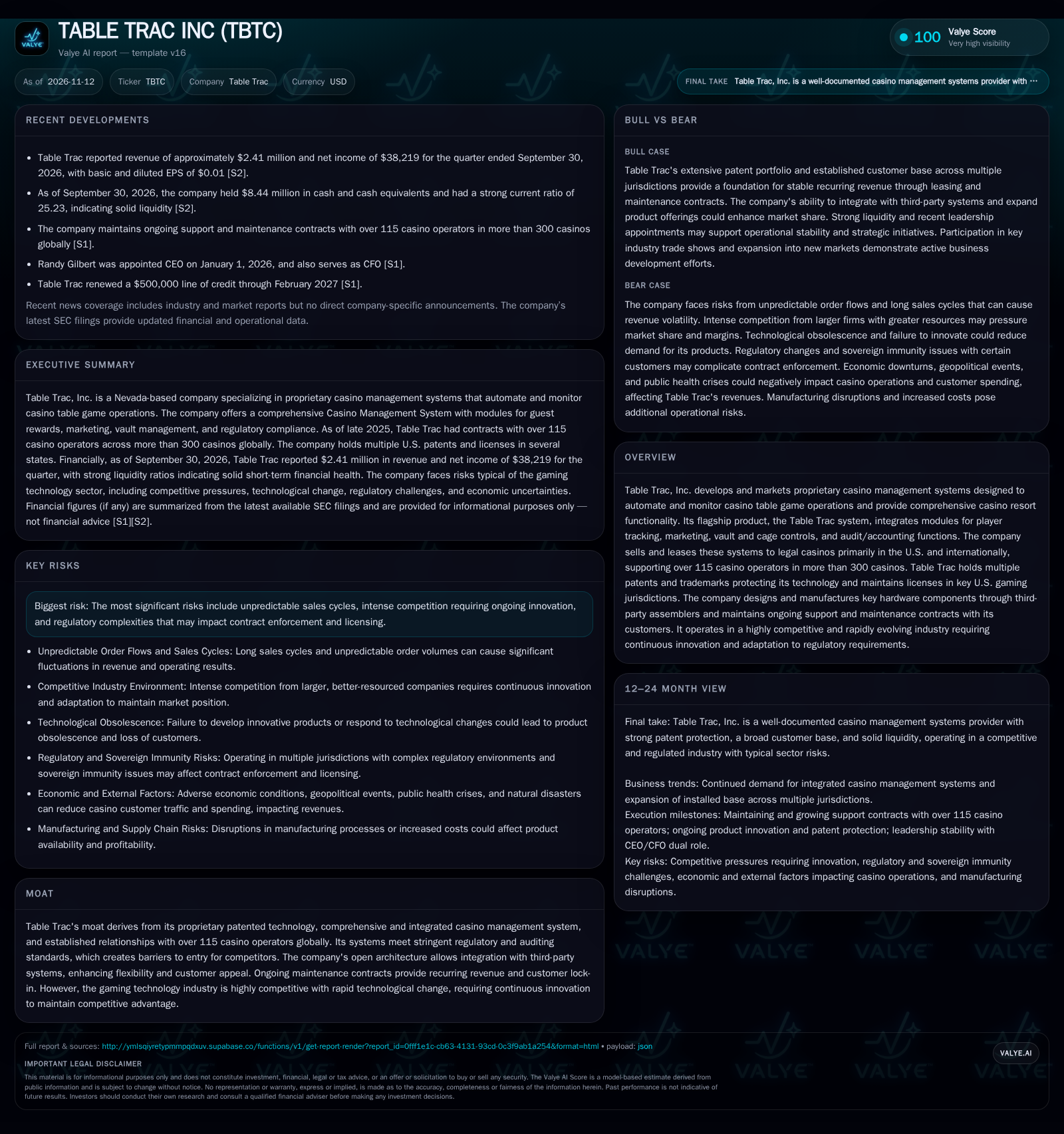
Table Trac serves over 115 casino operators in more than 300 casinos worldwide with its patented casino management systems. Future performance hinges on continued product innovation, customer retention, and the ability to adapt to evolving regulatory and technological landscapes. [S1] [S2]
Table Trac, Inc. occupies a defensible but challenging niche in the global gaming technology landscape, supplying patented casino management platforms to casinos across several continents. Its core strength lies in a recurring-revenue model anchored by support and maintenance contracts for its installed base, underpinned by a significant patent portfolio and broad regulatory coverage. However, the company’s fortunes are tightly linked to the cyclical upgrade patterns of casinos, the pace of technology change, and its ability to stave off intense competition from larger, better-resourced rivals.
Recent Financial Performance and Strategic Positioning
Table Trac reported $2.41 million in revenue and net income of $38,219 for the quarter ended September 30, 2026, translating to basic and diluted EPS of $0.01. The company’s liquidity position, as of that date, included $8.44 million in cash and cash equivalents and a current ratio of 25.23. This reflects a conservative financial posture with limited current liabilities ($0.54 million), which offers short-term operational flexibility. Table Trac’s installed base—supporting over 115 casino operators in more than 300 casinos across the U.S. and internationally—anchors recurring revenue via ongoing support and maintenance contracts. The dual appointment of Randy Gilbert as CEO and CFO in early 2026 signals a consolidated leadership approach as the company navigates a competitive and rapidly evolving landscape. [S1] [S2]
Revenue Streams and the Mechanics of Recurring Income
Table Trac’s business model is built around the sale and lease of proprietary casino management systems, complemented by technical support and maintenance contracts. The company’s unified Casino Management System (CMS) integrates player tracking, marketing, vault/cage, and accounting modules, providing casinos with a comprehensive operational backbone. While the initial sale or lease of systems likely drives lumpy, project-based revenue, the ongoing support and maintenance contracts create a recurring income stream that helps smooth cash flows between new deployments.
The economics of Table Trac’s model depend on both the volume and timing of system upgrades or replacements by casino operators. These cycles can be extended and unpredictable, with long sales lead times often dictated by regulatory approvals, capital budgeting by customers, and competitive bidding. Fixed costs are kept in check by a lean team (32 full-time employees as of 2025) and reliance on third-party manufacturers for hardware assembly, which limits capital intensity but exposes the firm to potential supply-chain disruptions.
Operating leverage is plausible on incremental service and support revenue, as servicing a larger installed base should not scale linearly with headcount or overhead. However, the relatively modest net income ($38K in Q3 2026) suggests that profitability is sensitive to quarter-to-quarter swings in system sales and the timing of large contracts. The company reported cash and liquidity metrics for the period; these figures do not by themselves establish operating runway, investment capacity, financial flexibility, or financing capacity.
Navigating a Fragmented and Rapidly Evolving Casino Tech Market
Table Trac operates in a highly competitive sector dominated by larger casino technology vendors and diversified gaming system providers. Its core advantages include a portfolio of U.S. patents—spanning from 1999 to 2022—and a reputation for meeting stringent regulatory and auditing requirements. These factors create friction for new entrants and support customer retention, particularly in tightly regulated jurisdictions. The open architecture of Table Trac’s CMS allows integration with third-party hardware and software, which may appeal to casinos seeking flexibility and interoperability.
However, Table Trac faces persistent threats from competitors with broader product suites, greater R&D budgets, and extensive sales relationships. The risk of technological substitution is acute: failure to keep pace with new features (e.g., real-time analytics, mobile integration, or cloud-based management) could erode its value proposition. The company’s moderate size and dependence on external manufacturers also mean it cannot easily absorb margin pressure or outspend rivals in innovation. Customer switching costs are meaningful but not insurmountable, as casinos weigh the expense and operational risk of changing core management systems against the potential benefits of newer technology.
Expanding the Installed Base and Leveraging Recurring Revenue
A favorable trajectory for Table Trac would involve accelerating the growth of its installed base, particularly in underpenetrated markets or newly regulated jurisdictions, while deepening wallet share with existing customers through upselling new modules and services. If Table Trac can continue to deliver feature-rich, compliant solutions that integrate with evolving casino operations, it could see steady increases in recurring maintenance and support revenue, improving both revenue visibility and margins.
Evidence of this scenario playing out would include a consistent uptick in the number of casinos adopting the Table Trac platform, higher renewal and retention rates for maintenance contracts (if disclosed), and expansion into new territories with successful regulatory approvals. Confirmation would also come from improved gross margins and rising net income as recurring revenue becomes a larger share of the mix. Successful product launches, new patents, or high-profile customer wins would further validate the upside case.
Managing Cyclical Demand and Sustaining Core Contracts
The most plausible outlook for Table Trac is continued reliance on existing customer relationships, with incremental growth driven by periodic system upgrades and selective new wins. The company’s recurring revenue from support and maintenance contracts provides a degree of stability, but revenue and profit will likely remain lumpy due to the unpredictable cadence of large system sales or lease deals.
This scenario would be confirmed by stable or slowly growing revenue, steady customer counts, and a consistent renewal of maintenance contracts. Operating margins may remain modest, reflecting ongoing R&D and regulatory compliance costs. Any material delays in customer upgrade cycles, heightened competitive pricing, or regulatory hurdles could suppress growth but not fundamentally threaten the business model.
Order Flow Volatility and the Threat of Technological Obsolescence
Adverse outcomes for Table Trac would stem from a combination of prolonged sales cycles, loss of key customers to better-resourced competitors, and failure to keep pace with technology trends. If casino operators defer upgrades, opt for alternative platforms with enhanced analytics or mobile capabilities, or encounter regulatory changes that complicate licensing, Table Trac could experience sharp declines in new sales as well as attrition in its support contract base.
This scenario would be evidenced by a marked drop in revenue, shrinking customer counts, or the loss of major contracts. Early warning signs could include increased customer churn (if disclosed), a slowdown in new installations, or margin compression from discounting and elevated R&D or compliance costs. Disruptions in third-party manufacturing or supply chains could exacerbate profitability pressures, while prolonged economic weakness or regulatory setbacks in key jurisdictions would amplify the downside risk.
Testing the Table Trac Thesis: What Would Move the Needle
Trends in the number of casinos and operators under active maintenance/support contracts, as a proxy for recurring revenue and customer retention, if disclosed.
The mix of revenue from new system sales versus recurring support and maintenance fees; a shift toward recurring revenue would support margin stability.
Gross margin trends, which would signal pricing power, cost control, and the impact of product mix or supply-chain dynamics.
Pace and outcome of new regulatory approvals or market entries, especially in newly legalized gaming jurisdictions.
Product innovation cadence—number of new features, modules, or patents introduced annually.
Any material supply-chain or manufacturing disruptions affecting hardware delivery or cost structure.
Leadership developments or organizational changes that could impact strategic direction or execution.
Disclaimer: This is research-only, informational analysis and not investment advice. It may include AI-generated interpretation and general industry context. Always verify important details using primary sources.

Comments