
Franklin BSP Capital Corp: Middle Market Lending, Portfolio Discipline, and the Dynamics of BDC Leverage
Franklin BSP Capital Corp operates as a Business Development Company with a $4.03 billion portfolio concentrated in senior secured loans to U.S. middle market firms. While its credit risk profile remains stable and leverage provides capital for growth and distributions, the interplay of credit quality, non-accruals, and macroeconomic shifts will determine whether the current income engine is sustainable or at risk of stress.
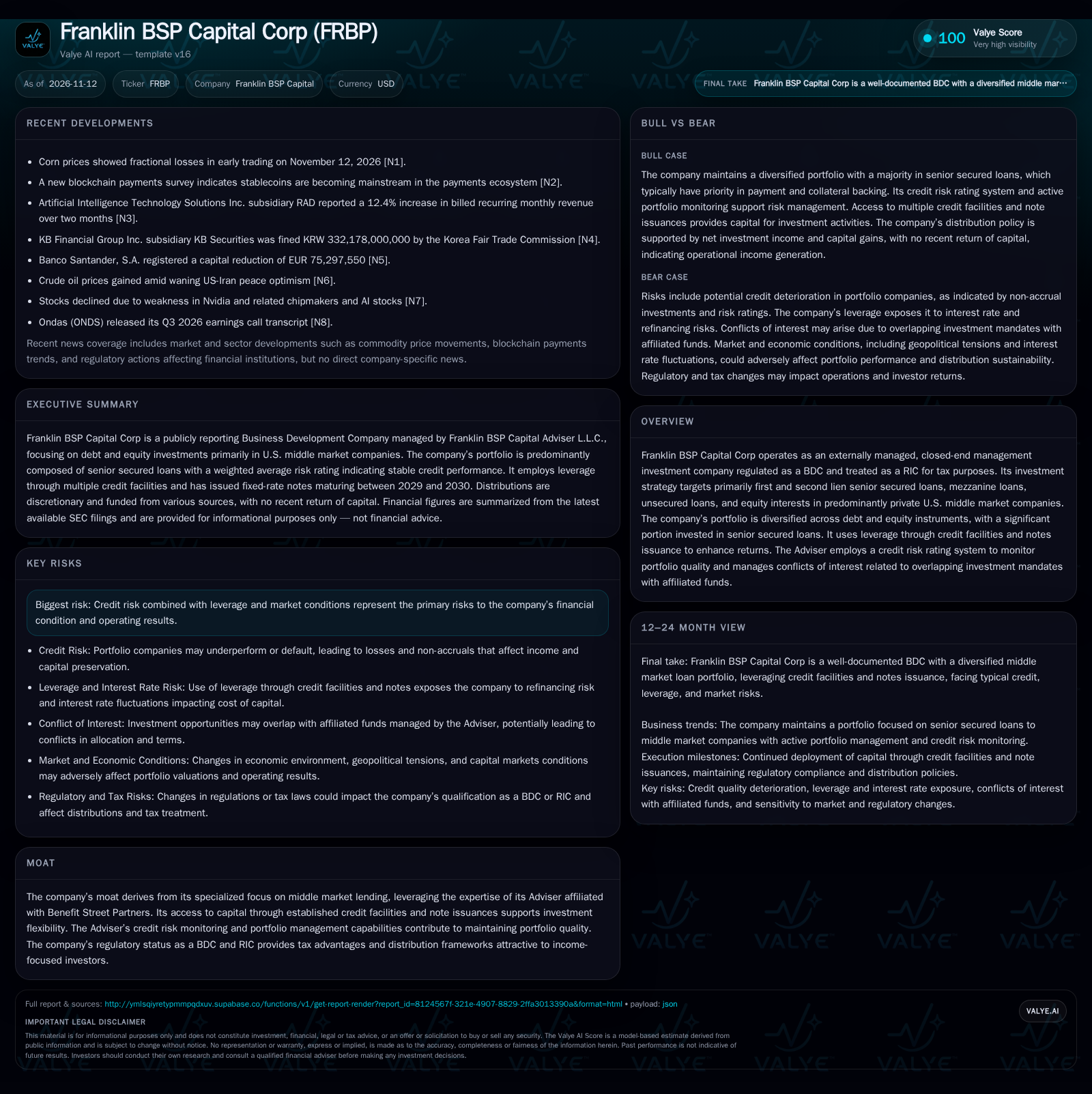
Franklin BSP Capital Corp is a BDC focused on U.S. middle market debt, with 79% of its $4.03 billion portfolio in senior secured loans and a stable risk profile as of September 2026. The company employs leverage via substantial credit facilities and notes, enabling portfolio expansion and regular distributions. The ability to maintain income and manage credit risk—especially with 2.9% of investments on non-accrual—will shape future performance and resilience in a shifting economic landscape. [S2]
Franklin BSP Capital Corp stands as a significant U.S. Business Development Company (BDC), channeling capital into the debt and equity of middle market enterprises. Its $4.03 billion portfolio is anchored by senior secured loans, leveraging the credit expertise of its external adviser and the structural advantages of the BDC regime. While credit metrics and income generation remain solid, the company’s reliance on leverage, presence of non-accruals, and exposure to broader market cycles raise questions about the durability of its income stream and the resilience of its model if macroeconomic conditions deteriorate or portfolio credit quality slips.
Portfolio Composition and Credit Performance in 2026: What the Numbers Say
As of September 30, 2026, Franklin BSP Capital Corp reported a $4.03 billion investment portfolio, with about 79% in senior secured loans—primarily first lien debt—targeting U.S. middle market companies. Net assets attributable to common stock stood at $1.8 billion, while net debt after deferred financing costs reached $2.13 billion, underscoring significant use of leverage [S2].
The portfolio’s weighted average risk rating of 2.2 indicates that, on aggregate, investments are performing in line with or just below expectations, and management does not expect imminent covenant breaches. However, 11 portfolio companies were on non-accrual status, representing 2.9% of amortized cost and 1.7% of fair value, signaling some credit strain [S2].
Leverage is facilitated by large credit facilities, including a $1.05 billion JPM Credit Facility and a $780 million revolving facility with JPMorgan and Wells Fargo, with maturities stretching to 2029 and 2030, plus $700 million in fixed-rate notes [S1].
Distributions to shareholders have been funded from net investment income and capital gains, with no recent return of capital—suggesting the income engine has so far been supported by underlying portfolio performance [S1].
How Portfolio Structure and Leverage Shape Earnings Power
Franklin BSP Capital’s business model centers on originating and investing in debt—primarily first and second lien senior secured loans—to middle market U.S. companies. Revenue is derived mainly from interest income on these loans, with incremental upside from equity positions and fees. The focus on senior secured debt typically provides higher recovery rates and collateral protection, but also limits yield relative to riskier tranches.
The company’s use of leverage—over $2.1 billion in net debt—amplifies both return on equity and risk. In a benign credit environment, borrowing at lower rates to invest in higher-yielding loans can drive strong net investment income and support regular distributions. However, as a regulated BDC, leverage is generally capped at a 2:1 debt-to-equity ratio, constraining risk-taking and requiring careful asset/liability management.
Operating leverage is limited, as most costs scale with assets under management and are paid to the Adviser. However, the ability to scale the portfolio through additional borrowing or capital raises can enhance earnings if new investments perform well and credit losses remain contained.
Funding costs are locked in for a significant portion of liabilities through fixed-rate notes, which can be an advantage if short-term rates rise, but may become a liability if portfolio yields compress or credit spreads widen.
Specialization, Adviser Expertise, and the BDC Regulatory Edge
Franklin BSP Capital’s competitive positioning is anchored in its specialization in U.S. middle market lending—a segment often underserved by traditional banks due to regulatory capital constraints. Its affiliation with Benefit Street Partners provides access to deal flow, credit expertise, and portfolio management resources that may be difficult for standalone BDCs to replicate.
Within the BDC ecosystem, Franklin BSP Capital competes with both large, diversified BDCs and specialist direct lenders. While the predominance of senior secured loans offers relative safety, it also exposes the company to yield compression in crowded markets and limits differentiation unless underwriting standards and sourcing networks are demonstrably superior.
A key advantage is the company’s regulatory status as a BDC and RIC, which allows it to avoid corporate-level taxation and mandates distribution of the bulk of taxable income—features that appeal to income-seeking investors. However, this also restricts retained earnings and cushions against downturns.
Major competitive risks include the potential for rising non-accruals in a downturn, competition from private credit funds, and the risk of conflicts of interest or adverse selection if investment opportunities are shared or allocated with affiliated funds.
If Credit Quality Holds and Deployment Accelerates, Income and Distributions Could Outperform
The most constructive scenario for Franklin BSP Capital is one in which economic conditions remain stable, portfolio credit quality is preserved, and the company continues to deploy capital into high-yielding, well-underwritten middle market loans. The high proportion of senior secured loans could limit losses from defaults, and if the Adviser’s credit process maintains discipline, non-accruals may remain contained or even decline as troubled credits are resolved.
Leverage could amplify returns to equity holders, especially if the spread between portfolio yields and funding costs widens or remains stable. Additional capital raised through private placements—such as the $375.5 million in common stock and $77.5 million in preferred stock commitments completed as of September 2026—could be deployed into attractive opportunities, further supporting net investment income and distributions [S2].
Evidence that would confirm this scenario includes declining or stable non-accrual rates, continued positive net investment income in excess of distributions, stable or improving risk ratings, and successful deployment of new capital at attractive yields.
Sustained Yield with Episodic Credit Losses: The Most Likely Trajectory
The most plausible medium-term outcome is that Franklin BSP Capital continues to generate regular income from its portfolio of senior secured loans, but faces periodic credit losses as a normal feature of middle market lending. The weighted average risk rating of 2.2 suggests most investments are performing as expected, but the presence of 2.9% of assets on non-accrual reflects persistent, if manageable, credit risk [S2].
Distributions are likely to remain covered by net investment income and capital gains, barring a material increase in defaults or a sharp decline in portfolio yields. Leverage will continue to enhance income, but also magnifies the impact of any deterioration in credit quality or funding market volatility.
This scenario would be confirmed by a stable ratio of non-accruals to total assets, continued positive net investment income relative to distributions, and risk ratings that do not deteriorate significantly. Signs of stress would include a rising trend in non-accruals, negative net realized/unrealized results, or forced asset sales to meet leverage covenants.
Adverse Credit Cycle or Funding Disruption Could Trigger Income and Distribution Stress
In a negative scenario, a downturn in the U.S. economy or sector-specific shocks could push more portfolio companies into distress, driving up non-accruals and eroding net investment income. Given the $2.1 billion in net debt, a sharp increase in defaults could quickly pressure asset coverage ratios and trigger BDC leverage limits, potentially forcing asset sales or halting new investments.
Funding risk could also emerge if capital markets tighten, making it more expensive or difficult to roll over credit facilities or issue new notes. Rising interest rates would increase the cost of floating-rate debt, compressing net interest margins if portfolio yields do not keep pace.
This downside would be confirmed by a marked rise in non-accruals, declining net investment income, reductions in or suspensions of distributions, or breaches of leverage covenants. Worsening risk ratings and realized losses would further signal credit deterioration.
What Will Prove Out Franklin BSP Capital’s Income Sustainability?
The trend in non-accrual investments as a percentage of total portfolio (if disclosed quarterly) will be critical for assessing underlying credit health.
Net investment income relative to distributions—specifically, whether recurring income consistently covers payouts without reliance on capital gains—would help test the durability of the income model.
Weighted average risk rating movements: A material uptick would suggest broadening credit stress.
Portfolio yield on new investments versus funding cost: Compression here could pressure future earnings.
Changes in leverage ratios and compliance with BDC regulatory limits, especially after any credit events or realized losses.
Deployment pace of newly raised capital—tracking whether new funds are invested at target returns and without relaxing underwriting standards.
Any amendments to credit facility terms or the cost/availability of new debt, which may signal market perceptions of risk or liquidity constraints.
Disclosures or developments regarding conflicts of interest or allocation of opportunities between Franklin BSP Capital and affiliated funds, if disclosed.
Disclaimer: This is research-only, informational analysis and not investment advice. It may include AI-generated interpretation and general industry context. Always verify important details using primary sources.

Comments