
Kaanapali Land LLC: Cash-Rich, Information-Poor—Analyzing the Strategic Levers and Uncertainties Beneath the Surface
With modest quarterly profits and a substantial cash reserve, Kaanapali Land LLC presents a paradox: it has financial stability but offers almost no visibility into its business model, sector, or strategic direction. This analysis explores the economics, competitive context, and the scenarios that could define its future trajectory.
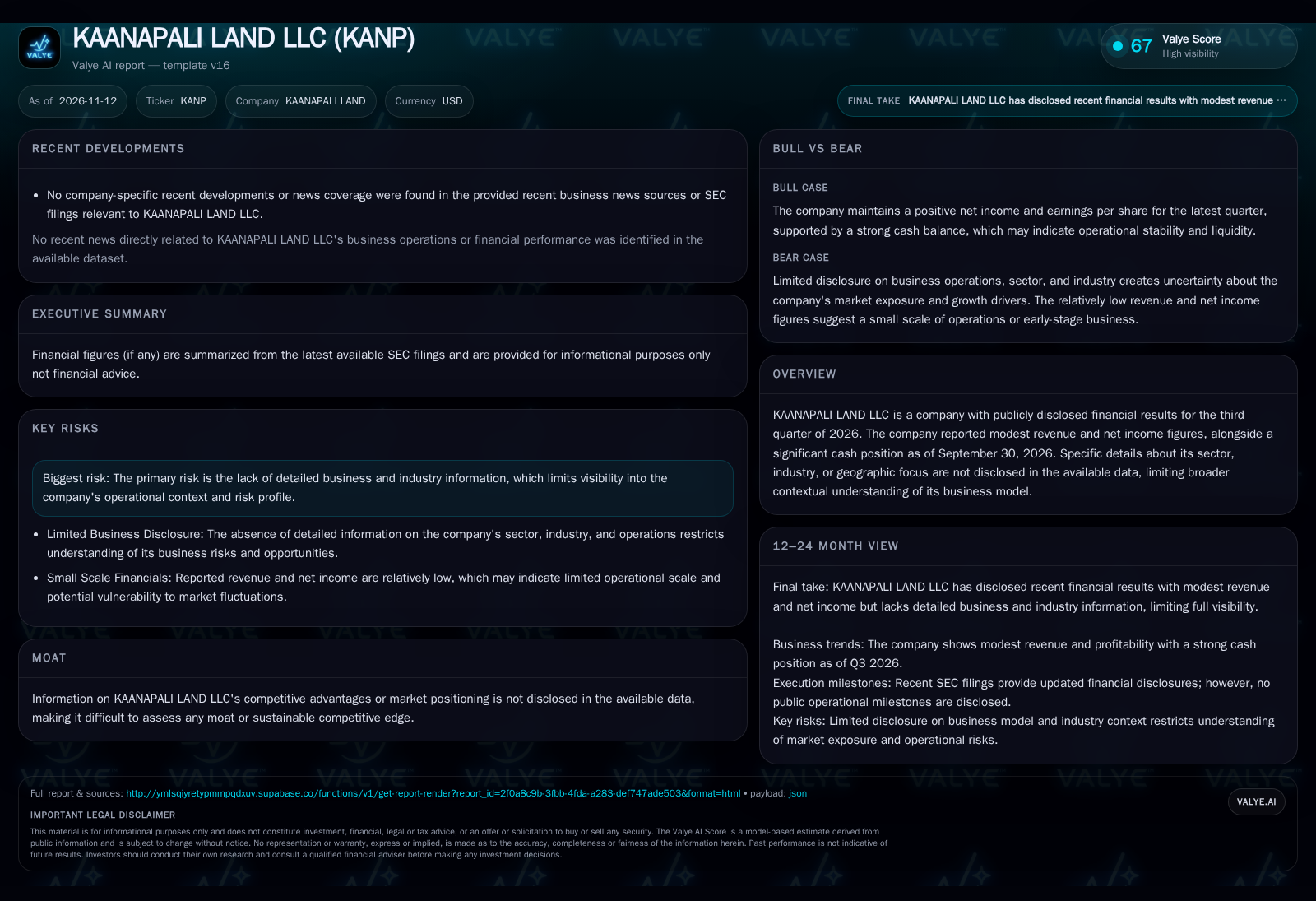
Kaanapali Land LLC reported Q3 2026 revenue of $731,000 and net income of $71,000, alongside a sizeable $37 million in cash. The company’s lack of disclosed business details creates significant uncertainty around its operational drivers and growth prospects. Investors must weigh the implications of this opacity against the apparent financial stability.
Kaanapali Land LLC stands out less for what it reveals than for what it withholds. Its latest financials show a company with a healthy reported cash balance and a slim but positive profit line, yet the complete absence of operational, sector, or strategic detail leaves investors facing a blank canvas. This combination of liquidity and opacity raises critical questions: Is Kaanapali Land a latent asset play, a holding company awaiting a catalyst, or simply an under-disclosed microcap with limited prospects? The answers depend on interpreting sparse financial data and understanding how such companies typically operate—and what might finally force their hand.
Financial Snapshot: Cash Reserves Outweigh Operating Scale
Kaanapali Land LLC reported revenue of $731,000 and net income of $71,000 for the third quarter of 2026, with both basic and diluted earnings per share at $0.04 [S2]. The most striking fact is the company’s $37 million in cash and cash equivalents as of September 30, 2026, dramatically exceeding its quarterly revenue and net income [S2]. There are no reported short-term investments, and no material news or operational disclosures have emerged since the last filing. These facts suggest a business with minimal ongoing operations relative to its cash position, raising questions about the source and intended use of this liquidity.
Decoding the Economics: What Drives Value in a Thinly Disclosed Entity?
With no specifics on business activities, sector, or geographic focus, the core economic engine of Kaanapali Land remains opaque. The low revenue and net income figures indicate a small-scale operation—potentially a land holding or asset management entity, given the company’s name and typical microcap structures. If this is a land-rich company, its value may be tied less to operating income and more to asset appreciation, periodic asset sales, or monetization events. Such models tend to have low operating leverage: fixed costs are modest, and cash needs are minimal unless pursuing development or acquisition.
The oversized cash position relative to revenue hints at either a recent asset sale, a legacy of prudent liquidity management, or a strategic reserve for future transactions. Without disclosure, it is unclear if this cash is earmarked for development, debt repayment, opportunistic acquisitions, or simply conservatively held. The absence of short-term investments may suggest a preference for liquidity or a lack of near-term investment opportunities.
If Kaanapali Land’s business is indeed passive or dormant, the main economic lever would be capital allocation—deploying cash for value-accretive opportunities or returning it to shareholders. Conversely, if it is in the early stages of a new strategy, the pace and nature of future investments will determine its economic trajectory.
Another dimension to consider is the potential impact of macroeconomic and sector-specific trends on Kaanapali Land’s asset valuation and cash management strategy. For example, if the company’s holdings are concentrated in real estate or land assets, fluctuations in interest rates, inflation expectations, and regional development policies could materially influence both the timing and magnitude of value realization events. In a rising interest rate environment, financing costs for development or acquisitions may increase, potentially delaying capital deployment or reducing returns. Conversely, inflationary pressures could enhance nominal asset values, incentivizing monetization or redevelopment initiatives.
Competitive Landscape: Where Does Kaanapali Land Fit?
The competitive environment for Kaanapali Land cannot be directly assessed due to the lack of operational disclosure. If the company is a landholder or asset manager, its peers would include microcap real estate investment trusts (REITs), land banks, or development-stage holding companies. In these niches, competitive advantage often derives from unique asset bases, zoning entitlements, or relationships with local authorities and developers.
However, the absence of disclosed sector or industry details precludes any assessment of market share, customer base, or direct competitive threats. If the company’s assets are illiquid or concentrated in a single region, it may face risk from adverse market cycles, regulatory shifts, or limited buyer pools. Conversely, a diversified or strategically located asset base could provide latent optionality.
Without evidence of recurring revenue streams, ecosystem effects, or product differentiation, Kaanapali Land’s competitive edge—if any—likely rests on its capital base and the latent value of its undisclosed assets.
Unlocking Hidden Value: How a Catalyst Could Transform Perceptions
The most favorable scenario for Kaanapali Land is the emergence of a clear value-unlocking event. This could take the form of a major asset sale, a strategic development partnership, or a business model pivot that leverages its substantial cash reserve. Such catalysts are common in under-disclosed microcaps with significant asset bases: a well-timed transaction or public disclosure can rapidly re-rate valuation.
Confirmation of this scenario would require new filings or press releases detailing asset monetizations, capital deployment plans, or entry into a growth business. Evidence might include a sharp increase in revenue, a jump in investment outflows, or direct communication of a strategic shift. The falsification would be continued operational stasis, with cash balances drifting down only through minor expenses and no sign of external engagement.
Stability Without Direction: The Most Likely Status Quo
Given the absence of operational milestones and the stable, low-level profitability, the most plausible outcome is a continuation of the current pattern: minimal operating activity, slow cash burn, and limited strategic disclosure. The company may function as a passive holding entity, preserving capital while waiting for market conditions or internal decisions to drive action.
This scenario would be confirmed by future filings showing flat or gradually declining cash balances, persistently low revenues, and no material business development. The company’s value would remain tethered to its cash and any unrecognized asset base, with little near-term prospect for growth or re-rating unless external or internal catalysts emerge.
Erosion by Inertia: Risks of Prolonged Opacity and Underutilized Capital
The primary risk is that Kaanapali Land’s lack of disclosure masks operational stagnation or value erosion. Prolonged inertia could see the company’s substantial cash reserves gradually depleted by overhead, legal, or administrative costs without any offsetting revenue growth or asset appreciation. In the absence of a clear strategy or asset monetization plan, market confidence could erode, further depressing valuation.
This scenario would be confirmed by a steady decline in cash and net income, continued absence of business development, and no new disclosures about operations or strategic intent. Any unexpected liabilities, regulatory actions, or adverse legal outcomes could further accelerate capital erosion.
Proving Out the Thesis: What Could Clarify Kaanapali Land’s True Direction?
Disclosure of asset composition or major property holdings—if provided—would help determine the underlying value and risk profile.
Announcements of asset sales, acquisitions, or development projects would indicate active capital deployment and a shift from stasis.
A useful metric would be any disclosure of recurring revenue streams or long-term contractual income, which would improve visibility into sustainable economics.
If disclosed, details on management’s capital allocation policy—such as buybacks, dividends, or reinvestment priorities—would clarify intentions.
Any regulatory filings or communications that reveal the company’s sector, industry, or geographic focus would reduce uncertainty.
The emergence of activist investor involvement or shareholder proposals could prompt strategic change or improved transparency.
Disclaimer: This is research-only, informational analysis and not investment advice. It may include AI-generated interpretation and general industry context. Always verify important details using primary sources.

Comments