
Yesway’s Expansion Playbook: Footprint Growth, Brand Strength, and the Economics of Convenience Retail
Yesway, Inc. is leveraging regional expansion and the Allsup’s brand to deepen its position in the U.S. convenience and fuel retail sector.
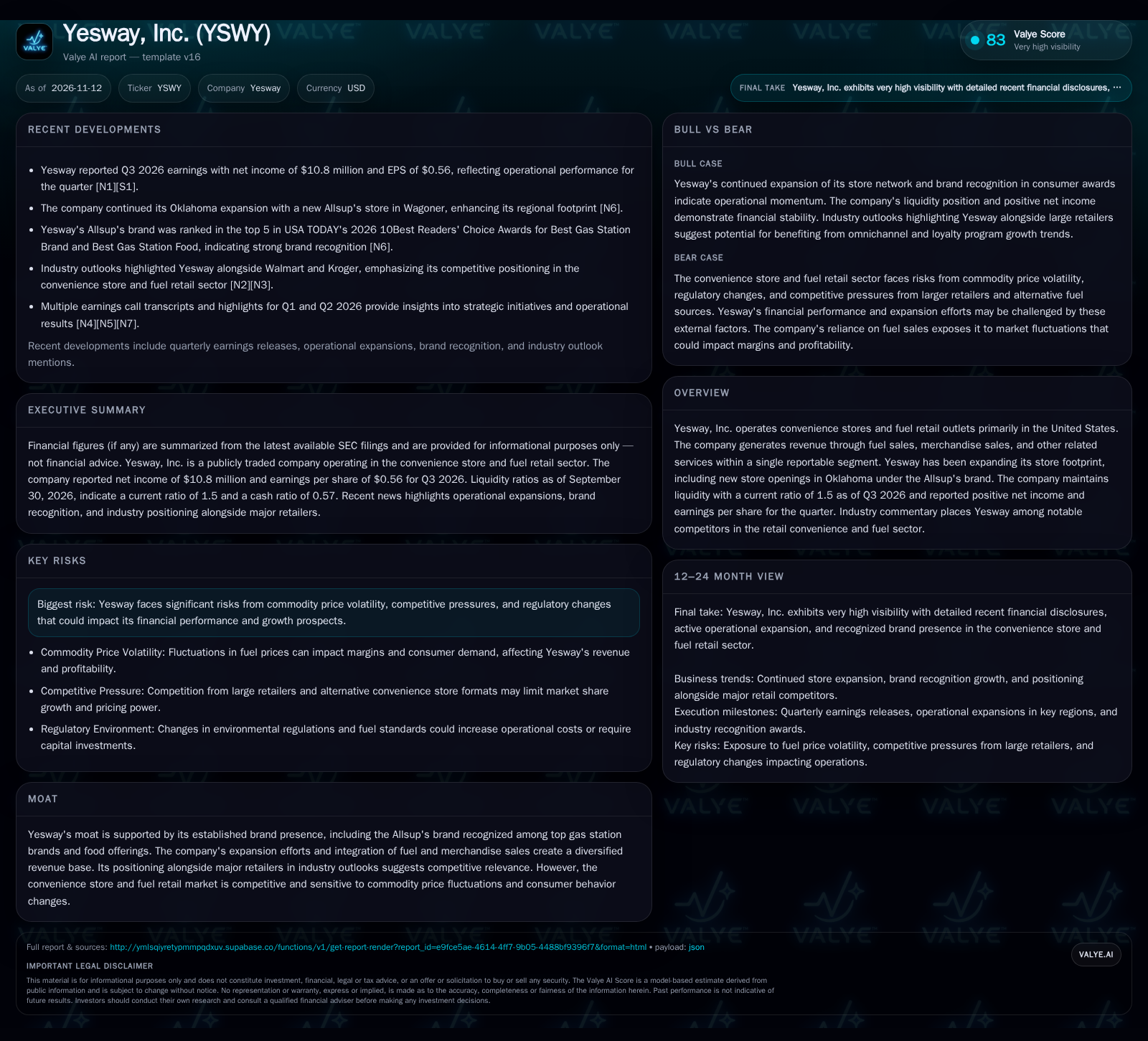
Yesway’s Q3 2026 results reflect both profitability and ongoing store expansion, with the Allsup’s brand gaining national recognition. The company’s economics hinge on balancing fuel and merchandise sales, extracting operating leverage as it scales, and navigating margin risks posed by commodity volatility and retail competition. Sustainable value creation depends on Yesway’s ability to differentiate its offering and adapt to shifting market forces.
Yesway, Inc. is executing a familiar but challenging playbook in the convenience store and fuel retail sector: leverage regional expansion, cultivate a distinctive brand, and drive operational scale to unlock earnings. The company’s Q3 2026 financials show positive net income and a reported liquidity position, while its Allsup’s brand continues to earn consumer accolades. Yet the path forward is fraught with industry headwinds, including commodity price volatility, aggressive competition from retail giants, and shifting consumer habits. Whether Yesway can sustain its current momentum and translate it into lasting economic value depends on its ability to adapt its business mix, extract operating leverage, and meaningfully differentiate its offering in a crowded market.
Recent Profitability and Expansion Define Yesway’s Current Trajectory
Yesway reported net income of $10.8 million and earnings per share of $0.56 for Q3 2026, confirming continued profitability in the most recent quarter [S1]. [S1] The company remains focused on growing its physical footprint, with ongoing expansion in Oklahoma through new Allsup’s store openings [N6] [N5]. Notably, the Allsup’s brand was ranked in the top 5 nationally for both gas station brand and food, reinforcing Yesway’s brand equity in a highly competitive sector [N6]. Industry analysis highlights Yesway as a relevant player alongside large-format retailers such as Walmart and Kroger, signaling both opportunity and competitive threat [N2].
Decoding the Economics of Fuel and Merchandise in Convenience Retail
Yesway’s revenue model is anchored in two primary streams: fuel sales and merchandise sales, with additional ancillary revenues from related services [S1]. Fuel typically represents a high-volume, low-margin segment, with profitability highly sensitive to wholesale price swings and local competitive dynamics. Merchandise, including prepared food and convenience items, often carries higher gross margins and is critical to store-level profitability—especially as fuel margins compress in periods of price volatility.
Operating leverage in this sector is largely a function of store count and throughput: as the fixed costs of store operations are spread over higher sales volumes, incremental earnings can scale rapidly if merchandise mix improves and labor/productivity is well managed. However, expansion requires significant upfront capital—both for real estate and store buildout—making the timing and quality of new store performance vital to returns on invested capital.
Yesway’s ability to extract value from its Allsup’s brand recognition could enable premium pricing on food offerings or greater customer loyalty, but this depends on sustained investment in store standards, supply chain, and marketing.
How Yesway Stacks Up: Brand, Scale, and the Threat from Retail Giants
Yesway operates in a fiercely competitive landscape, facing not only traditional convenience store chains but also large-scale retailers like Walmart and Kroger who are increasingly encroaching on the convenience and fuel segment [N2]. The Allsup’s brand’s national recognition for both fuel and food provides a point of differentiation, potentially supporting customer loyalty and higher-margin merchandise sales [N6].
However, the scale advantages of retail giants—greater purchasing power, integrated supply chains, and omnichannel capabilities—put pressure on mid-sized players like Yesway to innovate and control costs. Alternative formats, such as automated convenience kiosks and delivery-based models, represent additional substitution threats if consumer preferences shift.
Yesway’s competitive relevance will depend on its ability to deepen its regional density, leverage brand equity, and potentially layer on digital capabilities or loyalty programs to defend its share. The question is whether this can offset the margin and traffic pressures from both traditional and emerging competitors.
What If Yesway’s Expansion and Brand Play Unlock Material Margin Gains?
In a favorable scenario, Yesway’s continued store expansion—particularly under the Allsup’s banner—drives a virtuous cycle: increased regional density supports supply-chain efficiency, while strong brand recognition attracts higher traffic and enables premium pricing on food and merchandise. If the company can successfully shift its sales mix toward higher-margin prepared food and private-label items, overall gross margins could expand even as fuel remains a volume anchor.
Confirmation of this scenario would come through accelerating same-store sales growth, rising merchandise gross margin, and evidence of increasing customer loyalty or basket size—potentially supported by loyalty program uptake, if disclosed. A sustained ability to open new stores at or above historical returns on invested capital would further validate the expansion thesis.
Falsification would occur if new store productivity lags, merchandise margins stagnate, or customer retention fails to improve despite expansion and brand investments.
Sustained Growth Amid Margin Volatility and Competitive Friction
The most plausible medium-term outlook is one where Yesway continues to grow its store count and maintains brand relevance, but faces periodic margin compression due to fuel price swings and competitive pressure from both regional peers and national chains. Merchandise sales become an increasingly important profit center, but gains are incremental rather than transformative.
In this scenario, operating leverage is realized gradually as new stores mature, but industry-wide cost inflation (labor, logistics) and the need for ongoing promotional spend to defend traffic weigh on margins.
Evidence supporting this outcome would include steady, but not accelerating, earnings growth, stable or slightly improving merchandise margins, and continued but measured store openings. A sharp divergence in store productivity or a material loss of brand standing would challenge this trajectory.
Margin Squeeze: When Commodity Volatility and Big-Box Competition Collide
The adverse scenario centers on a convergence of fuel price volatility and intensifying competition from retail giants and alternative formats, leading to sustained margin compression. If fuel prices spike or remain highly volatile, Yesway could see both a squeeze in fuel margins and a decline in discretionary in-store spending, as consumers cut back.
Aggressive pricing or promotional campaigns by larger competitors could erode Yesway’s traffic and pricing power, especially in merchandise categories. If new stores underperform or require higher-than-expected capital to reach profitability, returns on expansion could deteriorate, straining both earnings and liquidity.
Confirmation of this scenario would involve declining same-store sales, a drop in merchandise margins, and negative operating leverage as fixed costs outpace revenue growth. A significant deterioration in liquidity or a pause in expansion plans would further validate downside risks.
Proof Points That Will Define Yesway’s Long-Term Competitive Value
Same-store sales growth, especially in merchandise and prepared food, would clarify whether expansion is driving organic demand or simply adding volume through new locations.
Gross margin trends for both fuel and merchandise—if disclosed—would help test the thesis that Yesway can shift its mix toward higher-margin categories over time.
Brand equity metrics, such as repeat customer rates or loyalty program participation (if disclosed), would provide insight into the durability of Allsup’s competitive advantage.
Store-level return on invested capital for new openings would reveal whether expansion is value-accretive or dilutive.
Working capital and liquidity trends beyond headline ratios, including cash flow from operations and capital expenditure requirements, would help assess financial resilience as the company grows.
Evidence of digital integration (e.g., mobile ordering, delivery partnerships, loyalty apps), if pursued, would indicate adaptation to evolving consumer habits and potential for differentiation.
Regulatory or environmental developments affecting fuel retail economics—such as new fuel standards or electric vehicle infrastructure expansion—could materially alter long-term business fundamentals.
Disclaimer: This is research-only, informational analysis and not investment advice. It may include AI-generated interpretation and general industry context. Always verify important details using primary sources.

Comments