
Ares Real Estate Income Trust: Scale, Oversight, and the Challenge of Turning Revenue into Profits
Ares Real Estate Income Trust Inc. posts substantial quarterly revenues but remains in the red amid a focus on cybersecurity and operational risk governance. The trust’s ability to translate top-line scale into sustainable profitability will hinge on asset performance, cost discipline, and sector dynamics.
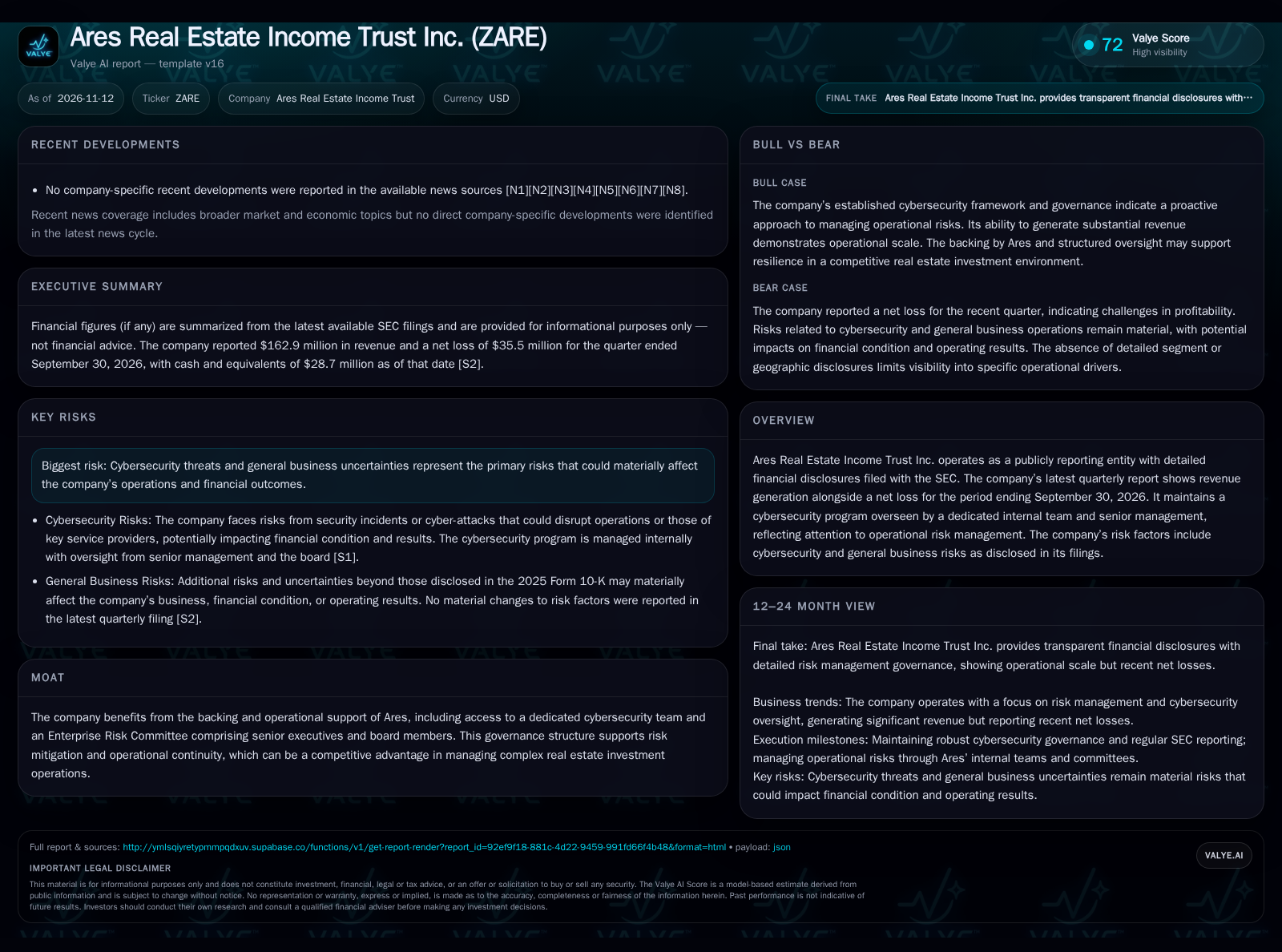
Ares Real Estate Income Trust Inc. reported $162.9M in revenue and a $35.5M net loss for Q3 2026, with cash holdings at $28.7M. Strong governance and a dedicated cybersecurity program address operational risks, but persistent unprofitability raises questions about structural costs, asset yields, and sector headwinds. The trust’s next phase depends on improving margins, maintaining risk controls, and navigating real estate market volatility. [S2]
Ares Real Estate Income Trust Inc., backed by the Ares platform, operates at significant scale but continues to report net losses even as revenues remain robust. The trust’s careful attention to cybersecurity and risk management reflects industry best practices, yet its financial trajectory suggests unresolved structural challenges. The tension between strong governance and persistent unprofitability raises important questions about asset selection, cost structure, and the ability to capitalize on real estate cycles. Investors and stakeholders will be watching for evidence that the trust can translate operational heft and risk oversight into sustainable earnings.
Recent Results Highlight Revenue Scale, But Losses Persist
For the quarter ending September 30, 2026, Ares Real Estate Income Trust Inc. generated $162.9 million in revenue, yet recorded a net loss of $35.5 million. Earnings per share for both basic and diluted calculations were negative $0.14, underscoring that the trust is not currently profitable on a per-share basis [S2]. Cash and cash equivalents at quarter-end totaled $28.7 million [S2].
The company’s cybersecurity program is managed by a dedicated internal team led by a Chief Information Security Officer, who reports up to an Enterprise Risk Committee and the board’s audit committee, reflecting a high level of risk governance [S1].
No material changes to risk factors or business model structure were disclosed in the most recent quarterly report, with cybersecurity and general business risks remaining the primary areas of concern [S1] [S2].
Revenue Generation and the Economics of REIT Performance
Ares Real Estate Income Trust Inc. operates as a real estate investment trust (REIT), which typically generates revenue through the ownership, management, and leasing of real estate assets. The trust’s reported revenue scale implies a sizable portfolio, though the lack of segment or property-type disclosure in the recent filings limits visibility into specific revenue sources or asset mixes [S2].
REITs generally face a mix of fixed costs (property management, interest expense, administrative overhead) and variable costs (maintenance, leasing commissions, transaction costs). The ability to generate positive net income depends on property-level net operating income (NOI) exceeding both operating expenses and corporate overhead. Persistent net losses suggest that either asset yields, occupancy, or rent growth are insufficient to cover costs, or that the trust carries a high structural expense burden.
REITs often rely on external capital for growth and refinancing, making balance sheet strength and access to debt and equity markets key to long-term viability. The company reported cash and liquidity metrics for the period; these figures do not by themselves establish operating runway, investment capacity, financial flexibility, or financing capacity. If the trust is investing in repositioning assets or facing sector-specific headwinds (such as office or retail softness), these could weigh on margins and delay a return to profitability.
Operational Oversight and Ares Platform Support: Competitive Advantages and Limits
Ares Real Estate Income Trust benefits from the operational infrastructure and reputational backing of Ares, a major alternative asset manager. This affiliation may provide advantages in deal sourcing, capital markets access, and risk management practices. The trust’s robust cybersecurity program, with dedicated internal leadership and board-level oversight, is a positive differentiator in an environment where operational disruptions and data breaches can have material financial and reputational consequences [S1].
However, the real estate investment trust sector is highly competitive, with a broad array of public and private vehicles targeting similar assets. Competing REITs may enjoy scale benefits, lower cost of capital, or more attractive asset mixes. Substitution risk arises from direct property ownership, private funds, and alternative real assets. The trust’s ability to generate above-average returns will depend on asset selection, cost discipline, and the ability to capture value through cycles.
The absence of reported segment or geographic detail in current filings makes it difficult to assess whether the trust is exposed to particularly challenged property types (e.g., office, certain retail) or more resilient sectors (e.g., industrial, multifamily), which would materially influence its risk-adjusted return profile.
Margin Expansion and Asset Repositioning Could Restore Profitability
A favorable outcome for Ares Real Estate Income Trust would see the company translate its revenue scale into sustainable net income. This could occur if property-level fundamentals improve—through higher occupancy, rent growth, or successful asset repositioning—allowing operating leverage to work in the trust’s favor. Cost control at both the property and corporate level, combined with disciplined capital deployment, would further support margin recovery.
Confirmation of this scenario would come from sequential improvements in net income, narrowing net losses, or a return to positive earnings per share. Detailed disclosure of asset mix and segment performance would help investors assess whether the trust is shifting toward higher-yielding or more resilient property types. Evidence of asset sales or capital recycling into accretive investments would further support the case for margin expansion.
Falsification would occur if net losses persist or widen despite stable or growing revenues, or if cost ratios remain stubbornly high, suggesting structural cost issues or asset underperformance.
Revenue Stability Amid Cost Pressures Defines the Near-Term Outlook
The most plausible trajectory for Ares Real Estate Income Trust is continued revenue generation at current scale, with net losses persisting until asset yields improve or cost structures are rationalized. The company’s strong governance and risk management practices may help it avoid operational disruptions, but these alone are unlikely to overcome sector headwinds or margin pressures.
Confirming evidence would include stable or modestly growing revenues, ongoing net losses, and continued emphasis on cybersecurity and risk disclosures. The absence of material changes to risk factors or business model structure in filings would reinforce the view that the trust is in a holding pattern, awaiting either external market improvement or internal cost discipline.
Deviation from this scenario would be signaled by either a sharp deterioration in revenues (suggesting asset distress or market weakness) or a sudden improvement in profitability, potentially from asset sales or substantial cost reductions.
Sustained Losses and Asset Weakness Could Force Strategic Retrenchment
The primary risk is that Ares Real Estate Income Trust remains unable to cover costs, with persistent net losses eroding potential financial flexibility and limiting reinvestment. If sector headwinds intensify—such as rising vacancies, declining rents, or property impairments—the trust could face pressure to sell assets at unfavorable prices, reduce dividends, or seek external capital on dilutive terms.
This scenario would be confirmed by widening net losses, declining cash balances, or negative operating cash flow. If cybersecurity or operational failures materialize, they could compound financial weakness and damage the trust’s reputation.
Falsification would require stabilization or improvement in profitability, or clear evidence of successful asset repositioning and cost management.
Milestones That Could Shift the Profitability and Risk Narrative
Quarterly trends in net income and earnings per share: sustained improvement or return to profitability would challenge the current loss-making profile [S2].
Disclosure of asset mix and segment/region performance, if provided, to clarify exposure to challenged or resilient property types.
Property-level operating metrics such as occupancy rates and same-property NOI growth, if disclosed, would help test whether asset fundamentals are improving.
Trends in operating expenses and corporate overhead as a percentage of revenue: declining ratios would indicate operating leverage and cost control.
Cash flow from operations and capital expenditures: positive cash flow and disciplined capex would support long-term sustainability.
Any changes in risk disclosures, such as new cybersecurity incidents or material business uncertainties, would affect the trust’s risk profile [S1] [S2].
Announcements of asset sales, acquisitions, or capital recycling into higher-yield opportunities could signal a strategic pivot.
Disclaimer: This is research-only, informational analysis and not investment advice. It may include AI-generated interpretation and general industry context. Always verify important details using primary sources.

Comments