
Where Food Comes From: Innovation in Certification, Earnings Fluctuations, and Building Trust in Food Supply
Where Food Comes From, Inc., a specialist in food traceability and certification, faces a crossroads: new proprietary programs and modest profitability contrast with sector headwinds, digital asset losses, and persistent macroeconomic risks. The company’s ability to monetize trust and transparency in food production is being tested by both industry volatility and evolving regulatory demands.
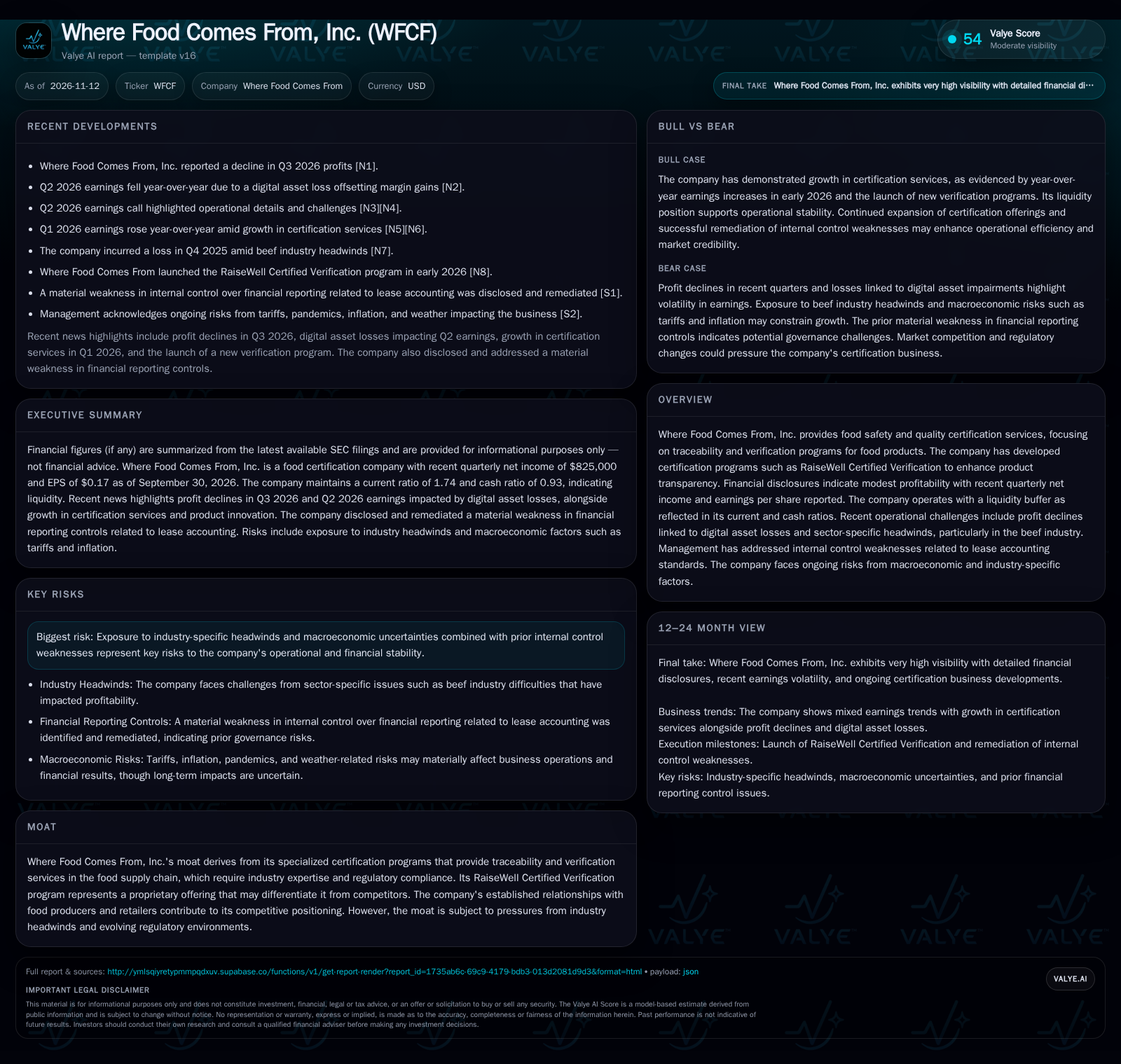
Where Food Comes From, Inc. reported mixed 2026 results: new verification programs and certification growth were offset by profit declines, digital asset losses, and beef industry headwinds. The company’s moat lies in proprietary traceability offerings and established relationships, but its earnings volatility and exposure to macro/industry risks could pressure future performance. Monitoring the adoption of new programs, margin trends, and resilience to sector shocks will be critical for assessing the company’s trajectory.[N1] [N2] [N5] [N8] [S2]
Where Food Comes From, Inc. occupies a specialized but turbulent niche in the food supply chain: verifying the safety, quality, and traceability of food products for producers, retailers, and consumers. In 2026, the company’s financial performance has been marked by both innovation—such as the launch of its RaiseWell Certified Verification program—and volatility, with recent profit declines and digital asset losses offsetting gains in its core certification segment. The company’s future may hinge on its ability to expand proprietary offerings, demonstrate operational resilience, and navigate external shocks that challenge both food producers and the broader certification ecosystem.
2026 Outlook Influenced by Earnings Variability, New Initiatives, and Industry Focus
As of Q3 2026, Where Food Comes From, Inc. reported a decline in profits, continuing a pattern of earnings volatility observed over the past year.[N1] Q2 2026 results were notably affected by losses in digital assets, which offset margin improvements in the core certification business.[N2] Earlier in the year, the company launched the RaiseWell Certified Verification program, representing a strategic push into proprietary traceability offerings.[N8] Operationally, the company has remediated a material weakness in internal control over lease accounting—a governance concern now addressed.[S1] Sector-specific headwinds, particularly in the beef industry, have weighed on results, highlighting the company’s exposure to industry cycles and broader macroeconomic risks such as tariffs and inflation.[N7] [S2]
How Certification and Traceability Create Economic Value
Where Food Comes From, Inc. generates revenue primarily through food safety and quality certification services, which are typically sold as recurring or periodic audits and verification programs to producers and supply chain participants. The launch of proprietary offerings such as RaiseWell Certified Verification suggests a move to differentiate and potentially command premium pricing for higher-value, more complex certification programs.[N8] In this model, revenue growth depends on both volume (number of certified entities and programs) and mix (adoption of higher-value or proprietary standards versus commodity audits).
Cost structure is likely a blend of fixed costs—such as compliance, technology infrastructure, and specialized labor—and variable costs tied to audit activity and program expansion. This creates the possibility of operating leverage if the company can drive incremental certification volume or adoption of new programs without proportionally increasing overhead. However, recent digital asset losses and beef industry exposure point to potential non-operational earnings volatility and sector sensitivity.[N2] [N7]
Food Certification’s Changing Dynamics: Focus on Specialization and Partnerships
Where Food Comes From, Inc. operates in a competitive landscape that includes both large global certification bodies and niche verification specialists. Its moat is grounded in specialized traceability programs, regulatory expertise, and established relationships with food producers and retailers. The RaiseWell Certified Verification program is a proprietary offering that could differentiate the company, provided it gains market traction and is recognized by buyers and regulators.[N8]
However, competitive pressures are likely to intensify as food traceability and ESG (Environmental, Social, and Governance) standards become more mainstream. Larger players may have greater resources to invest in technology and compliance, while smaller or regional competitors could offer lower-cost or specialized local services. Substitutes—such as in-house compliance, blockchain-based traceability, or alternative third-party platforms—could erode pricing power if customers perceive certifications as commoditized.
Switching costs for producers may be moderate, tied to regulatory requirements and the perceived value of certification for market access or brand differentiation. The degree to which proprietary programs like RaiseWell can create true customer lock-in or premium pricing will depend on adoption rates and external validation.
Margin and Revenue Growth Through Exclusive Certification Programs
A favorable outcome for Where Food Comes From, Inc. would see rapid adoption of the RaiseWell Certified Verification program and other proprietary offerings by major food producers and retailers. This could enable the company to command premium pricing, improve margins, and increase recurring revenue from higher-value verification services.[N8]
Evidence supporting this scenario would include: sustained sequential growth in certification revenue, increasing average revenue per customer or program, and external endorsements or regulatory acceptance of RaiseWell as a preferred certification standard. Additional upside would be confirmed if the company can scale these programs with limited incremental SG&A expenses, demonstrating operating leverage.
This scenario could be undermined if adoption stalls, if competitors launch similar or superior programs, or if pricing pressure from large customers erodes margins. Confirmation would require disclosure of program-specific revenue growth, customer count expansion, and margin improvement tied to proprietary offerings.
Managing Sector Instability with Steady Certification Service Growth
The most plausible outcome is a mixed operating environment: Where Food Comes From, Inc. continues to grow its certification services gradually, supported by incremental adoption of new programs, but remains exposed to volatility from sector headwinds and macroeconomic shocks.[N1] [N2] [N5] [N7]
Under this scenario, earnings may fluctuate quarter-to-quarter as gains in certification are partially offset by industry cycles (such as beef sector downturns), non-operational losses, or inflationary pressures.
Confirmation would come from stable or modestly growing top-line certification revenue, relatively consistent operating margins, and no recurrence of significant internal control or governance issues. This scenario would be challenged by unexpected losses (such as further digital asset impairments), sharp declines in core industry segments, or failure to grow proprietary program adoption.
Impact of Sector Disruptions and Certification Challenges on Earnings
The adverse scenario sees Where Food Comes From, Inc. unable to offset sector-specific headwinds (such as prolonged beef industry weakness), facing continued earnings volatility from non-operational losses, and struggling to scale proprietary certification programs.[N1] [N2] [N7]
In this environment, certification services risk being commoditized, leading to price pressure and margin erosion. Larger or tech-enabled competitors could take share, while customers may question the incremental value of proprietary programs. Operational missteps—whether in financial controls, compliance, or digital asset management—could further damage credibility and financial performance.
Evidence confirming this scenario would include declining certification revenue, contracting margins, renewed internal control weaknesses, or customer attrition. It would be reinforced by persistent sector downturns, regulatory changes that increase compliance costs, or loss of key customer relationships.
Factors Shaping Where Food Comes From’s Market Position and Financial Health
Adoption rates and revenue contribution from the RaiseWell Certified Verification program—if disclosed—would provide direct evidence of proprietary program traction and potential pricing power.
Quarterly trends in certification service revenue and segment margins will be critical for assessing the sustainability of growth versus volatility from sector-specific shocks.
Recurring disclosures about internal control effectiveness and remediation progress will help gauge operational discipline and governance risk.
Customer concentration metrics—if disclosed—would clarify exposure to specific industry segments, especially the beef sector.
Evidence of margin improvement or deterioration in the face of inflation or tariff pressures would test the company’s pricing flexibility and cost control.
Any further digital asset impairment charges or non-operational losses would signal ongoing volatility and risk management challenges.
External endorsements, regulatory acceptance, or major customer wins related to proprietary certification programs would provide validation of strategic differentiation.
Disclosure of capital allocation priorities—such as investment in technology or program development—would clarify the company’s growth strategy and risk tolerance.
Disclaimer: This is research-only, informational analysis and not investment advice. It may include AI-generated interpretation and general industry context. Always verify important details using primary sources.

Comments