
Vivos Inc.: Scaling Y-90 Hydrogel Therapy from Veterinary Momentum to Human Oncology Ambition
Vivos Inc. leverages proprietary yttrium-90 hydrogel technology to target solid tumors in both animals and humans. While veterinary adoption has surged, the company’s near-term trajectory hinges on regulatory progress and manufacturing execution for human therapies, with financial and operational levers under close scrutiny.
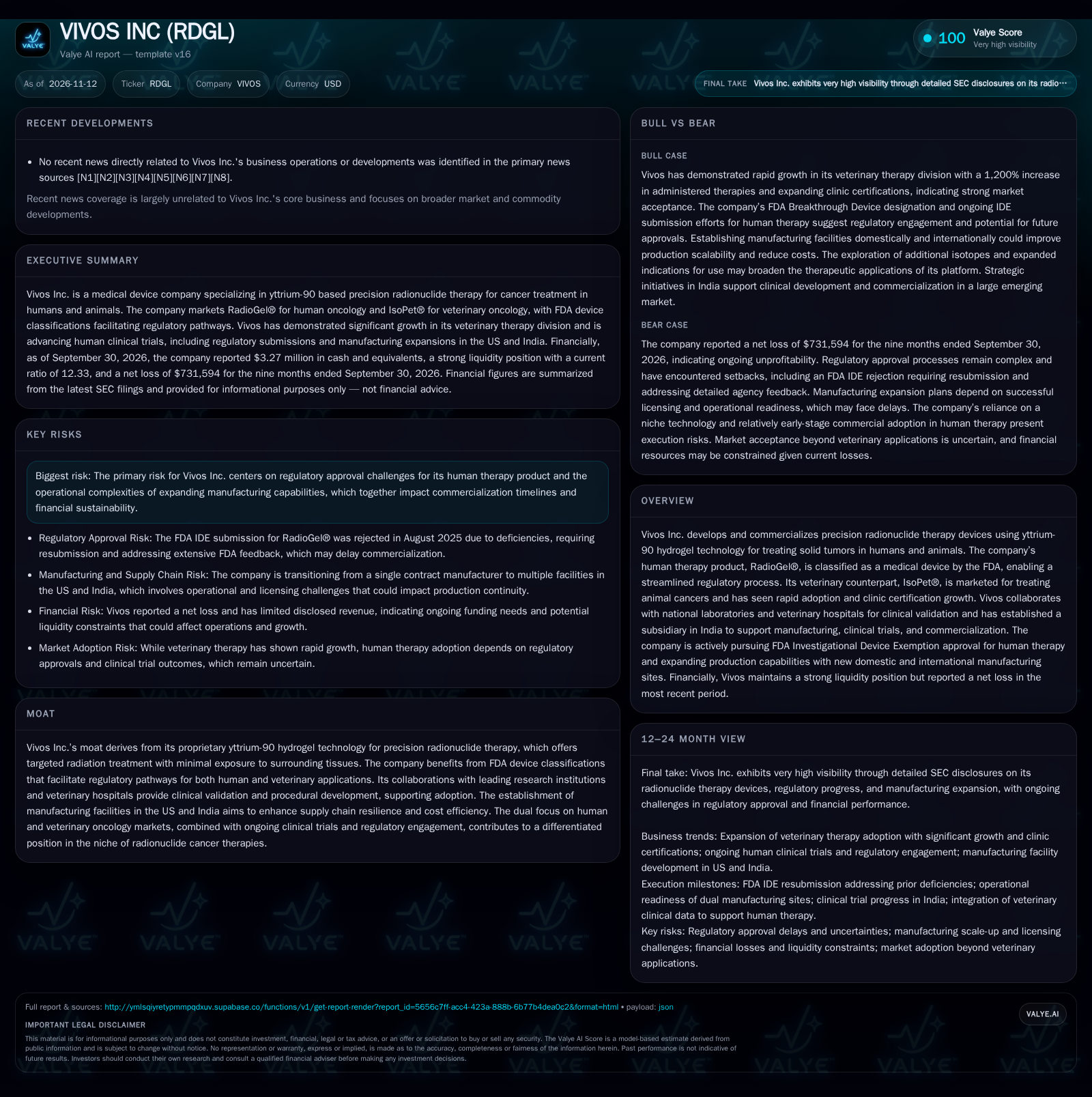
Vivos Inc. has achieved rapid growth in its IsoPet® veterinary oncology business and is expanding manufacturing capacity in the US and India. However, the pathway for its human therapy, RadioGel®, remains contingent on FDA approval and successful clinical validation, with financial losses and execution risks tempering the outlook. Near-term milestones in regulatory progress and operational scale-up will determine whether veterinary momentum translates into sustainable, broader commercial success. [S1] [S2]
Vivos Inc. is advancing a dual-market strategy in precision radionuclide therapy, using yttrium-90 hydrogel technology to address solid tumors in both veterinary and human oncology. The company’s IsoPet® veterinary division has shown explosive growth, but the pivotal test lies in translating this momentum into the human market, where regulatory pathways are more complex and capital requirements higher. With new manufacturing facilities planned in the US and India and ongoing FDA engagement, Vivos stands at a critical juncture: will operational expansion and clinical progress unlock broader adoption, or will regulatory and financial headwinds limit its potential?
Veterinary Oncology Surge and Human Therapy Regulatory Push Define Vivos’s Present
The most striking recent fact for Vivos Inc. is the 1,200% year-over-year increase in IsoPet® veterinary therapies administered between 2024 and 2025, accompanied by an expansion in certified veterinary clinics. This surge signals strong product-market fit in the animal health segment and demonstrates the commercial viability of the yttrium-90 hydrogel platform in a real-world setting. [S1]
In parallel, the company’s human therapy product, RadioGel®, remains in regulatory limbo: the FDA rejected its Investigational Device Exemption (IDE) in August 2025, prompting resubmission and a continued back-and-forth over device classification and trial design. This regulatory bottleneck is the gating factor for near-term human market entry. [S1]
Vivos is also investing in manufacturing infrastructure, with plans for new facilities in Richland, Washington, and India, aiming to reduce costs and increase supply chain resilience. [S1]
Financially, Vivos reported $3.27 million in cash and a net loss of $731,594 for the nine months ended September 30, 2026, with a reported current ratio but ongoing unprofitability. [S2]
Economic Model: Platform Leverage, Capital Intensity, and the Path to Margin Expansion
Vivos’s core economics are shaped by the platform nature of its yttrium-90 hydrogel, which is commercialized under two brands: IsoPet® for veterinary oncology and RadioGel® for human therapy. The business model likely blends device sales to clinics, procedure-based revenue, and potentially recurring consumables or service fees, especially if repeat dosing or follow-up imaging is required. However, without explicit disclosure, the precise revenue model for each segment remains to be confirmed.
Veterinary applications offer a shorter time to revenue, as FDA device classification allows IsoPet® to be marketed without premarket approval—translating into lower regulatory costs and faster adoption cycles. This segment may exhibit relatively high gross margins due to technology differentiation and limited direct competition, but volumes are inherently smaller than in human oncology.
The human therapy segment carries much higher potential volume and pricing, but faces a protracted and costly regulatory process, with significant upfront R&D and clinical trial expenses. If RadioGel® secures FDA approval, operating leverage could be substantial—fixed R&D and regulatory costs would be spread across a larger installed base and higher procedure volumes. Manufacturing scale-up, especially with new facilities in the US and India, is intended to lower per-unit costs and improve margins, but requires capital outlay and operational ramp-up.
The company reported cash and liquidity metrics for the period; these figures do not by themselves establish operating runway, investment capacity, financial flexibility, or financing capacity.
Differentiation in a Niche: Precision, Safety, and Market Entry Barriers
Vivos’s competitive position is anchored in its proprietary Y-90 hydrogel technology, which targets solid tumors with highly localized radiation and minimal off-target exposure. This precision could offer a clinical advantage over traditional external beam radiation, brachytherapy, or systemic radiopharmaceuticals, especially for non-resectable tumors.
In the veterinary market, barriers to entry are relatively high for advanced radionuclide therapies, and Vivos’s early-mover status, clinical validation through partnerships with national labs and university hospitals, and rapid clinic certification provide a defensible niche. However, the overall market size is limited compared to human oncology, and competitors could eventually enter with alternative isotopes or delivery platforms.
In human oncology, the competitive landscape is more crowded and heavily regulated. Vivos competes not only with other device-based local therapies but also with systemic therapies (such as radioembolization and targeted radiopharmaceuticals), surgery, and evolving immuno-oncology approaches. Regulatory hurdles, clinical data requirements, and physician adoption represent significant counterforces—even if technology is sound.
The company’s dual focus (veterinary and human) diversifies risk but could stretch resources, and its long-term moat will depend on durable clinical differentiation, regulatory progress, and the ability to scale manufacturing and distribution.
From Veterinary Validation to Human Oncology Breakthrough: A High-Leverage Chain Reaction
The most favorable scenario for Vivos would see continued exponential growth in IsoPet® veterinary therapies, validating the hydrogel platform’s safety, efficacy, and clinical workflows. This momentum could be leveraged as real-world evidence to support regulatory submissions and physician confidence in the human market.
If the company successfully addresses the FDA’s feedback and secures IDE approval for RadioGel®, human clinical trials could progress rapidly, especially with manufacturing capacity in place. Approval would unlock a far larger addressable market with higher procedure volumes and pricing power, enabling dramatic operating leverage as fixed costs are amortized across more cases.
A further upside lever is the pipeline of additional isotopes (P-32, Lu-177, Ac-225) and expanded indications—if clinical validation is achieved, Vivos could evolve into a platform oncology company, capturing a broader swath of the solid tumor market.
Evidence that would confirm this scenario includes: a successful FDA IDE approval and trial initiation; rapid enrollment and positive interim human clinical data; operational manufacturing sites running at scale; and ongoing triple-digit growth in veterinary procedures and clinic certifications.
Translating Veterinary Success into Cautious Expansion—But Human Market Remains Unproven
The most plausible near-term trajectory is that Vivos continues to grow its IsoPet® veterinary business at a strong, though moderating, rate, with new clinics coming online and procedure volumes increasing from a small base. Revenues from this segment likely cover a portion of operating costs but are insufficient to offset R&D and regulatory expenses associated with human therapy development.
Progress in human therapy is incremental: the company resubmits its IDE and engages in further dialogue with the FDA, but approval is not immediate. Manufacturing expansion proceeds, but operational ramp-up is gradual and may face licensing or supply chain delays, especially in a dual-site model spanning the US and India.
Additional capital raises may be required if regulatory or commercial milestones slip.
Confirmation of this scenario would involve continued veterinary therapy growth (but not at the prior 1,200% rate), steady but slow regulatory progress for RadioGel®, incremental manufacturing milestones (e.g., facility licensing, initial production runs), and ongoing but controlled net losses.
Regulatory Friction and Capital Strain Impede Transition to Human Oncology
A more adverse scenario unfolds if the FDA continues to raise substantive concerns about RadioGel®, resulting in extended delays, additional costly studies, or even a requirement to reclassify the device as a drug, which would dramatically lengthen and complicate the approval process.
Meanwhile, manufacturing expansion could hit operational snags: delays in facility build-out, regulatory licensing issues, or unforeseen cost overruns could erode the company’s reported cash balance and force a halt or restructuring of expansion plans.
Veterinary growth, while robust to date, may decelerate as the early adopter pool saturates, and competitors or alternative modalities gain traction. Without the step-change in human therapy revenues, Vivos could face a funding gap and be forced to pursue dilutive financing or strategic alternatives.
Evidence supporting this scenario would include repeated IDE rejections or FDA requests for new studies, slow or stalled manufacturing progress, a plateau or decline in veterinary therapy volumes, and rapid cash burn not matched by revenue growth.
Milestones That Will Clarify Whether Veterinary Momentum Can Power Broader Oncology Ambitions
FDA IDE approval status and the pace of subsequent human clinical trial enrollment—if disclosed, this will be the single most important gating factor for human therapy commercialization.
Number of certified veterinary clinics and year-over-year growth in IsoPet® therapy procedures—a continued high growth rate would indicate sustained veterinary market traction.
Operational readiness and output capacity of new manufacturing facilities in both the US and India—facility licensing, initial production runs, and cost metrics would help test scale-up assumptions.
Regulatory feedback cycles: the nature, frequency, and substance of FDA responses to IDE submissions—prolonged or substantive new requests would signal ongoing regulatory risk.
Progress in the development and preclinical/clinical validation of additional isotopes (P-32, Lu-177, Ac-225)—pipeline breadth is a potential future differentiator, but requires technical and commercial proof.
Evidence of partnerships or commercial agreements with oncology networks, major veterinary chains, or international distributors—if disclosed, these could accelerate market penetration and validate commercial viability.
Disclaimer: This is research-only, informational analysis and not investment advice. It may include AI-generated interpretation and general industry context. Always verify important details using primary sources.

Comments