
Ionic Digital’s Transition: From Bitcoin Mining to Hyperscale AI Infrastructure Leasing
Ionic Digital is shifting its business model from pure-play cryptocurrency mining to leasing digital infrastructure for hyperscale AI and high-performance computing customers, underpinned by a $1.9–2.6 billion long-term lease with Nscale. The company’s financial strength and evolving asset monetization strategy position it at a crossroads, with execution and market adoption as pivotal variables.
The sustainability of this transformation hinges on demand from hyperscalers and the pace of digital infrastructure buildout. [S1]
Ionic Digital Inc. stands at a pivotal juncture: once a pure cryptocurrency miner, it is now recasting itself as a digital infrastructure landlord for the surging AI and high-performance computing (HPC) sectors. Anchored by a transformative multiyear lease with Nscale, the company is leveraging its existing powered sites and robust cash reserves to secure more stable, long-term revenues. However, this transition brings both promise and uncertainty, as Ionic Digital must execute on ambitious energy expansion, attract additional tenants, and manage the operational complexities of running both mining and infrastructure leasing businesses. The company’s trajectory will be defined by its ability to scale, deliver contracted cash flows, and adapt to evolving market demand for compute power. [S1]
Recent Financials and Strategic Lease Signal a Business Model Inflection
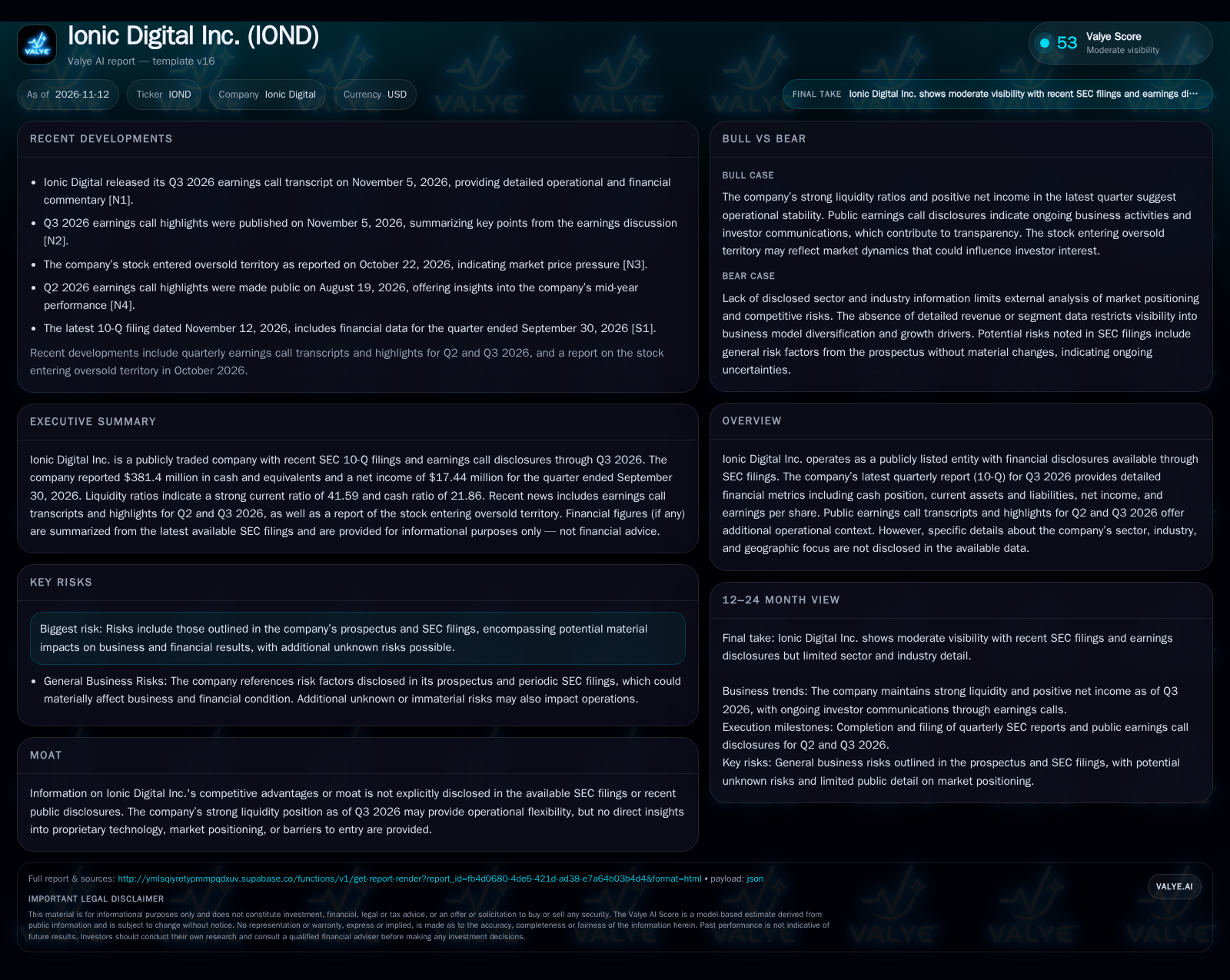
As of September 30, 2026, Ionic Digital reported $381.4 million in cash and cash equivalents, with a current ratio of 41.59 and net income of $17.44 million for the quarter. These metrics underscore a fortress-like liquidity profile and recent operating profitability. The most material development is the company’s 126-month ‘triple net’ lease with Nscale, a hyperscaler focused on sovereign-grade AI infrastructure, covering 234 MW initially and expanding under amendment. The Nscale Agreement is projected to generate $1.9–2.6 billion in contracted revenues over the lease term, with fixed monthly payments beginning August 2026. In parallel, Ionic Digital continues to mine bitcoin at its Midland facility, but the strategic emphasis has shifted toward infrastructure leasing. [S1]
How Leasing and Mining Shape Ionic Digital’s Evolving Revenue Streams
Ionic Digital’s legacy business model centered on bitcoin mining, a capital-intensive, highly variable-margin activity dependent on cryptocurrency prices, mining difficulty, and energy costs. Mining revenues are volatile, with profitability sensitive to bitcoin market swings and power input costs. The company’s pivot toward leasing digital infrastructure fundamentally alters its economic profile: long-term leases with hyperscalers such as Nscale provide stable, predictable cash flows, typically with high operating leverage after initial capital outlay for site buildout and power access.
The Nscale Agreement, structured as a triple net lease, likely transfers property expenses (taxes, insurance, maintenance) to the tenant, maximizing margin stability for Ionic Digital. With fixed monthly payments and up to $2.6 billion in contracted revenue potential, the company’s future earnings visibility improves substantially, provided tenants remain solvent and demand for AI/HPC capacity persists. The economics of expanding from 234 MW to 700 MW hinge on capital investment in power infrastructure and the company’s ability to secure new tenants at attractive lease rates. As mining winds down, capital and operating expenditures may decline, but the pace of lease-up and returns on incremental MWs will determine long-term cash generation.
Strategic Positioning in the Digital Infrastructure and AI Compute Arms Race
Ionic Digital’s value proposition now aligns with the growing need for hyperscale, high-availability digital infrastructure to support AI and HPC workloads. The company’s initial customer, Nscale, positions it within a competitive arena dominated by large data center REITs, specialized AI infrastructure providers, and traditional cloud hyperscalers building their own capacity. Key sources of potential advantage include ownership of powered sites in energy-abundant West Texas, experience in large-scale power management from its mining days, and the ability to offer long-term, sovereign-grade infrastructure leases.
Counterforces include capital intensity, the risk that larger incumbents (such as established data center operators or utilities) could undercut lease economics, and the possibility of technological shifts reducing demand for certain types of physical infrastructure. The pace of AI and HPC adoption, and the willingness of enterprise and government customers to outsource compute requirements, will shape Ionic Digital’s growth runway. Without a pipeline of additional anchor tenants, the company may face periods of underutilized capacity or pricing pressure.
Unlocking Full Capacity and Multi-Tenant Demand Could Transform Earnings Power
The most favorable outcome for Ionic Digital is a successful expansion of energy capacity at the Ward County property to the targeted 700 MW, coupled with strong demand from additional hyperscale and enterprise tenants seeking AI/HPC infrastructure. If the company executes on buildout and attracts further long-term leases at rates comparable to or above the Nscale Agreement, recurring contracted revenue would scale substantially, supporting robust operating leverage and free cash flow.
Confirmation of this scenario would come from announcements of new multi-year lease agreements, visible progress on power infrastructure expansion, and declining reliance on bitcoin mining as a revenue source. A sustained market shift toward outsourced, sovereign-grade AI compute would reinforce pricing power and tenancy stability. If Ionic Digital delivers consistent earnings growth and demonstrates disciplined capital allocation, its valuation could re-rate to reflect infrastructure-like cash flow predictability.
Balanced Execution: Steady Lease Revenue, Gradual Mining Phase-Out
The most plausible trajectory is one where Ionic Digital reliably collects fixed payments under the Nscale Agreement, incrementally develops additional MWs of capacity, and gradually phases out bitcoin mining as economics dictate. While the initial lease provides stable cash flows, the pace of new tenant additions may be measured, reflecting industry competition and long sales cycles for hyperscale infrastructure.
Evidence supporting this scenario would include stable or modestly growing lease revenues, continued positive net income, and capital expenditures aligned with phased infrastructure buildout. If the company maintains its liquidity cushion and avoids major operational missteps, it could steadily transition to a predominantly lease-driven business, albeit without the outsized upside of a rapid multi-tenant ramp. Conversely, sluggish demand for new capacity or delays in infrastructure expansion would confirm a more measured growth path.
Execution Risk and Market Shifts Could Undermine Monetization Strategy
Adverse outcomes for Ionic Digital could stem from execution failures in expanding energy capacity, inability to secure additional anchor tenants, or a deterioration in demand for outsourced AI/HPC infrastructure. If Nscale encounters financial distress or renegotiates terms, or if technological advances reduce the need for large-scale physical infrastructure, contracted revenue could fall short of expectations.
This scenario would be confirmed by project delays, cost overruns in site buildout, missed or renegotiated lease payments, and persistent reliance on volatile bitcoin mining revenues. Signs of sustained underutilization of expanded capacity or entrance of aggressive competitors offering lower-cost or more flexible infrastructure would further pressure the company’s economics and strategic positioning.
Milestones That Will Define Ionic Digital’s Pivotal Transformation
Progress and completion of energy capacity expansion at the Ward County property, measured in MWs brought online and available for lease.
Disclosure and terms of additional long-term lease agreements with new hyperscale, AI, or enterprise customers—tenant diversity and lease duration would help test the thesis.
Stability and collection of fixed monthly payments under the Nscale Agreement; any amendments, missed payments, or renegotiations would be material.
Reduction in bitcoin mining activity and revenue share, and the speed at which legacy mining sites are converted to infrastructure leasing.
Trends in capital expenditures related to infrastructure buildout versus maintenance, as an indicator of growth versus sustaining investment.
Gross margin and cash flow generation from leasing operations, if disclosed, to assess the economics of the new business model.
Any evidence of competitive lease pricing pressure, tenant churn, or market saturation in the West Texas digital infrastructure market.
Disclaimer: This is research-only, informational analysis and not investment advice. It may include AI-generated interpretation and general industry context. Always verify important details using primary sources.

Comments