
Flowers Foods: Margin Pressures, Volume Crossroads, and the Search for Sustainable Growth
Flowers Foods faces a pivotal period as margin compression and volume headwinds test its operational resilience.
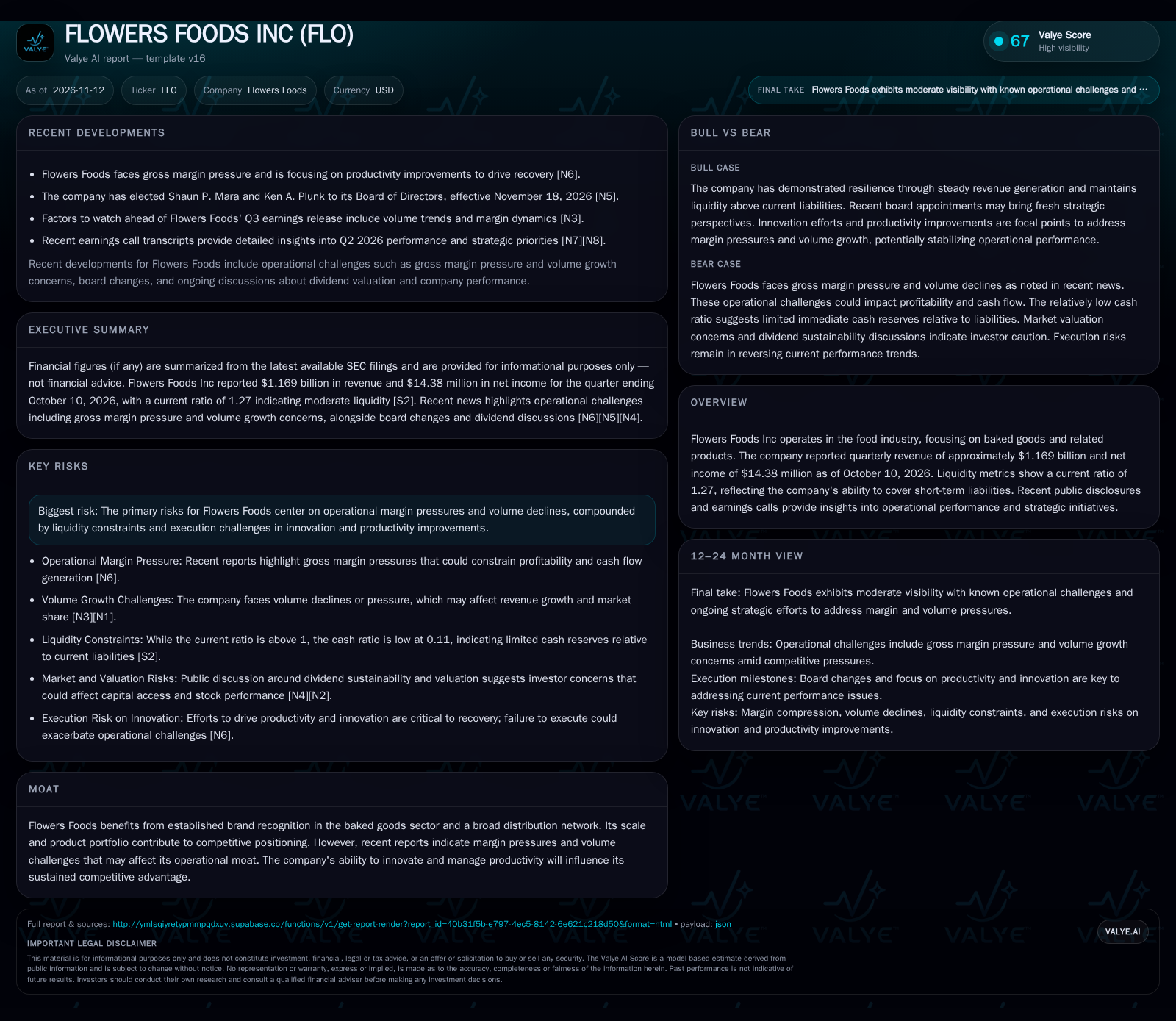
Flowers Foods reported $1.169 billion in revenue and $14.38 million in net income for the quarter ending October 10, 2026, but faces ongoing gross margin pressure and volume challenges. Recent board changes signal potential strategic shifts, while the company’s reported liquidity position (current ratio 1.27, cash ratio 0.11) highlights the need for effective operational improvement and innovation initiatives to stabilize performance in a competitive baked goods market. [S2] [N6] [N5]
Flowers Foods, one of the largest producers of packaged baked goods in the U.S., is at a crossroads. Despite generating $1.169 billion in revenue last quarter, the company is contending with gross margin compression and volume declines that threaten its operational stability. New board appointments and a renewed focus on productivity signal a willingness to adapt, but with a current ratio of 1.27 and a cash ratio of just 0.11, Flowers Foods’ room for error is limited. How effectively the company navigates these pressures will determine whether it can sustain its brand-driven moat or face deeper profitability and market share erosion.
Recent Financial Performance and Strategic Moves: Setting the Stage for Change
Flowers Foods reported $1.169 billion in revenue and $14.38 million in net income for the quarter ending October 10, 2026. Basic and diluted earnings per share were $0.07, reflecting modest profitability in the face of industry headwinds [S2]. The company reported cash and liquidity metrics for the period; these figures do not by themselves establish operating runway, investment capacity, financial flexibility, or financing capacity. [S2]
Recent news highlights persistent gross margin pressure and ongoing volume declines, prompting the company to emphasize productivity improvements as a path to recovery [N6] [N3]. The election of Shaun P. Mara and Ken A. Plunk to the board, effective November 18, 2026, may bring new strategic perspectives as Flowers Foods attempts to address these operational challenges [N5].
Baked Goods Economics: Margin Squeeze, Scale, and the Limits of Pricing Power
Flowers Foods operates in a mature, low-growth segment of the food industry—packaged baked goods—where revenue is primarily driven by volume and modest pricing adjustments. The company’s cost structure features high fixed costs for manufacturing and distribution facilities, alongside variable costs for ingredients and labor. This creates meaningful operating leverage: small changes in volume or gross margin can have outsized effects on net income.
Historically, branded baked goods companies have sought to offset commodity cost inflation through price increases or product mix improvements, but this strategy has limits in a price-sensitive category with abundant private-label and regional competition. When volume declines coincide with gross margin pressure, as currently reported, Flowers Foods’ ability to pass through costs without sacrificing market share may be constrained. Productivity initiatives—such as automation, supply chain optimization, and SKU rationalization—offer potential margin relief but often require time and upfront investment.
Given the mature nature of the packaged baked goods market, Flowers Foods faces structural challenges in leveraging pricing power without risking volume erosion. The elasticity of demand in this category tends to be relatively high, meaning consumers are sensitive to price changes, especially when lower-cost private-label alternatives are readily available. This dynamic limits the company’s ability to pass through rising input costs fully, forcing a delicate balancing act between maintaining competitive pricing and protecting margins. Moreover, the fixed-cost intensity of production amplifies the financial impact of any volume downturn, as fixed overheads are spread over fewer units, increasing per-unit costs and compressing profitability further.
Operational improvements aimed at productivity gains must be carefully prioritized to ensure they deliver sustainable cost reductions without compromising product quality or brand integrity. For example, automation investments may reduce labor costs but require significant capital outlays and entail implementation risks, including potential disruptions during transition periods. Similarly, SKU rationalization can streamline manufacturing and logistics but may alienate loyal customers if popular products are discontinued. Therefore, the timing and sequencing of these initiatives are critical; premature or poorly executed changes could exacerbate volume declines or weaken brand equity, undermining the intended margin benefits.
Defending the Shelf: Brand Strength, Distribution Reach, and Erosion Risks
Flowers Foods’ competitive position is built on strong regional and national brands, a broad product portfolio, and extensive direct-store-delivery and warehouse distribution networks. This scale provides shelf access and some negotiating power with retailers, but the core baked goods market remains highly competitive, with private-label players, regional bakeries, and large food conglomerates all vying for share.
Brand equity and distribution breadth can support pricing power and customer loyalty, but these advantages are vulnerable if operational execution falters. Margin compression and volume declines may signal that competitors are undercutting prices or that consumer preferences are shifting toward niche or healthier alternatives. If Flowers Foods cannot stem these trends through innovation or operational improvements, its competitive moat could narrow.
The risk of technology-driven substitution—such as direct-to-consumer delivery or digital grocery disruptors—remains limited but could grow if incumbents fail to adapt packaging, marketing, or product innovation to changing retail dynamics.
If Productivity Gains and Innovation Take Hold, Margin Recovery Could Follow
The most favorable scenario is one in which Flowers Foods successfully implements productivity improvements—such as automation, process streamlining, and ingredient sourcing optimization—leading to a stabilization or recovery in gross margins. If these efforts are paired with effective product innovation (e.g., healthier baked goods, premium offerings, or new formats) that resonates with evolving consumer preferences, the company could regain lost volume and defend or expand its market share.
Evidence that would confirm this scenario includes a sequential improvement in gross margin percentage, stabilization or growth in unit volumes, and increased mentions of new product launches or expanded distribution in earnings calls. Board refreshment could accelerate strategic pivots if new directors champion bolder cost or product initiatives.
Falsification would be signaled by continued margin erosion despite cost-cutting efforts, persistent volume declines, or evidence that new products fail to gain traction with retailers and consumers.
Navigating Margin Headwinds While Maintaining Brand Relevance
The most plausible outcome is that Flowers Foods manages to slow, but not fully reverse, margin compression and volume declines through a mix of incremental productivity gains and modest product innovation. The company continues to leverage its distribution scale and brand equity to maintain shelf presence, but faces ongoing competitive and input cost pressures that limit meaningful margin expansion.
Under this scenario, quarterly revenue and net income remain relatively stable, with earnings volatility tied to commodity costs and promotional activity.
Confirmation of this base path would come from stable or slightly improving operating margins, muted volume declines, and continued moderate capital expenditures. Signs that would challenge this scenario include a sudden acceleration of volume loss, erosion of retailer relationships, or inability to fund necessary investments.
Prolonged Margin Compression and Volume Losses Threaten Stability
In the adverse scenario, Flowers Foods is unable to meaningfully offset cost inflation or stem volume declines. Retailers may shift shelf space to competitors or private-label offerings, and the company could be forced to take additional price cuts or promotional spending, further compressing margins.
Indicators of this scenario would include a sustained drop in gross margin percentage, accelerating year-over-year volume declines, and negative free cash flow. Liquidity stress could emerge if working capital needs spike or if refinancing becomes necessary under less favorable terms.
Falsification would require evidence of margin stabilization, improved volume trends, or a strategic action (such as asset sales or a capital raise) that restores potential financial flexibility.
Thesis Tests: Margin Trends, Volume, and Strategic Execution to Monitor
Sequential and year-over-year gross margin percentage—continued compression would indicate operational or competitive pressures are not abating.
Quarterly volume growth or decline by major product category—if disclosed, this would clarify whether revenue trends are price- or volume-driven.
Frequency and scale of new product launches or reformulations—evidence of innovation traction or lack thereof.
Changes in shelf space or retailer relationships—if disclosed, this would test the resilience of Flowers Foods’ distribution moat.
Board and management commentary on cost reduction and productivity initiatives—progress updates would help assess turnaround execution.
Commodity cost trends and the company’s ability to pass through increases—particularly wheat, sugar, and packaging inputs.
Disclaimer: This is research-only, informational analysis and not investment advice. It may include AI-generated interpretation and general industry context. Always verify important details using primary sources.

Comments