
Evommune: Pipeline Inflection Points and the Economics of Clinical-Stage Inflammatory Disease Therapeutics
Evommune’s story is one of high stakes and volatility, with recent clinical milestones and setbacks reshaping its risk/reward profile.
The company’s future pivots on further clinical progress, regulatory wins, and the ability to translate partnerships and licensing into sustainable economics. [S2] [N2] [N5] [N6]
Evommune, a clinical-stage biotech focused on therapies for chronic inflammatory diseases, stands at a pivotal juncture. However, the company’s mixed clinical results in 2026, particularly the failed Phase 2b trial for EVO756, underscore the binary nature of biotech value creation at this stage. The next chapters for Evommune will be written by further clinical readouts, regulatory progress, and the company’s ability to either independently commercialize or strategically partner its assets.
Recent Clinical Outcomes and Funding Moves Define Evommune’s Current Position
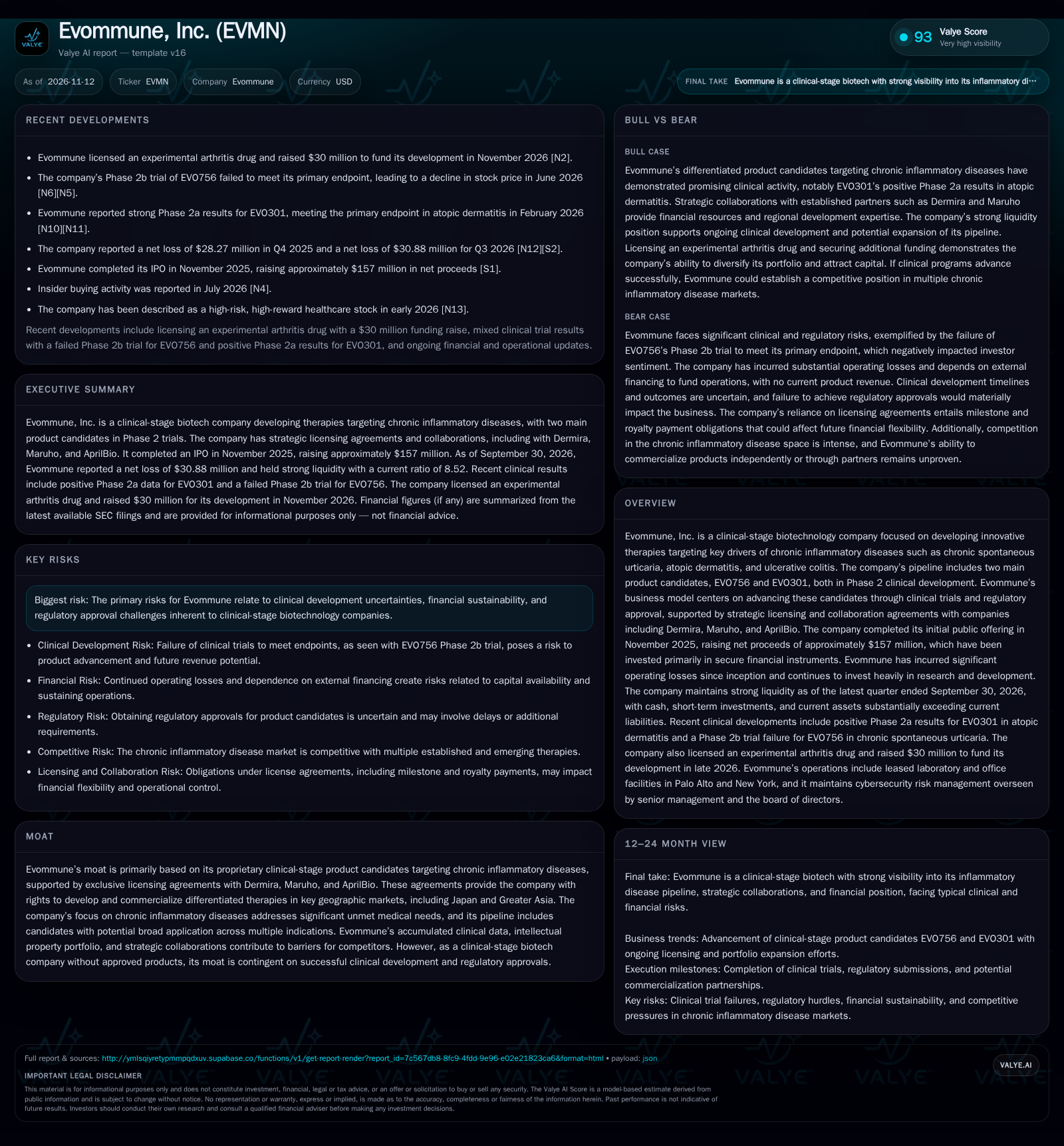
Evommune’s most consequential developments in 2026 include a failed Phase 2b trial for EVO756 in chronic spontaneous urticaria—an event that triggered a sharp decline in the company’s stock price [N5] [N6]—and strong Phase 2a results for EVO301 in atopic dermatitis, where the primary endpoint was met. These divergent clinical results have immediate implications for both pipeline prioritization and market sentiment. [N2] [S2] However, the company continues to report material net losses, and no product sales revenue has yet been realized.
How Evommune’s Model Could Capture Value in Inflammatory Disease
Evommune’s business model is predicated on the successful development and regulatory approval of novel therapies for chronic inflammatory diseases, with the intention to commercialize products directly or through out-licensing and partnerships. Revenue to date has been derived exclusively from license agreements, not product sales [S2]. The economics of this model are characterized by high upfront R&D expenditures, milestone and royalty structures in licensing deals, and deferred revenue realization until late-stage clinical success or market approval. Operating leverage is significant: if a product candidate achieves approval, fixed R&D and administrative costs would be spread over growing revenue streams, potentially yielding attractive margins. Conversely, clinical failures can quickly erode value, as seen with EVO756’s recent trial miss.
Capital needs are substantial at this stage, with ongoing expenses for clinical trials, regulatory submissions, and business development. The mix of direct development and strategic licensing (e.g., agreements with Dermira, Maruho, AprilBio) allows for risk-sharing but also creates contingent payment obligations that could impact future cash flows.
The timing and structure of milestone payments within licensing agreements critically influence Evommune’s cash flow dynamics and risk exposure. Upfront payments provide immediate capital but are typically modest relative to development costs, while later-stage milestones depend on uncertain clinical outcomes and regulatory approvals. Royalty streams, often contingent on commercial success, represent long-term value but do not mitigate near-term liquidity needs. Consequently, Evommune’s financial strategy must balance aggressive clinical investment against preserving sufficient capital to sustain operations through pivotal trial phases. This interplay underscores the importance of securing flexible financing arrangements and adaptive partnership terms to manage the inherent volatility in clinical-stage biotech economics.
Pipeline Differentiation Amidst Intense Competition in Chronic Inflammation
Evommune operates in a highly competitive landscape shaped by large pharmaceutical players, specialty biotech firms, and emerging platform companies—all targeting chronic inflammatory diseases like atopic dermatitis, urticaria, and ulcerative colitis. The company’s potential advantages stem from its proprietary clinical-stage assets, exclusive licensing agreements granting regional rights (notably with Dermira and Maruho), and a focus on indications with substantial unmet need.
However, barriers to durable advantage are conditional. Without approved products or established commercial infrastructure, Evommune’s moat is largely theoretical, hinging on continued clinical progress and successful regulatory navigation. Competitors with approved therapies, deeper pipelines, or greater commercial reach could outpace Evommune if it cannot demonstrate superior efficacy, safety, or patient convenience. Technology substitution risk is moderate in this context, as new biologics and oral agents could rapidly shift treatment paradigms—making speed, data quality, and partnership agility critical competitive levers.
Evommune’s competitive positioning is also influenced by the evolving regulatory environment for inflammatory disease therapeutics. Regulatory agencies increasingly emphasize robust safety profiles and real-world evidence, which could favor candidates with differentiated mechanisms of action or improved tolerability. However, this raises the bar for clinical trial design complexity and duration, potentially increasing development costs and timelines. The company’s ability to anticipate and integrate regulatory expectations into its clinical programs will be a key determinant of competitive advantage. Furthermore, intellectual property protection and freedom-to-operate considerations remain essential to sustaining exclusivity amid a crowded therapeutic landscape, especially as biosimilars and generics encroach on established treatment classes.
Catalysts for Value Creation: Clinical Wins and Strategic Partnerships
The most favorable outcome for Evommune would be a string of positive clinical results—building on the Phase 2a success of EVO301 in atopic dermatitis—and the advancement of its newly licensed arthritis program toward proof-of-concept. This could attract additional licensing deals, non-dilutive capital, or even acquisition interest from larger pharmaceutical companies seeking to bolster their inflammatory disease portfolios.
Upside would be confirmed by: (1) continued progress of EVO301 into late-stage trials with positive efficacy and safety data; (2) successful early-stage results for the arthritis program; (3) execution of new or expanded partnership agreements with favorable economics; and (4) regulatory feedback supporting accelerated development or expanded indications. Evidence against this scenario would include additional clinical setbacks, regulatory delays, or an inability to secure new collaborations despite promising data.
Strategic partnerships not only provide non-dilutive capital but can also enhance Evommune’s development capabilities through access to complementary expertise, expanded geographic reach, and shared regulatory experience. Such collaborations could enable faster patient recruitment, more efficient trial execution, and broader market access upon approval. Additionally, leveraging partner resources may allow Evommune to allocate internal capital toward pipeline diversification or next-generation assets. However, the value derived from partnerships is conditional on alignment of interests, clear governance structures, and the ability to negotiate favorable economic terms that preserve upside potential. The company’s agility in structuring and managing these relationships will be instrumental in translating clinical successes into sustainable commercial outcomes.
Pipeline Advancement with Ongoing Losses and Incremental Derisking
The most plausible trajectory is one where Evommune continues to advance its lead candidates—EVO301 in atopic dermatitis and ulcerative colitis, and the new arthritis asset—while absorbing the setback of EVO756 in urticaria.
This scenario would be supported by steady clinical progress (even if not transformative), prudent capital management, and the ability to secure additional funding or partnerships as needed. Confirmation would come from continued enrollment and data readouts in key trials, maintenance of a robust balance sheet, and updates on business development activities. The thesis would be challenged if operational burn accelerates without pipeline advancement, or if competitive data renders Evommune’s assets less compelling.
Adverse Clinical Outcomes and Capital Constraints Could Force Strategic Retrenchment
The primary risk is that additional clinical trials fail to meet key endpoints—most notably for EVO301 or the new arthritis candidate—leading to further erosion of investor confidence and limited partnership interest. Given the company’s lack of product sales and ongoing operating losses, repeated clinical setbacks could leave Evommune unable to raise additional capital on favorable terms.
This downside scenario would be confirmed by negative or inconclusive trial results, regulatory setbacks, acceleration of cash burn beyond current liquidity, or the need for highly dilutive financing. Failure to secure new collaborations or monetize pipeline assets would further constrain options, possibly leading to program discontinuations or workforce reductions.
Milestones and Metrics That Will Determine Evommune’s Trajectory
Progression and outcomes of ongoing and planned clinical trials for EVO301, especially Phase 2b/3 results in atopic dermatitis and ulcerative colitis.
Early-stage pipeline development and any disclosed data from the newly licensed arthritis program.
Updates on partnership, licensing, or co-development agreements—including any new deals or expansions with existing collaborators.
Net cash burn rate and projected runway; a useful metric would be quarterly operating cash flow if disclosed.
Timing and magnitude of milestone or royalty payments under existing licensing agreements, and their impact on cash reserves.
Regulatory feedback or designations (e.g., Fast Track, Breakthrough Therapy) that could accelerate development timelines.
Competitive trial readouts or new product launches in the same indications, which could alter the commercial or clinical landscape for Evommune’s assets.
Disclaimer: This is research-only, informational analysis and not investment advice. It may include AI-generated interpretation and general industry context. Always verify important details using primary sources.

Comments