
Andretti Acquisition Corp. II: SPAC Deal Imperative, Execution Window, and the Dynamics of Sponsor-Led Sourcing
Andretti Acquisition Corp. II faces a narrowing timeline to secure a business combination, following the termination of its StoreDot deal.
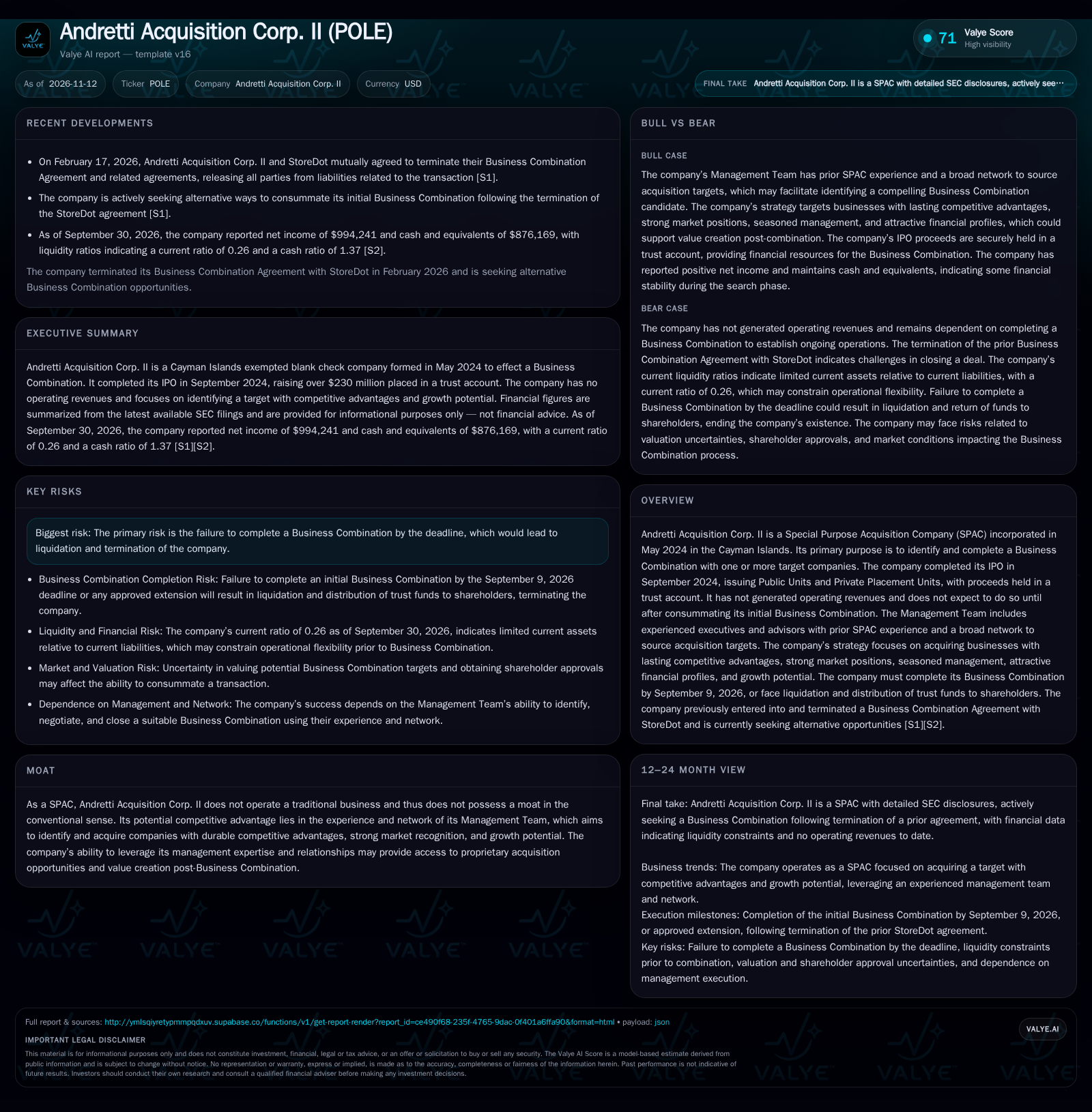
Andretti Acquisition Corp. II must complete a business combination by September 2026 or liquidate, after its planned merger with StoreDot was called off. With $231 million in trust and a sponsor team with SPAC experience, its outlook now depends on identifying and closing a compelling deal amid fierce competition and a tightening timeline. Financials as of September 2026 show no operating revenue, modest net income, and a current ratio of 0.26, underscoring the urgency to execute or face dissolution. [S1] [S2]
Andretti Acquisition Corp. II stands at a critical juncture: after raising over $230 million in its 2024 IPO and subsequently terminating its merger agreement with StoreDot in February 2026, it now faces a hard deadline of September 2026 to complete a business combination or liquidate. The next months will test both the sponsor’s network and the broader SPAC market’s appetite for new deals.
Recent Deal Termination and the Ticking Clock to Secure a Business Combination
Andretti Acquisition Corp. II, a SPAC formed in May 2024, completed its IPO in September 2024, raising $231.15 million (including private placement proceeds) held in a trust account. As of September 30, 2026, the company reported cash and equivalents of $876,169, current assets of $165,134, current liabilities of $639,472, and a current ratio of 0.26. Crucially, the company terminated its Business Combination Agreement with StoreDot in February 2026 and is actively searching for a new target. The SPAC must complete a business combination by September 9, 2026, or face liquidation with trust funds returned to shareholders. [S1] [S2]
The absence of operating revenue and the looming deadline make the successful identification and closing of a deal the central near-term driver for shareholder value. The management team’s prior SPAC experience and network are now being put to the test as the window to secure a transaction narrows.
SPAC Economics: Trust Structure, Sponsor Incentives, and the Cost of Delay
Andretti Acquisition Corp. II’s economic model is that of a typical SPAC: IPO proceeds are placed in a trust account, with interest accruing to the benefit of shareholders (net of permitted withdrawals for taxes and certain expenses). The company itself generates no operating revenue until a business combination is consummated, and most expenses are funded from outside the trust, often via sponsor loans or at-risk capital.
Sponsor economics are driven by the promote—typically founder shares or warrants that convert to equity in the post-merger entity—providing strong incentives to close a deal. However, this can also create pressure to prioritize deal completion over deal quality if the deadline approaches without a viable target.
The company reported cash and liquidity metrics for the period; these figures do not by themselves establish operating runway, investment capacity, financial flexibility, or financing capacity. Should the company fail to close a deal, trust funds are returned to shareholders, and the sponsor’s at-risk capital is lost—further sharpening the execution imperative. [S2]
Post-combination, the economics shift entirely, depending on the acquired company’s business model, margins, and growth trajectory. Until then, Andretti Acquisition Corp. II’s financial levers are largely limited to deal sourcing and negotiation.
Sourcing Edge or Commodity Capital? The SPAC Landscape and Deal Sourcing Dynamics
As a SPAC, Andretti Acquisition Corp. II’s competitive position is defined by its ability to source and close an attractive deal ahead of liquidation. The company’s management team and advisors, including industry figures like Mario Andretti, may grant access to proprietary deal flow or lend credibility in competitive processes. Prior SPAC experience among the sponsors can improve both sourcing and execution, potentially differentiating the vehicle among a crowded field.
However, the current SPAC market is characterized by intense competition for high-quality targets, with many SPACs chasing a limited pool of attractive private companies. The failure to close the StoreDot transaction—while not uncommon in the sector—raises questions about differentiation and the ability to navigate due diligence, valuation, and regulatory hurdles.
Potential competitors include other SPACs with capital in trust, private equity funds, and strategics seeking similar targets. The ability to offer speed, certainty, and value to potential targets (including public listing benefits) remains central. Without a clear sector focus or disclosed pipeline, Andretti Acquisition Corp. II’s advantage rests primarily on its sponsor network and deal-making agility, rather than any structural moat.
How a High-Quality Business Combination Could Unlock Shareholder Value
The favorable outcome for Andretti Acquisition Corp. II is predicated on the identification and successful merger with a target that offers durable competitive advantages, a strong growth profile, and public-market readiness. If the management team leverages its network to source a proprietary opportunity—such as a technology or industrial company with scale and visibility—the resulting transaction could generate enthusiasm in the market, drive share appreciation, and justify the sponsor’s promote.
Evidence confirming this scenario would include a timely announcement of a business combination with a target possessing clear financial strength, a proven management team, and sector tailwinds. Additional signs would be minimal shareholder redemptions at the combination vote, favorable analyst commentary, and post-deal trading above trust value.
This scenario could be falsified if the announced target is perceived as low quality, the deal structure is heavily dilutive, or if redemption rates are high—suggesting limited investor confidence in the combined entity’s prospects.
Most Likely Outcome: A Rushed or Competitive Deal as the Deadline Approaches
Given the compressed timeline and the competitive SPAC environment, the most plausible scenario is that Andretti Acquisition Corp. II announces a business combination in the months ahead of the September 2026 deadline—potentially with a target that is less differentiated or in a sector with more modest growth prospects.
In this outcome, the sponsor team’s experience enables completion of a transaction, but the deal may face significant shareholder redemptions, leading to less cash for the combined entity and potentially weaker post-merger trading. This is a common pattern in late-cycle SPACs, where market enthusiasm and target quality often decline as deadlines loom.
Confirmation of this scenario would include a deal announcement in the final quarters before the deadline, a target with moderate scale but less clear competitive advantages, and high redemption rates at the combination vote. Conversely, early disclosure of an attractive target or unusually low redemptions would challenge this baseline.
Deal Failure, Liquidation, and the Sponsor’s At-Risk Capital Loss
The adverse scenario is straightforward: Andretti Acquisition Corp. II fails to secure and close a business combination by the September 2026 deadline, triggering liquidation and the return of trust funds to public shareholders. In this case, the sponsor’s at-risk capital (private placement units and any additional advances) is forfeited, and the SPAC dissolves.
This outcome could be precipitated by continued difficulty in sourcing a viable target, shareholder or regulatory hurdles, or macroeconomic shocks that make deal-making unattractive. Additional confirmation would be a lack of deal announcements as the deadline approaches, sponsor warnings about deal pipeline challenges, or a formal extension vote that ultimately fails to secure sufficient support.
The scenario would be falsified by a credible deal announcement and progress toward closing well before the deadline.
What Will Determine Andretti Acquisition Corp. II’s Outcome in the Months Ahead
Announcement (or credible rumors) of a new business combination agreement, with details on target quality, sector, and financials.
Shareholder redemption rates at the time of business combination vote—high redemptions would signal skepticism, while low redemptions suggest support.
Any extension requests or deadline amendments put to a shareholder vote, indicating whether the SPAC may seek more time or faces imminent liquidation.
Sponsor advances or additional capital infusions to support ongoing search costs—if disclosed—would indicate runway and commitment.
Market reaction (trading price relative to trust value) following any deal announcement, reflecting investor confidence in the target.
Public disclosures regarding the sponsor team’s ongoing search process, pipeline, or sector focus—if provided—would offer insight into deal prospects.
Material changes in the SPAC regulatory environment or competitive landscape that could affect deal timing or structure.
Disclaimer: This is research-only, informational analysis and not investment advice. It may include AI-generated interpretation and general industry context. Always verify important details using primary sources.

Comments