
Hartford Creative Group: Straddling Agency Advertising in China and Mini-Drama Streaming in the U.S.
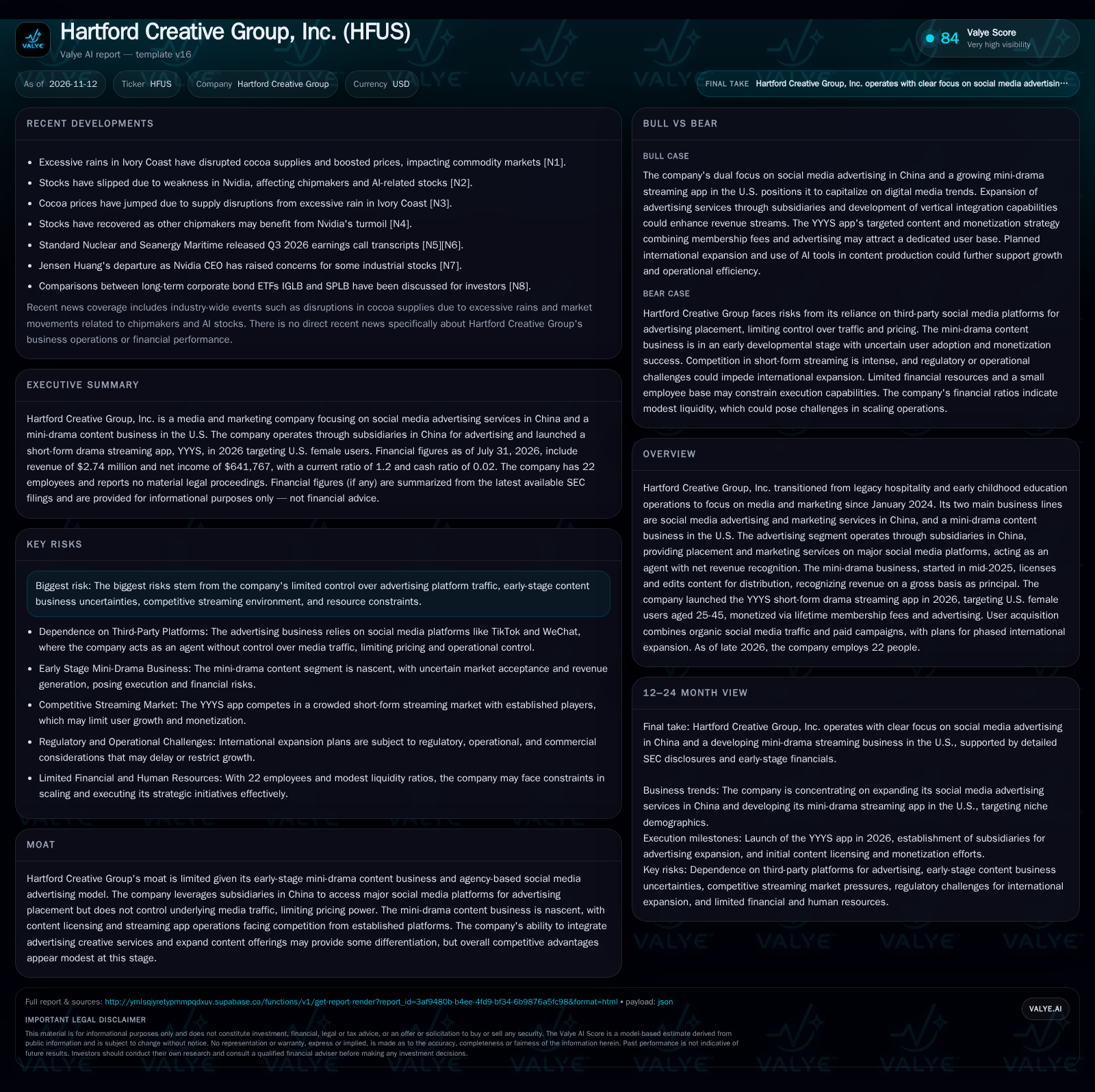
Hartford Creative Group, Inc. is pursuing a dual-pronged strategy: acting as an agent for social media advertising on major Chinese platforms and building a mini-drama streaming app, YYYS, for U.S. audiences.
Hartford Creative Group is navigating two distinct digital media arenas: agency advertising in China and a nascent U.S.-focused mini-drama streaming app. The next phase hinges on user adoption, monetization effectiveness, and operational leverage in both core segments. [S1]
Hartford Creative Group, Inc. is attempting to build a bridge between two fast-moving but fundamentally different digital media markets: agency-based social media advertising in China and a mini-drama streaming platform for U.S. consumers. With its YYYS app only just launched and advertising services reliant on third-party platforms, Hartford's future will depend on its ability to carve out defensible niches and execute efficiently in both arenas. [S1]
Recent Launches, Financials, and Market Entry Set the Stage
Hartford Creative Group's transformation is well underway: since January 2024, the company has focused on two principal lines of business—social media advertising in China and a mini-drama content initiative in the U.S. The company operates its advertising services through three subsidiaries in China, acting as an agent for ad placements on platforms such as TikTok, Toutiao, Kwai, RED, WeChat, and Baidu. In the U.S., the company launched its YYYS short-form drama streaming app in mid-2026, targeting women aged 25-45 with romance and emotionally driven stories. As of July 31, 2026, Hartford reported $2.74 million in revenue and $641,767 in net income. However, its cash and cash equivalents stood at only $88,638, with a current ratio of 1.2 and a cash ratio of 0.02, indicating tight liquidity. The company employs 22 people and has no reported material legal proceedings. [S1]
Revenue Recognition, Monetization Models, and the Challenge of Scale
Hartford's economics diverge starkly between its two business lines. In China, the company provides advertising placement as an agent, earning net revenue based on commissions or service fees, rather than controlling the underlying ad inventory or traffic. This model typically yields lower gross margins than owning media inventory but reduces risk and working capital needs. Pricing power is limited by the company's reliance on dominant Chinese platforms, making Hartford a price-taker in a competitive agency ecosystem.
The mini-drama business, by contrast, recognizes revenue on a gross basis as principal. Content is acquired via non-exclusive licenses, edited in-house, and distributed through the YYYS app. Monetization relies on a one-time lifetime membership fee and an advertising-supported model using reward-based video ads for non-paying users. This mix introduces both upside (from direct consumer monetization and higher per-user economics) and risk (uncertain adoption, heavy marketing spend, and content acquisition costs).
Fixed costs (content curation, app development, personnel) are leveraged across a small revenue base, so operating leverage could be significant if user growth materializes. [S1]
Competitive Pressures and Differentiation: Navigating Agency Crowds and Streaming Giants
In China, Hartford operates as an agency intermediary among thousands of competitors, many with deeper relationships, larger scale, or proprietary data. The major social media platforms—TikTok (Douyin), WeChat, Baidu, and others—control the traffic and set the terms. Switching costs for advertisers are low, and differentiation is limited unless an agency can deliver unique creative, analytics, or client access.
In the U.S., the YYYS app faces intense competition from both established streaming giants and a proliferation of niche short-form content platforms. The targeted demographic (U.S. women ages 25-45) is attractive, but consumer attention is fragmented, and incumbents offer broader content libraries and deeper pockets for marketing and original production. Hartford’s approach—curating and editing licensed mini-dramas, focusing on emotionally resonant themes, and offering a one-time membership—could appeal to a specific audience, but content exclusivity and brand recognition will be critical for retention.
Overall, Hartford's competitive advantages are modest at this stage: its Chinese subsidiaries offer local market access and operational flexibility, but the agency model limits bargaining power. In streaming, the mini-drama niche is underexplored, but barriers to entry are low and user acquisition is costly. The company’s ability to build differentiated content, foster community, or leverage data-driven personalization may determine its long-term defensibility.
A Path to Leverage: If User Adoption and Content Resonance Accelerate
The most favorable scenario for Hartford is one in which the YYYS app achieves rapid user adoption among its target demographic, fueled by effective organic and paid marketing campaigns. As the user base expands, the app could see strong conversion to lifetime memberships and robust engagement with ad-supported content, driving both direct and advertising revenues. If the mini-drama format proves sticky and the company can maintain a steady pipeline of compelling licensed content, Hartford could achieve significant operating leverage, turning fixed content and development costs into high-margin incremental revenue.
On the advertising side, expansion of the agency network in China—potentially with the addition of value-added creative or analytics services—could attract larger clients and increase commission rates. International expansion of the mini-drama business, if executed in phases as planned, could open new revenue streams and diversify risk.
Evidence that would support this outcome includes rapid growth in YYYS app downloads and active users, high conversion rates to paid membership, rising average revenue per user (ARPU), and improved gross margins in the mini-drama business. Confirmation would also come from disclosure of larger or multi-year advertising client wins, expansion into new geographic markets, or evidence of positive cash flow from operations.
Balancing Early Traction with Scale Constraints
The most plausible near-term outcome is that Hartford achieves moderate traction in both business lines, but growth is constrained by limited cash and headcount. The advertising agency business in China delivers steady, but incremental, net revenue as Hartford competes for business in a crowded market. YYYS gains initial users, but scaling is slower than anticipated due to high user acquisition costs, limited brand awareness, and the need to expand the content library to broaden appeal.
In this scenario, the company remains EBITDA-positive or marginally profitable at the consolidated level, but must continually reinvest to maintain growth momentum. Cash generation is limited, and any significant investments—such as exclusive content deals or major international expansion—would likely require outside funding. The company’s ability to optimize marketing spend, retain users, and negotiate favorable licensing terms will be critical to maintaining operating stability.
Evidence supporting this scenario would be stable or modestly growing revenue, continued positive net income but stagnant or declining cash balances, and slow but steady increases in YYYS app engagement. Falsification could come from a sharp drop in advertiser demand, user churn outpacing acquisition, or a liquidity crunch forcing operational cutbacks.
Execution Risk and Resource Constraints Could Stall Momentum
The adverse scenario for Hartford is one where execution missteps, user acquisition underperformance, or intensifying competition undermine both core businesses. If the YYYS app fails to gain traction—due to low adoption, limited content differentiation, or poor user retention—the company may be unable to cover fixed costs, leading to mounting losses and potential impairment of content investments.
In the advertising business, increased competition, platform policy changes, or regulatory shifts in China could erode margins or reduce client demand, particularly as Hartford lacks control over underlying media traffic. Resource constraints—limited cash and a small team—may hamper the company’s ability to respond, innovate, or pivot quickly. If liquidity tightens further without new funding or a step-change in profitability, Hartford could face forced retrenchment or asset sales.
Confirmation of this scenario would include declining revenue, negative cash flow from operations, rising payables or delayed payments, shrinking headcount, or public disclosures of going-concern risks.
Milestones and Metrics That Will Clarify Hartford’s Trajectory
Trends in YYYS app downloads, active users, and time spent per user would provide direct evidence of product-market fit and user engagement.
Conversion rates from free to paid (lifetime membership) users on YYYS, if disclosed, would help gauge monetization effectiveness and revenue quality.
Gross margin trends in the mini-drama segment would clarify the scalability of the content licensing and streaming model.
Net revenue per client and client retention rates in the Chinese advertising business, if disclosed, would illuminate the company’s competitive position and pricing power.
Changes in cash and cash equivalents quarter-over-quarter will signal the company’s ability to self-fund growth or its need for external capital.
Content acquisition costs and the breadth/depth of the drama library would help assess the sustainability of the YYYS content pipeline.
Geographic expansion milestones—such as app launches in new markets or new advertising subsidiaries—would test the company’s execution capacity and international strategy.
Any disclosed partnerships, exclusive licensing deals, or strategic investments would indicate progress toward differentiation and operational scale.
Disclaimer: This is research-only, informational analysis and not investment advice. It may include AI-generated interpretation and general industry context. Always verify important details using primary sources.

Comments