
Arrowhead Pharmaceuticals: RNAi Platform Advances, Commercial Launches, and the Next Wave of Clinical Proof
Arrowhead Pharmaceuticals is transitioning from a clinical-stage innovator to a commercial-stage RNAi company. With its first approved product, REDEMPLO, and a robust pipeline targeting severe metabolic and CNS disorders, Arrowhead faces both the promise of market expansion and the execution risks of scaling new modalities.
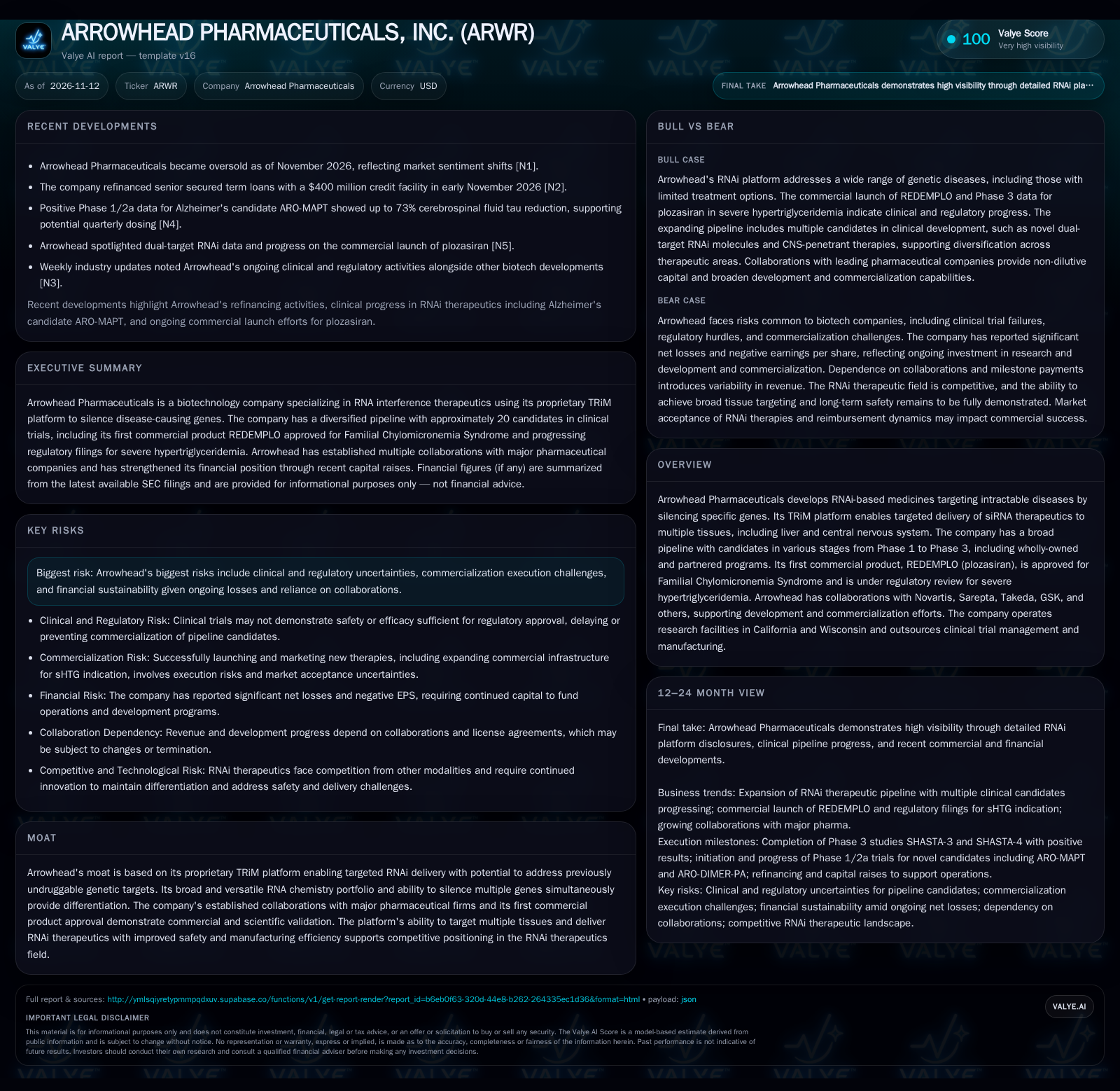
Arrowhead Pharmaceuticals has achieved its first commercial approval with REDEMPLO for Familial Chylomicronemia Syndrome and is advancing multiple late-stage RNAi candidates, including plozasiran for severe hypertriglyceridemia. [N2] [N5] [N4]
Arrowhead Pharmaceuticals is at a pivotal inflection point, having moved from a pure R&D-focused RNAi innovator to a company with its first approved therapy, REDEMPLO, now commercially available for Familial Chylomicronemia Syndrome and under regulatory review for broader metabolic indications. The company’s progress—highlighted by strong early clinical data in CNS and metabolic disorders, a $400 million refinancing, and deep partnerships with major pharma—positions it to potentially scale its proprietary TRiM RNAi platform across a broad spectrum of high-need diseases. However, Arrowhead’s ability to translate clinical promise into sustainable revenue faces the realities of ongoing net losses, competitive pressure, and execution risk as it seeks to validate new modalities in both rare and common disease markets.
Recent Milestones: Commercial Entry, Pipeline Progress, and Financial Moves
Arrowhead Pharmaceuticals has reached several material milestones in late 2026. The company launched its first commercial product, REDEMPLO (plozasiran), for Familial Chylomicronemia Syndrome and has submitted the therapy for regulatory review in severe hypertriglyceridemia—a much larger patient population. This marks Arrowhead’s transition from a clinical-stage to a commercial-stage operation, opening a new revenue stream and the operational challenges of commercialization. [N5]
Positive Phase 1/2a data for ARO-MAPT, a CNS-targeted RNAi candidate, showed up to 73% reduction in cerebrospinal fluid tau levels, demonstrating proof-of-concept for Arrowhead’s platform in neurodegenerative diseases and supporting the feasibility of quarterly dosing. [N4]
To support ongoing investment, Arrowhead refinanced senior secured term loans with a $400 million credit facility in November 2026, providing additional liquidity for development and commercialization activities. [N2]
Despite these advances, Arrowhead continues to report significant net losses and negative EPS, underscoring the high upfront costs of drug development and the delayed revenue profile typical of the biotech sector. Financial results and operational updates are detailed in the company's most recent SEC filings. [S1] [S2]
How Arrowhead’s Platform Could Scale: Revenue Drivers and Cost Structures
Arrowhead’s economics hinge on its ability to convert pipeline progress into high-margin commercial revenue. The company’s first product, REDEMPLO, targets a rare disease with limited competition and potentially favorable pricing and reimbursement, but the initial addressable market is small. Expansion into severe hypertriglyceridemia, if approved, could significantly increase the revenue base due to a larger patient pool. Pricing in rare and specialty disease markets is typically premium, but adoption depends on payer willingness and demonstration of clinical benefit.
The business model combines wholly-owned programs (potentially yielding higher margins but requiring full commercial build-out) and partnered programs (which provide milestone payments, risk-sharing, and access to broader commercial infrastructure). Collaborations with Novartis, Sarepta, Takeda, and GSK bring non-dilutive capital and validation, but also cap long-term economic upside for partnered assets.
Arrowhead’s cost structure is dominated by R&D and outsourced clinical manufacturing. The TRiM platform is designed for modularity and efficiency, potentially enabling lower per-program costs as the pipeline scales. Operating leverage could emerge if multiple products reach commercial stage, allowing fixed infrastructure costs to be spread across a larger portfolio. However, significant SG&A investment is required to build out commercial capabilities for broader indications.
The company’s reliance on milestone and collaboration revenue introduces volatility, and net losses are expected until a critical mass of products are commercialized and reimbursed. The recent $400 million refinancing supports near-term funding needs but underscores the capital-intensive nature of RNAi drug development. [N2] Financial disclosures in Arrowhead's SEC filings further detail the company's revenue composition, expense structure, and ongoing investment requirements. [S1] [S2]
RNAi Landscape: Where Arrowhead Stands Amid Rivals and Modalities
Arrowhead’s competitive position is defined by its proprietary TRiM platform, which enables targeted delivery of siRNA therapeutics to multiple tissues, including the liver and central nervous system. This platform approach differentiates Arrowhead from traditional small molecule or antibody therapies and from earlier-generation RNAi companies with more limited tissue targeting.
Key competitors include other RNAi-focused biotechs and established pharma with RNA-based programs. The competitive landscape is dynamic, with rapid advances in delivery technologies, safety profiles, and the emergence of alternative modalities such as antisense oligonucleotides, CRISPR-based gene editors, and small-molecule gene modulators. Success in CNS delivery, as suggested by ARO-MAPT data, could provide a unique competitive edge, as CNS penetration remains a challenge for most genetic medicines.
Arrowhead’s broad pipeline and major pharma partnerships provide validation and access to resources, but also invite direct competition as partners develop adjacent or overlapping programs. The company’s ability to maintain leadership will depend on the pace of innovation, clinical success, and the translation of platform breadth into tangible commercial products.
Unlocking Platform Value: What a Breakout Success Could Look Like
In a favorable scenario, Arrowhead successfully launches plozasiran for severe hypertriglyceridemia (sHTG), securing broad payer reimbursement and rapid physician adoption. This would provide a meaningful revenue base beyond the ultra-rare Familial Chylomicronemia Syndrome indication, validating the commercial scalability of the TRiM platform.
Simultaneously, continued positive data from CNS and dual-target programs (such as ARO-MAPT and other pipeline assets) could open entirely new therapeutic markets, attracting further partnership interest or even acquisition offers from large pharma. The modularity of TRiM may enable a steady cadence of new INDs and clinical readouts, supporting a multi-product, multi-indication portfolio.
Confirmation of this scenario would come from strong initial sales of plozasiran in sHTG, rapid expansion of the commercial footprint, additional major partnership deals, and successful advancement of novel RNAi candidates into late-stage trials and regulatory review.
From Pipeline to Product: Navigating Typical Biotech Pacing and Risks
The most plausible trajectory for Arrowhead is a gradual transition from a predominantly R&D-driven organization to a modestly scaled commercial-stage company. REDEMPLO generates initial revenue in a rare disease segment, while regulatory review for plozasiran in sHTG proceeds at a standard pace, with a measured commercial launch post-approval. Pipeline progress continues, but most candidates remain in early- to mid-stage development, with risk-adjusted attrition typical of the biotech sector.
Collaboration revenue and milestone payments from pharma partners provide partial offset to ongoing net losses, but Arrowhead remains reliant on periodic capital raises or refinancing to fund its broad development agenda. Operating leverage and margin expansion are limited until multiple products are approved and reimbursed. Execution risk around commercialization, payer negotiations, and clinical trial outcomes remains material.
Evidence supporting this scenario would include steady, but not breakout, growth in product revenue, periodic positive (and negative) data updates, and continued but measured expansion of pharma collaborations. Financial and operational updates are available in the company's periodic SEC filings. [S1] [S2]
Clinical Setbacks or Commercial Stumbles: How Value Could Erode
In a negative scenario, Arrowhead encounters clinical setbacks—such as adverse safety signals or failed efficacy endpoints—in key programs like plozasiran (sHTG) or ARO-MAPT. Regulatory delays or rejections could impede commercialization plans and erode investor confidence.
Commercial uptake of REDEMPLO and subsequent launches may fall short due to payer resistance, slow physician adoption, or competitive entrants. The volatility inherent in milestone and collaboration revenue could be exacerbated if partners deprioritize or terminate agreements, leaving Arrowhead with greater funding needs.
If net losses persist and capital markets become less receptive, Arrowhead could face a constrained runway, forcing pipeline reprioritization, down-round financings, or even asset sales. Evidence of downside risk would include failed or delayed trials, negative regulatory outcomes, disappointing launch metrics, terminated partnerships, or a material increase in cash burn relative to available capital. The company's SEC filings provide further details on risk factors and financial exposures. [S1] [S2]
Milestones That Could Shift Arrowhead’s Trajectory
Initial sales uptake and payer coverage levels for REDEMPLO and, if approved, plozasiran in severe hypertriglyceridemia.
Progress and outcomes of Phase 3 studies such as SHASTA-3 and SHASTA-4, particularly for key metabolic indications.
Clinical safety and efficacy updates from CNS-targeted programs, including ARO-MAPT, especially any new adverse event signals.
The cadence and size of new partnership or licensing deals with major pharmaceutical companies.
Operating expense trends and R&D spend relative to pipeline advancement (would help test cost discipline and leverage if disclosed).
The rate of clinical attrition or advancement across the approximately 20 pipeline candidates.
Any changes in the regulatory landscape or competitive environment for RNAi and genetic medicines.
Frequency and terms of future capital raises or debt refinancing events, including any signals of tightening financial runway.
Disclaimer: This is research-only, informational analysis and not investment advice. It may include AI-generated interpretation and general industry context. Always verify important details using primary sources.

Comments