
iAnthus Capital Holdings: Portfolio Realignment amid Liquidity Strains and Cannabis Sector Crosswinds
iAnthus Capital Holdings, a multi-state cannabis operator, is sharpening its focus on select high-potential markets while confronting acute liquidity pressures. The company's ongoing asset divestitures and resource reallocation highlight both the opportunities and constraints of scaling in a fragmented, regulation-heavy industry.
Its multi-state footprint may offer scale advantages, but persistent losses and regulatory headwinds raise questions about long-term viability. The next phase hinges on successful portfolio optimization, cost discipline, and navigating the evolving U.S. cannabis landscape. [S2]
iAnthus Capital Holdings, Inc. stands at a critical juncture, balancing the promise of its extensive U.S. cannabis footprint against mounting liquidity pressures and recurring net losses. With a portfolio spanning cultivation, processing, and retail across a dozen states, the company is executing a strategy of asset divestiture and market prioritization in an attempt to shore up its financial position and focus on growth regions. The path forward will test whether scale and geographic reach can ultimately offset the structural headwinds of a highly regulated, capital-intensive, and fiercely competitive sector. [S2]
Financial Strains and Strategic Refocusing Define the Current State
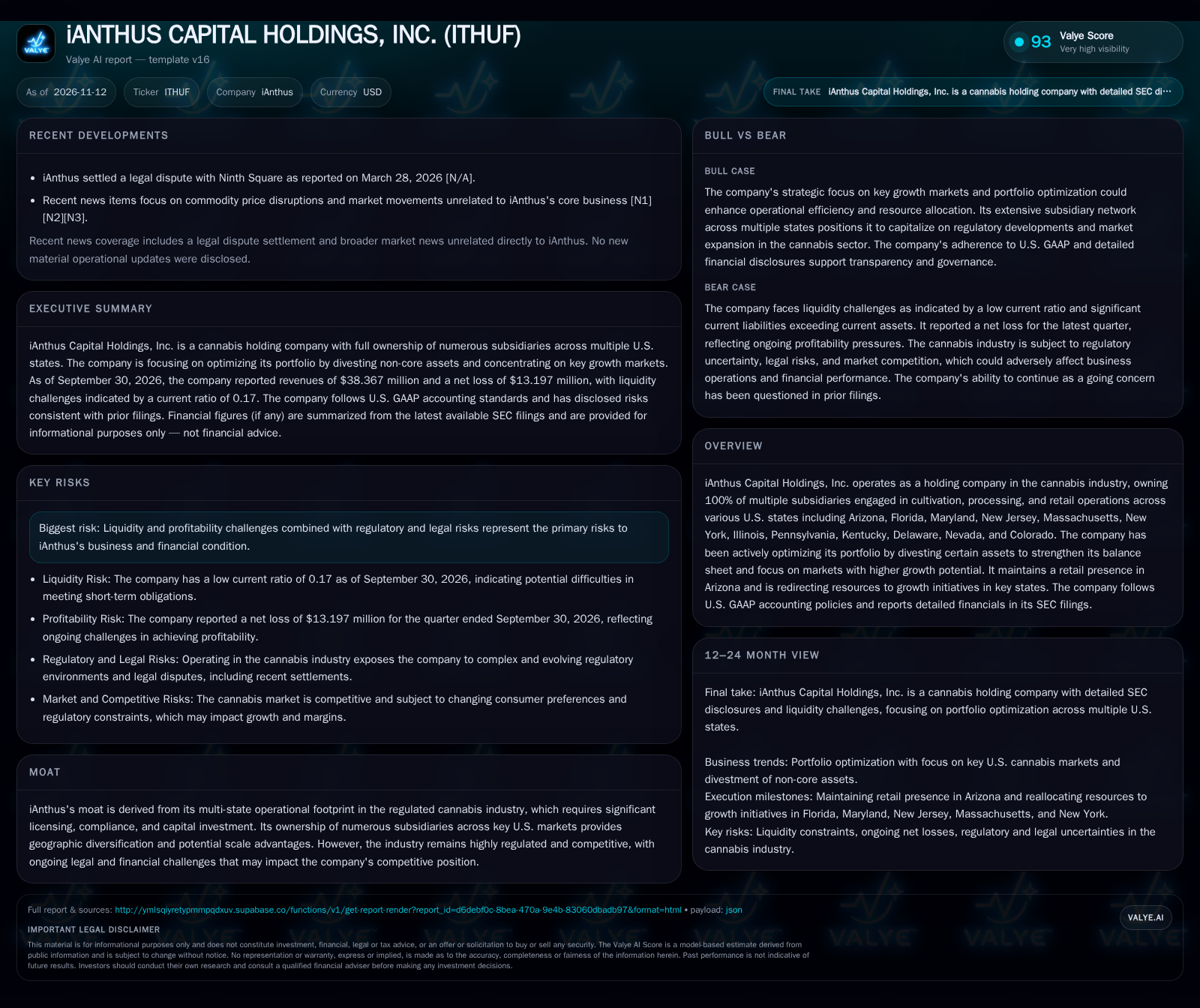
As of September 30, 2026, iAnthus reported quarterly revenues of $38.367 million but posted a net loss of $13.197 million, continuing a trend of unprofitability. The company’s balance sheet reflects acute liquidity stress, with current assets of $49.542 million dwarfed by current liabilities of $286.722 million, resulting in a current ratio of 0.17. No cash or short-term investment figures were disclosed, and the cash ratio is effectively zero. Against this backdrop, iAnthus is actively divesting non-core assets to concentrate resources in growth-oriented markets such as Florida, Maryland, New Jersey, Massachusetts, and New York, while sustaining a retail presence in Arizona. These moves are intended to strengthen operational focus and balance sheet resilience, but the immediate financial picture is precarious. [S2]
How Portfolio Restructuring Could Influence Unit Economics and Capital Needs
iAnthus’s business model centers on vertical integration—owning cultivation, processing, and dispensary assets across multiple states. The company’s ongoing asset divestitures suggest a move to reduce overhead, streamline operations, and potentially focus on markets with higher regulatory barriers and better pricing power.
Given the reported losses, the company’s operating leverage appears negative at present—fixed costs and interest burdens are not being covered by gross profit. Without access to traditional banking due to federal cannabis restrictions, iAnthus and its peers typically rely on higher-cost debt, sale-leasebacks, or equity dilution to fund operations and growth. The company’s ability to improve unit economics will depend on whether it can drive higher sales density and margin in its remaining core markets while slashing unproductive costs.
Multi-State Presence: Scale Advantage or Complexity Trap?
iAnthus’s competitive positioning is built on a multi-state footprint, which, in the cannabis sector, can confer advantages such as regulatory diversification, brand reach, and cross-market operational learning. Regulatory barriers to entry remain high: licenses are limited, compliance is complex, and capital requirements are steep. However, scale can also be a double-edged sword. Managing a geographically dispersed asset base increases operational complexity and overhead, particularly in an industry where each state functions as a separate regulatory fiefdom.
Peers in the U.S. cannabis market include other multi-state operators (MSOs) as well as large single-state players and vertically integrated regional firms. Competition is intensifying as more states legalize cannabis and as established operators seek to expand. Pricing power is often constrained by local oversupply and regulatory price controls, while illicit market competition remains a persistent drag on margins. In this environment, iAnthus’s ability to secure profitable market share will hinge on execution, cost control, and the ability to adapt to evolving regulatory regimes.
Scenario: Focused Market Strategy Enables Margin Recovery and Growth
If iAnthus can successfully divest non-core assets and concentrate capital and management attention on its highest-potential markets, it could realize higher sales density, better operating leverage, and improved profitability. The most favorable outcome would see the company stabilizing its liquidity position through asset sales and cost reductions, followed by revenue growth in core states as regulatory frameworks mature and consumer demand expands.
This scenario would be supported by evidence such as: successful asset sales at reasonable valuations, a sequential improvement in gross and operating margins, stabilization or growth of same-store sales in focus markets, and narrowing net losses or a return to profitability. Additional tailwinds could come from regulatory changes at the federal or state level that lower tax burdens or open access to conventional banking, reducing capital costs and increasing potential financial flexibility.
Falsification would occur if asset sales fail to generate needed liquidity, if cost reduction efforts are insufficient to offset negative operating leverage, or if market share is lost to better-capitalized competitors.
Most Likely Trajectory: Incremental Progress Shadowed by Ongoing Financial Stress
The most plausible near-term path for iAnthus is one of incremental improvement in operational focus, but with persistent financial constraints. The company may achieve some progress by exiting underperforming markets and reallocating resources to its core states, resulting in modest operational efficiencies and a slower pace of net losses. However, without a significant external catalyst—such as a favorable regulatory shift or access to lower-cost capital—liquidity pressures are likely to remain acute.
Confirming evidence would include modest improvement in current ratio, stabilization of net losses, and evidence of successful cost control alongside stable or growing revenues in core markets. Falsification would be indicated by continued deterioration in liquidity metrics, further asset fire-sales at distressed prices, or additional legal/regulatory setbacks that sap management focus and financial resources.
Adverse Chain: Liquidity Crisis Forces Distressed Sales or Restructuring
A plausible negative outcome is that iAnthus’s liquidity position deteriorates further, forcing distressed asset sales at unfavorable valuations or even restructuring to address mounting obligations. In this scenario, persistent net losses and inability to refinance or raise capital could trigger covenant breaches, creditor actions, or bankruptcy proceedings. The company’s multi-state footprint could become a liability, with regulatory complexity and overhead outpacing any operational benefit.
This scenario would be confirmed by a rapid decline in current assets, missed payments or default disclosures, fire-sale divestitures, or a formal going-concern warning. Additional signs would include management turnover, loss of key licenses, or negative regulatory developments in core markets.
Milestones That Will Reveal Whether iAnthus’s Realignment Can Succeed
Quarterly progress in asset divestitures, including transaction terms and impact on liquidity, will be critical to assess whether the company can stabilize its balance sheet.
Sequential trends in current ratio and working capital, if disclosed, will help gauge whether liquidity pressures are easing or intensifying.
Gross and operating margin trajectories in core focus markets (Florida, Maryland, New Jersey, Massachusetts, New York), if segmented, would clarify whether operational improvements are translating to better economics.
Same-store sales or retail revenue trends by state, if disclosed, would provide insight into demand resilience and competitive positioning.
Updates on regulatory or legal developments—particularly any new settlements, license renewals, or changes to state/federal cannabis policy—could materially affect both risk and opportunity.
Management commentary or disclosures regarding refinancing activity, capital infusions, or going-concern status would directly inform the risk of distress.
Evidence of cost structure adjustments, such as SG&A reductions or supply chain efficiencies, would help test the effectiveness of portfolio optimization.
Disclaimer: This is research-only, informational analysis and not investment advice. It may include AI-generated interpretation and general industry context. Always verify important details using primary sources.

Comments