
Braiin Limited: Scaling Diversified AI Platforms Amid Contract and Integration Hurdles
Braiin Limited’s rapid expansion via acquisitions across agriculture, customer experience, and property technology has produced a multi-vertical AI platform with global reach. With early revenue driven by acquired businesses and significant uncommenced long-term contracts, the company’s next phase hinges on execution, integration, and market acceptance.
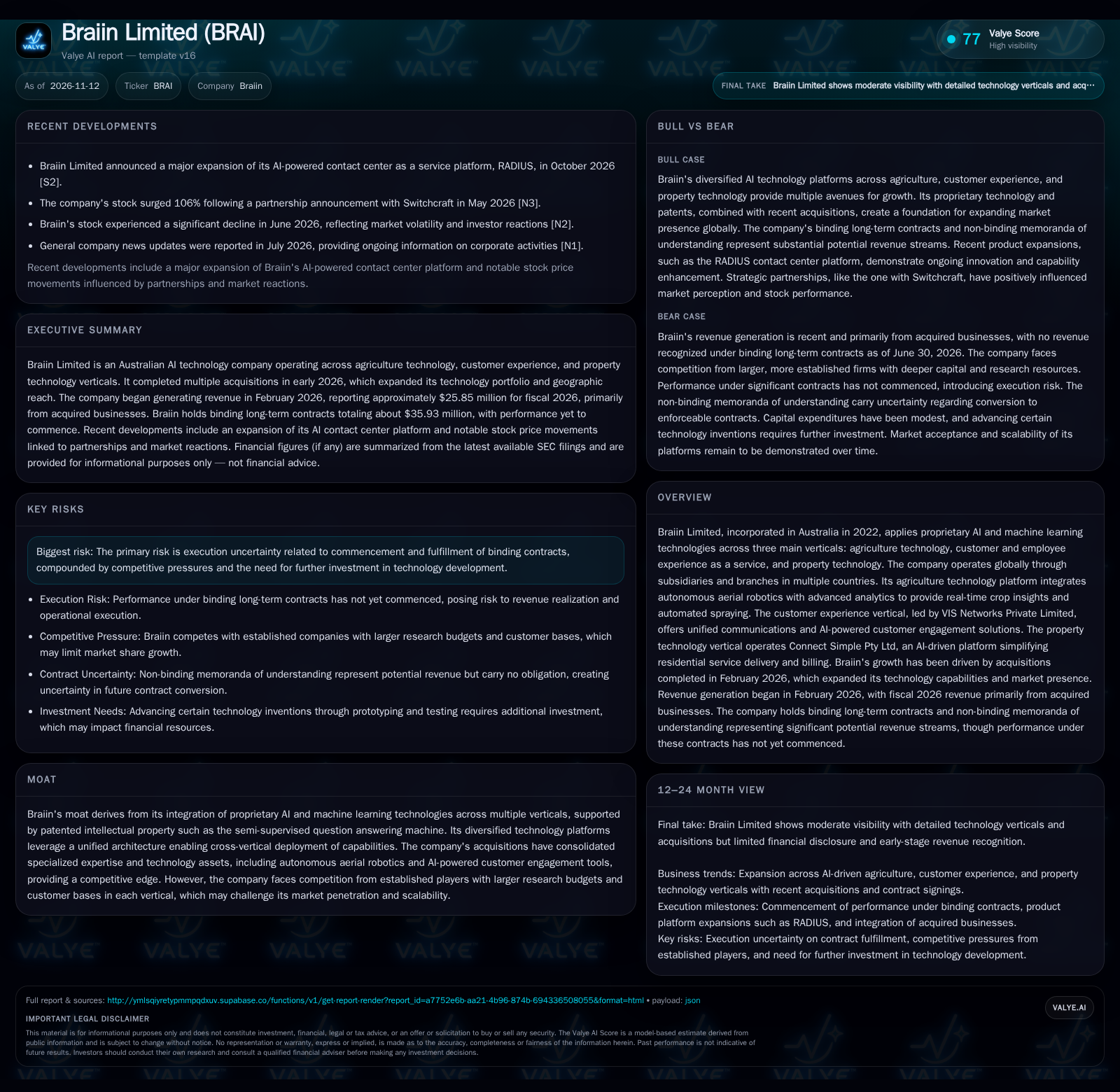
Braiin Limited, an Australian AI tech firm, has swiftly assembled a diversified platform spanning agriculture robotics, customer engagement, and property tech, primarily through acquisitions. While the company holds binding contracts worth $35.93 million and reported $25.85 million in revenue for fiscal 2026, contract performance has not begun, leaving near-term growth dependent on execution and integration. The company’s capital-light profile and proprietary IP support upside, but risks include contract conversion, market adoption, and heavy competition from established players. Monitoring contract ramp, platform adoption, and investment in R&D will be critical.
Braiin Limited has moved quickly to build a global AI technology platform by acquiring businesses in agriculture robotics, customer engagement, and property technology. With revenue only beginning in February 2026 and significant contract performance still ahead, the company is at an inflection point: its ability to turn backlog and pipeline into recurring, scalable revenue will determine whether its multi-vertical strategy produces sustainable economics or faces the integration and execution challenges typical of newly consolidated platforms. Proprietary AI, modest capital outlays, and a growing international footprint provide opportunity, but market acceptance and contract fulfillment remain unproven.
Braiin’s Current Position: Early Revenues and Pending Contract Deployments
Braiin Limited began generating revenue in February 2026 following four acquisitions and reported approximately $25.85 million in fiscal 2026 revenue, primarily from these acquired businesses [S1]. The company holds binding long-term contracts totaling $35.93 million over five years as of June 30, 2026; however, performance under these contracts has not yet commenced, and thus this revenue is not yet recognized [S1]. In addition, Braiin has $111.98 million in non-binding memoranda of understanding, but there is no assurance these will convert to enforceable contracts [S1]. On the product front, Braiin announced a major expansion of its AI-powered RADIUS contact center as a service platform in October 2026, signaling continued investment in core technology [S2]. Recent stock price swings—including a surge after a partnership with Switchcraft in May 2026 and a decline in June—reflect investor sensitivity to news flow and execution milestones [N3] [N2].
Potential for Profit Growth Through Braiin’s Multi-Vertical AI Strategy
Braiin’s business model is structured around leveraging AI and machine learning platforms across three distinct but potentially synergistic verticals: agriculture technology (autonomous aerial robotics for precision farming), customer and employee experience (AI-powered unified communications and contact centers), and property technology (AI-driven residential service automation) [S1]. Each vertical taps different end markets and revenue models—ranging from recurring software/service contracts in customer experience, to platform fees and commissions in property tech, to hardware-enabled analytics and robotics in agriculture.
The company’s capital expenditures were modest at $160,953 for the year ended June 30, 2026, with asset growth mainly from acquisitions rather than organic investment [S1]. This suggests a capital-light approach, at least in the near term, but also means that future R&D or go-to-market investment may be needed to drive organic adoption and innovation. With binding contracts not yet commenced, revenue visibility remains limited to the acquired book of business and the pipeline’s conversion.
If Braiin can achieve high platform utilization and cross-sell across verticals, fixed R&D and software development costs could be leveraged over a broader revenue base, supporting margin expansion. However, customer acquisition costs, integration expenses, and the need to prove out its AI platforms in diverse markets could weigh on margins in the intermediate term. The commission-based revenue model in property tech, for example, may offer lower gross margins but more predictable cash flow if scaled, while the agriculture robotics vertical may require periodic capital investment for hardware upgrades or deployment.
Market Standing: Proprietary AI Facing Established Competitors and Growth Challenges
Braiin’s moat is anchored in its proprietary AI and machine learning platforms, including a US patent for a semi-supervised question answering machine used in its customer experience solutions [S1]. The company’s ability to integrate these technologies across agriculture, customer engagement, and property tech offers a potential advantage in creating differentiated, unified solutions.
However, each vertical faces entrenched competition. In agriculture tech, established players with global distribution and R&D scale may offer integrated precision farming solutions, making customer switching costly and adoption cycles slow. In customer and employee experience, large enterprise software vendors and cloud-based contact center providers have sizable installed bases, recurring revenue streams, and deep integration with enterprise IT. Property technology is similarly fragmented but populated by well-capitalized incumbents and specialist startups.
While Braiin’s cross-vertical architecture and recent acquisitions provide a foundation for scale, the company must overcome brand recognition, channel access, and the inertia of incumbent customer relationships. Its ability to rapidly convert MOUs to binding contracts and demonstrate referenceable deployments will be critical to gaining share.
Success Scenario: Accelerated Contract Execution and Platform Uptake
The most favorable scenario for Braiin is one in which the company successfully commences and delivers on its $35.93 million in binding long-term contracts, converting a meaningful share of its $111.98 million in non-binding MOUs into enforceable, revenue-generating agreements [S1]. This would provide both revenue growth and validation of the company’s multi-vertical AI platform.
Upside would be further supported if the October 2026 expansion of the RADIUS contact center platform leads to significant customer wins, higher average contract values, and demonstrable improvements in customer engagement for clients [S2]. If Braiin can leverage its proprietary AI and robotics IP to win reference customers in agriculture and property tech, this could drive cross-vertical upsell and could support premium pricing.
Evidence that would confirm this scenario includes: sequential growth in contractually committed backlog, rapid commencement of contract performance with milestone payments received, visible customer case studies or reference deployments, and a rising mix of recurring revenue from software/services. If disclosed, improvements in gross and operating margins due to operating leverage would also validate the scaling thesis.
Expected Developments in Platform Integration and Contract Fulfillment
The most plausible near-term outcome is that Braiin experiences a staggered ramp in contract performance, with revenue growth driven by gradual commencement on binding contracts and selective conversion of MOUs. Integration of the four acquired businesses—each with different customer bases and operational cultures—may create friction, slowing the realization of cross-vertical synergies and delaying the full benefit of unified platform investments.
The company will likely need to invest further in sales, product development, and customer support to establish credibility and win new business in competitive markets. Margin expansion may be modest as integration costs and customer acquisition expenses offset initial operating leverage.
Confirmation of this scenario would come from steady, but not explosive, revenue growth; moderate increases in binding contract backlog; and incremental platform improvements or product launches. Delays in contract commencement, limited disclosure of major new customer wins, or muted improvement in margin metrics—if reported—would support this view.
Risks from Contract Delays, Integration Issues, and Market Pushback
In a more adverse scenario, Braiin struggles to commence performance on its binding contracts, perhaps due to customer delays, operational bottlenecks, or technology integration challenges. Conversion of non-binding MOUs stalls, leaving the company reliant on legacy revenue streams from its acquired businesses, which may be insufficient to support continued R&D and sales investment.
Integration risks—such as cultural clashes, platform incompatibilities, or talent turnover following the February 2026 acquisitions—could erode operational efficiency, distract management, and undermine customer confidence. In parallel, if the expanded RADIUS platform or agriculture robotics solutions fail to gain traction due to superior incumbent offerings, pricing pressure, or slow market adoption, revenue growth could flatline or decline.
Confirmation of this scenario would include extended delays in contract revenue recognition, declining or stagnant contract backlog, negative operating leverage, or public disclosure of customer losses or integration setbacks.
Progress Benchmarks Reflecting Braiin’s Multi-Vertical AI Trajectory
The pace at which Braiin commences and recognizes revenue from its $35.93 million binding long-term contracts will be a decisive indicator of execution.
Conversion rates from the $111.98 million in non-binding MOUs to enforceable, revenue-generating contracts would help gauge the strength of the commercial pipeline.
Sequential growth in total contract backlog, if disclosed, would signal momentum in new business wins and customer retention.
Adoption metrics for the RADIUS contact center platform—such as customer counts, average contract size, or expansion into new geographies—would clarify the impact of the October 2026 product expansion.
Gross and operating margin trends, if reported, will indicate whether integration and platform leverage are translating into improved profitability.
Progress in cross-vertical sales or bundled platform adoption, such as customers using both agriculture and customer experience solutions, would validate the unified platform thesis.
Disclosures of R&D and capital expenditure trends, especially relative to revenue growth, would help assess the sustainability of innovation and product development.
Publicly announced reference customers or case studies in each vertical would demonstrate market acceptance and support further growth.
Disclaimer: This is research-only, informational analysis and not investment advice. It may include AI-generated interpretation and general industry context. Always verify important details using primary sources.

Comments