
TTEC Holdings: Digital Pivot, Margin Pressures, and the Stakes of Enterprise Client Engagement
TTEC’s high-margin digital segment and extended relationships with major clients represent both a lever and a test: can strategic pivots offset persistent profitability pressures in a fiercely competitive customer experience landscape?
TTEC Holdings is navigating a transitional phase marked by operational pivots toward higher-margin digital services, ongoing net losses, and the extension of key enterprise collaborations. The outcome will likely hinge on execution in digital transformation, client retention, and margin restoration.
TTEC Holdings, Inc., a provider of customer experience technology and services, is at a critical inflection point. The company’s recent financials show continued net losses even as it touts a high-margin digital segment and renewed partnerships with major enterprise clients like Volkswagen Group UK. The next phase will test whether its digital focus and client engagement can meaningfully shift margin dynamics and restore investor confidence.
Recent Losses, Digital Focus, and Strategic Partnerships Define Today’s TTEC
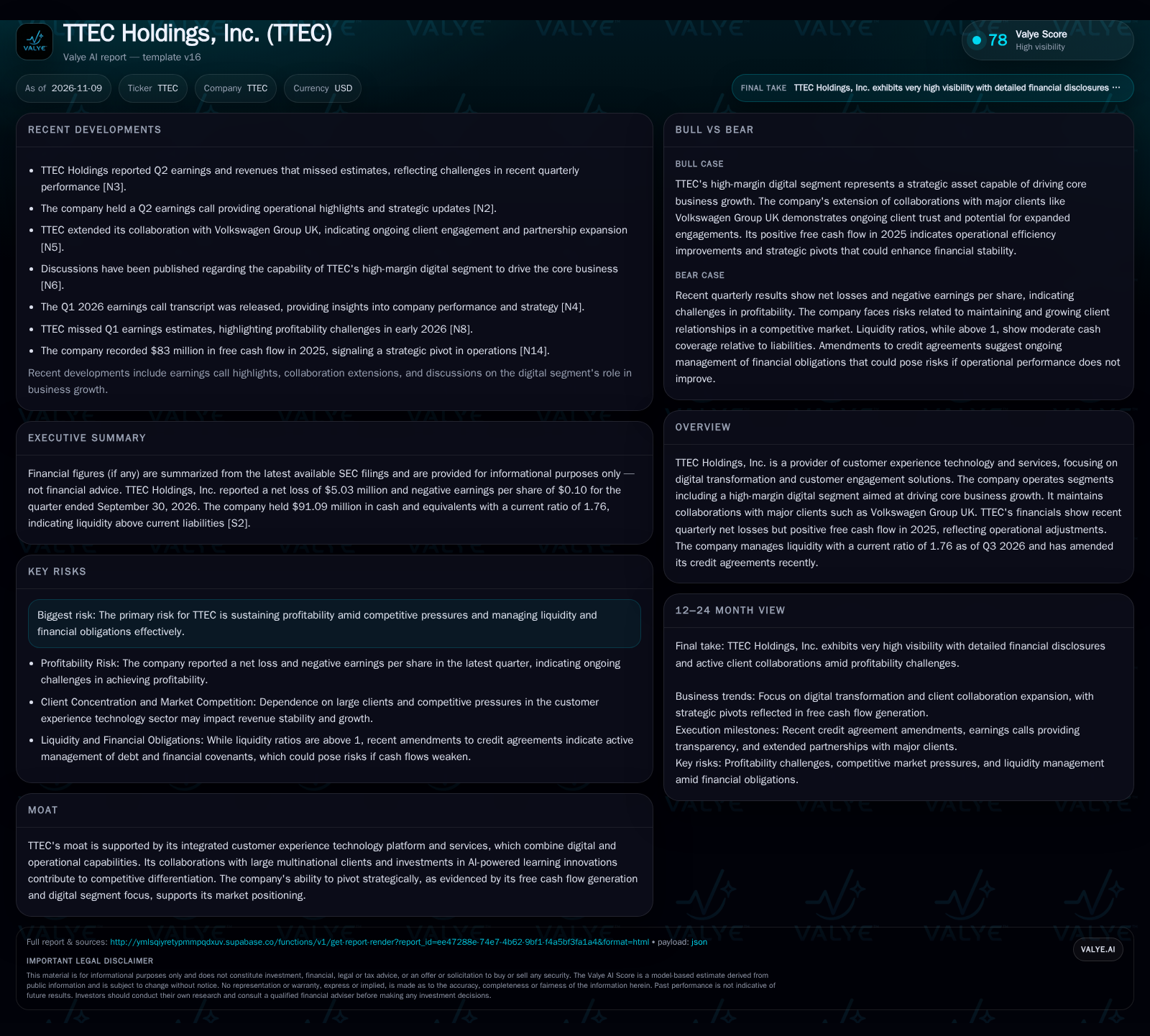
TTEC Holdings reported a net loss of $5.03 million for the quarter ended September 30, 2026, alongside negative basic and diluted earnings per share of -$0.10 [S2]. While this continues a pattern of quarterly losses, the company reported liquidity-ratio trends of 1.76, with $91.09 million in cash and equivalents as of the same date [S2]. Importantly, TTEC has extended its collaboration with Volkswagen Group UK, underscoring its ongoing relevance to major enterprise clients [N5]. Meanwhile, industry discussions are increasingly focused on the potential of TTEC’s high-margin digital segment to drive core business performance [N6]. The company’s recent amendment to its credit agreement signals active attention to financing arrangements and possibly a need to navigate cash flow pressures [S2]. Collectively, these facts frame a business balancing operational pivots and enterprise relationships against persistent profitability pressures.
How Digital Segments Could Reshape TTEC’s Revenue Model and Margin Structure
TTEC generates revenue by providing technology-enabled customer engagement solutions—spanning digital transformation consulting, managed services, and contact center operations. The economics of this model are increasingly driven by the mix shift toward higher-margin digital offerings, such as AI-powered automation, analytics, and omnichannel platforms. If TTEC successfully expands its digital footprint, this could reduce reliance on labor-intensive, lower-margin legacy services and improve blended gross margins. However, the transition is not frictionless: digital transformation requires upfront investment in technology, talent, and client acquisition, while legacy contracts may exert downward pressure on margins during the shift.
Pricing power in digital services depends on differentiation, integration with client workflows, and demonstrable ROI for enterprise customers. Volume growth is often tied to the ability to land large, multi-year relationships with global clients—an area where TTEC’s extended relationship with Volkswagen Group UK is illustrative but does not necessarily indicate recurring, contractually secured revenue. Operating leverage may improve if digital revenues scale, as incremental platform deployments typically carry lower variable costs than traditional BPO services. Nevertheless, persistent net losses suggest that either cost structure, pricing discipline, or the pace of digital adoption is not yet sufficient to offset competitive and operational headwinds.
Competitive Dynamics in Customer Experience Technology: Where TTEC Stands
TTEC operates in a sector marked by intense competition from both traditional business process outsourcing (BPO) providers and a new generation of digital-first CX platforms. Incumbents and digital disruptors alike are investing in AI, automation, and analytics to capture enterprise digital transformation budgets. TTEC’s integrated offering and track record with global clients create some stickiness, but switching costs for enterprise customers are not insurmountable—particularly if rivals can offer better integration, lower costs, or more innovative technology.
The company’s high-margin digital segment may serve as a differentiator, particularly if TTEC can embed itself deeper into clients’ digital transformation roadmaps and demonstrate measurable business outcomes. However, the sector’s low barriers to entry in software, the pace of technological change, and clients’ growing in-house capabilities all act as counterforces. TTEC’s ability to maintain and grow large enterprise relationships, such as its extended collaboration with Volkswagen Group UK, is a key competitive asset, but retention is contingent on continuous innovation, service quality, and pricing discipline.
If Digital-Led Growth Outpaces Margin Headwinds: What Would Success Look Like?
In a favorable scenario, TTEC’s digital segment accelerates, accounting for a growing share of revenue and driving a sustained improvement in gross and operating margins. This would likely be confirmed by a sequence of quarterly reports showing not only revenue growth in digital, but also a reversal of net losses and a return to positive earnings per share. Successful cross-selling of digital solutions to existing enterprise clients—anchored by extended relationships like that with Volkswagen Group UK—could catalyze larger, multi-year engagements and higher revenue visibility.
Investor confidence would be further reinforced if TTEC demonstrates operating leverage, with SG&A and technology costs growing slower than digital revenue. Evidence supporting this scenario would include a rising proportion of digital segment revenue, improved free cash flow, and fewer amendments to credit agreements. Falsification would come from continued net losses despite digital revenue growth, signaling that incremental digital business is not sufficiently profitable or that legacy cost drag remains an unresolved issue.
A Mixed Transition: Digital Growth Partially Offsets Legacy Drag
The most plausible near-term scenario is one in which TTEC’s digital segment continues to grow, but at a pace insufficient to fully offset the profitability pressures from legacy operations and competitive pricing. The company maintains enterprise client relationships but faces ongoing price competition and margin compression in traditional BPO and contact center services. Quarterly results may oscillate between modest profit and loss, reflecting both the capital investment needed for digital transformation and the slow unwinding of lower-margin contracts.
Confirmation of this scenario would be a gradual improvement in digital revenue as a percentage of total sales, intermittent (but not sustained) profitability, and continued active management of credit agreements. Falsification would be either a sharp, sustained turn to profitability (suggesting successful transformation) or a deepening of losses without evidence of digital acceleration.
When Margin Recovery Stalls: The Consequences of Weak Digital Execution
Should TTEC’s digital initiatives fail to gain sufficient traction, the company could remain trapped in a cycle of low-margin, labor-intensive service delivery while facing rising competitive threats from more agile digital-first providers. This scenario would see continued net losses, potential client attrition, and greater reliance on debt or credit amendments to manage cash flow. The risk of covenant breaches or liquidity stress could rise if free cash flow turns negative and digital growth stalls.
Confirmation would come from repeated quarterly losses, declining or stagnant digital segment revenue, increased client churn, and further amendments to credit agreements. Falsification would require a clear break in this pattern, with evidence of digital-led margin inflection and renewed client momentum.
Milestones That Will Determine Whether TTEC’s Digital Pivot Delivers
Quarterly digital segment revenue growth rate—if disclosed—would help determine the pace and sustainability of the business model shift.
Gross and operating margin trends, particularly as digital mix increases, will clarify whether higher-margin services are offsetting legacy drag.
Updates on major enterprise relationship wins, renewals, or expansions (e.g., with Volkswagen Group UK) will indicate client traction and revenue visibility.
Frequency and terms of credit agreement amendments or new financing arrangements could signal underlying cash flow health or stress.
Client retention and churn metrics, especially among large enterprise customers, if disclosed, would provide insight into the stickiness of TTEC’s solutions.
Free cash flow generation and its relationship to investment in digital capabilities will show whether transformation is self-funding.
Headcount trends and SG&A as a percentage of revenue may reveal whether operating leverage is being achieved as digital scales.
Disclaimer: This is research-only, informational analysis and not investment advice. It may include AI-generated interpretation and general industry context. Always verify important details using primary sources.

Comments