
MAIA Biotechnology: Clinical Milestones, Financial Strain, and the Stakes of Telomere-Targeting Immunotherapy
MAIA Biotechnology advances its telomere-targeting immunotherapy platform with late-stage trials in lung cancer, fast track regulatory status, and expanded global reach—but faces acute funding constraints and the execution risks inherent to pre-revenue oncology development.
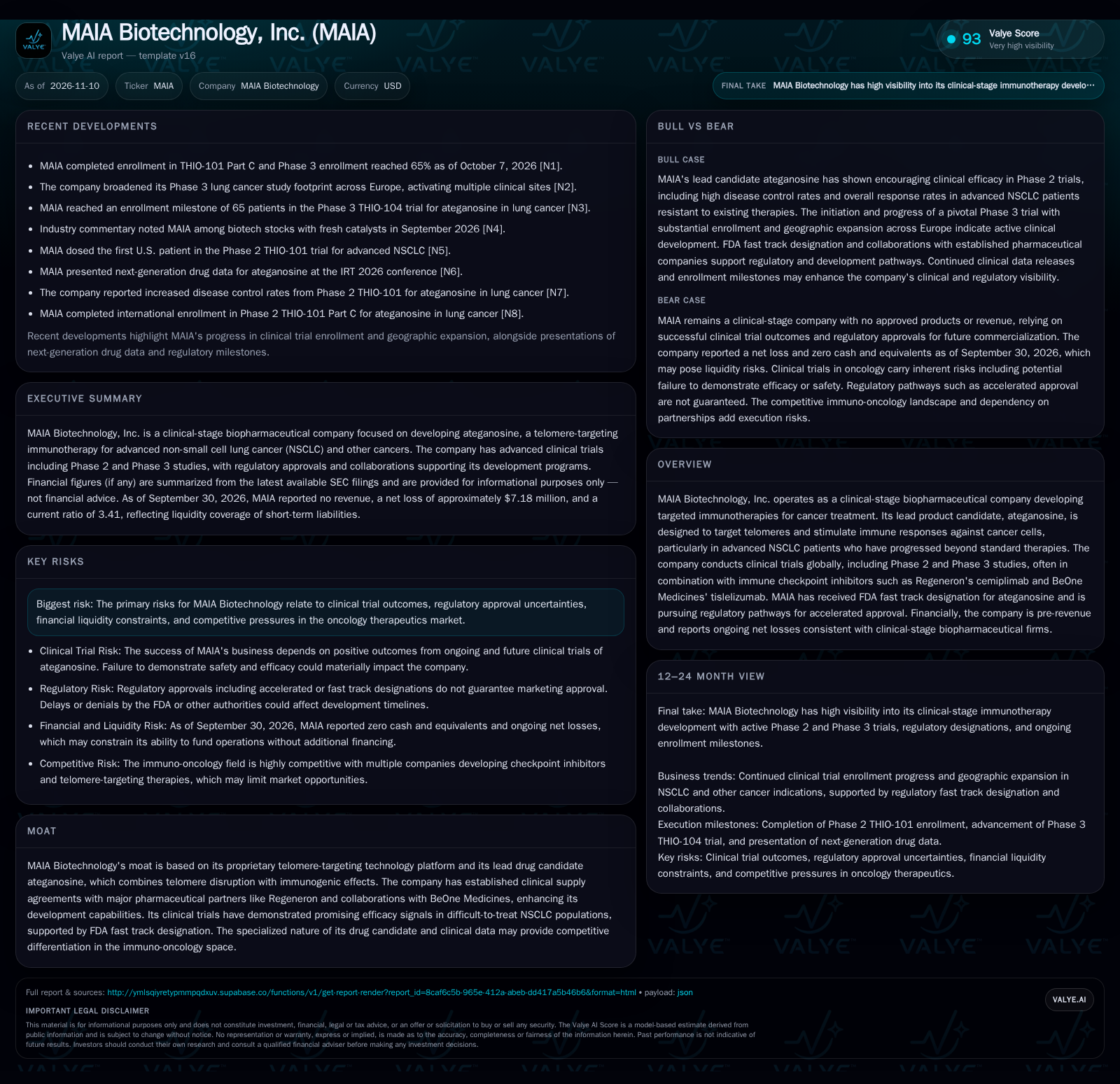
MAIA Biotechnology is progressing pivotal Phase 3 and late-stage Phase 2 trials for its lead cancer immunotherapy, ateganosine, with promising early efficacy signals and global clinical expansion. However, the company’s zero cash balance as of September 2026 highlights urgent liquidity pressures, making successful trial outcomes and near-term financing critical for survival and strategic optionality. The next twelve months will test MAIA’s ability to convert scientific and regulatory momentum into both sustained operational runway and eventual commercial relevance. [S2] [N1] [N3]
MAIA Biotechnology stands at a pivotal juncture: its lead telomere-targeting immunotherapy, ateganosine, has advanced through critical clinical milestones, including substantial enrollment in a pivotal Phase 3 lung cancer trial and encouraging efficacy signals in earlier studies. The company's global clinical expansion and FDA fast track status position it for regulatory visibility and potential expedited review. The coming year will be decisive in determining whether MAIA can bridge the gap from scientific promise to sustainable business execution. [S2] [N1] [N3]
Enrollment Milestones and Financial Pressures Define MAIA’s Present
MAIA Biotechnology’s lead asset, ateganosine, is in active clinical development for advanced non-small cell lung cancer (NSCLC), with a pivotal Phase 3 trial (THIO-104) reaching 65% enrollment (65 patients) as of October 2026. The company also completed enrollment for Part C of its Phase 2 THIO-101 trial, marking significant progress in its clinical pipeline. [N1] [N3]
Promising clinical signals have emerged: in the Phase 2 setting, ateganosine delivered disease control rates (DCR) up to 100% in second-line and overall response rates (ORR) of 38% in third-line NSCLC patients, suggesting potential activity in heavily pretreated populations. [N7]
MAIA has expanded its clinical footprint, activating multiple sites across Europe and the US, and received FDA fast track designation for ateganosine in July 2025, positioning the program for potential regulatory acceleration. [N2] [S2]
Financially, the company reported a cash and equivalents balance of $0 and a net loss of $7.18 million for the first nine months of 2026, with no revenue to date—a critical liquidity position that heightens the urgency of near-term financing or partnership. [S2]
How MAIA’s Model Could Monetize Telomere-Targeting Oncology
MAIA’s business model is contingent on successful clinical and regulatory progression of ateganosine, which, if approved, would likely be commercialized as a specialty oncology therapy. In the prevailing oncology market, such drugs are typically priced at a premium, reflecting high R&D costs and targeted patient populations. If ateganosine demonstrates clear efficacy and safety in pivotal trials, MAIA could pursue direct commercialization in select markets or out-license to a larger pharmaceutical partner, capturing either high-margin product revenue or milestone and royalty streams.
The economics for a first- or best-in-class therapy in refractory NSCLC could be attractive: payors have shown willingness to reimburse for drugs that meet unmet needs in late-line settings, especially with supporting data. However, the path to revenue is long and capital-intensive. MAIA’s current lack of cash and continued net losses mean that additional financing—via equity, debt, or strategic partnerships—will be essential to fund ongoing trials, regulatory submissions, and any pre-commercial buildout.
Fixed costs are dominated by R&D and clinical trial operations, with variable economics largely tied to trial scale, site expansion, and, eventually, commercial manufacturing and distribution. Operating leverage could materialize if ateganosine achieves approval and scales, but current economics are heavily negative, with no offsetting revenue and acute dependence on external capital.
Telomere-Targeting: Differentiation and the Reality of Immuno-Oncology Competition
MAIA’s core differentiation is a proprietary approach: ateganosine targets telomere maintenance mechanisms in cancer cells while stimulating an immunogenic response, a dual-action strategy that may offer incremental benefit over standard checkpoint inhibitors alone. The company’s collaborations with Regeneron (for cemiplimab) and BeOne Medicines (for tislelizumab) bolster clinical development, broaden the dataset, and potentially ease future regulatory or commercial partnerships.
However, the immuno-oncology field is intensely competitive, with numerous approved checkpoint inhibitors, next-generation combinations, and other telomere-targeting agents in development. Large pharmaceutical incumbents possess more resources, commercial infrastructure, and established relationships with oncologists and payors. The ultimate competitive threat comes from either superior efficacy/safety profiles from rivals or the emergence of new modalities (such as cell therapies, bispecific antibodies, or targeted small molecules) that could erode ateganosine's addressable market.
If ateganosine’s clinical data continue to show robust efficacy in populations resistant to existing therapies, it may carve out a niche, particularly as a salvage or combination agent. However, real-world adoption will depend on comparative data, pricing, and the ability to secure guideline inclusion and reimbursement.
Breakout Clinical Data and a Strategic Financing Unlock Commercial Potential
In the most favorable scenario, MAIA’s Phase 3 THIO-104 trial demonstrates statistically and clinically meaningful improvements in progression-free and overall survival in third-line NSCLC, confirming Phase 2 efficacy signals. This would likely trigger regulatory filings under fast track or accelerated approval pathways, with the potential for priority review.
Robust data could attract a strategic partner or acquirer, providing the capital necessary to complete development, support launch, and scale commercial operations. The company could negotiate lucrative milestone payments and royalties or retain some commercialization rights for higher-margin sales in select geographies.
Evidence that would support this outcome includes positive topline Phase 3 results, continued high enrollment/completion rates, and the announcement of a major financing or partnership deal. Additional clinical progress in secondary indications (such as HCC, CRC, or SCLC) with BeOne Medicines would further validate the platform and expand addressable markets.
Falsification would occur if Phase 3 fails to replicate earlier efficacy or safety signals, or if MAIA is unable to secure the capital needed to sustain operations through regulatory review.
Trial Progress Amid Capital Constraints: The Most Likely Path Forward
The most plausible scenario is that MAIA continues to advance clinical enrollment and data readouts in its core NSCLC program, but faces recurring funding gaps due to its zero cash balance and ongoing net losses. The company may secure modest bridge financing or dilutive equity raises to extend its runway just long enough to reach critical data milestones.
Phase 3 results may be mixed or delayed, requiring further post-hoc analyses or additional studies to satisfy regulators. In this environment, MAIA would likely prioritize resource allocation to its most promising indications and seek non-dilutive partnerships or grants where possible.
Confirmation of this scenario would be further incremental clinical progress, small-scale financings, and cautious management commentary about operational priorities. Falsification would be a dramatic positive or negative clinical inflection, a major partnership, or insolvency forcing a halt to development.
Liquidity Crisis or Clinical Setback Forces Strategic Retrenchment
The adverse scenario for MAIA is a combination of negative or inconclusive Phase 3 data and acute funding shortfalls. With no cash on hand and no revenue, the company would be forced to drastically curtail operations, potentially pausing or terminating clinical programs. This could lead to layoffs, asset sales, or a distressed strategic transaction at unfavorable terms.
Even if early clinical signals are promising, delays in trial enrollment, regulatory setbacks, or inability to secure timely financing could erode confidence and bargaining power with potential partners. The risk of delisting or bankruptcy would rise if MAIA cannot stabilize its financial position or demonstrate compelling clinical value.
This scenario would be confirmed by management announcing trial suspensions, workforce reductions, or failure to close new financing rounds. Falsification would require a rapid and material improvement in either funding or data.
What Will Test MAIA’s Ability to Survive and Scale in Cancer Immunotherapy
Topline efficacy and safety results from the Phase 3 THIO-104 trial in third-line NSCLC will be the single most decisive catalyst for valuation and strategic options.
Disclosure of new financing events, partnership agreements, or non-dilutive capital sources will determine the company’s operational runway and bargaining leverage.
Enrollment pace and completion rates in ongoing and planned Phase 2/3 trials, particularly as MAIA expands into new indications or geographies.
Updates on regulatory interactions—such as FDA feedback, accelerated approval filings, or EMA engagement—will clarify the timeline to potential commercialization.
Progress in secondary cancer indications (HCC, CRC, SCLC) in collaboration with BeOne Medicines, as this would validate platform breadth and increase addressable market.
Changes in competitor landscape, including new approvals or clinical readouts in telomere-targeting or next-generation immuno-oncology agents.
Operating expense trends and cash burn rates disclosed in future filings, as these will signal the urgency and scale of upcoming capital needs.
Disclaimer: This is research-only, informational analysis and not investment advice. It may include AI-generated interpretation and general industry context. Always verify important details using primary sources.

Comments