
Citizens Community Bancorp: Margin Recovery, Internal Controls, and the Stakes of Interest Rate Volatility
Citizens Community Bancorp’s recent net interest margin improvement and dividend increase signal management’s response to a shifting rate environment, but a disclosed material weakness in internal controls and sector-wide economic sensitivity pose real risks. The interplay between credit quality, balance sheet optimization, and regulatory oversight will define its resilience—and shareholder returns—in the coming quarters.
The cited source reports dividend-related activity; that disclosure alone does not establish dividend-policy continuity, management confidence, or a material constraint on capital flexibility. The company’s ability to remediate governance issues, manage credit quality, and adapt to macroeconomic shifts will determine whether recent gains are sustainable or at risk of reversal. [S2] [N2] [N4]
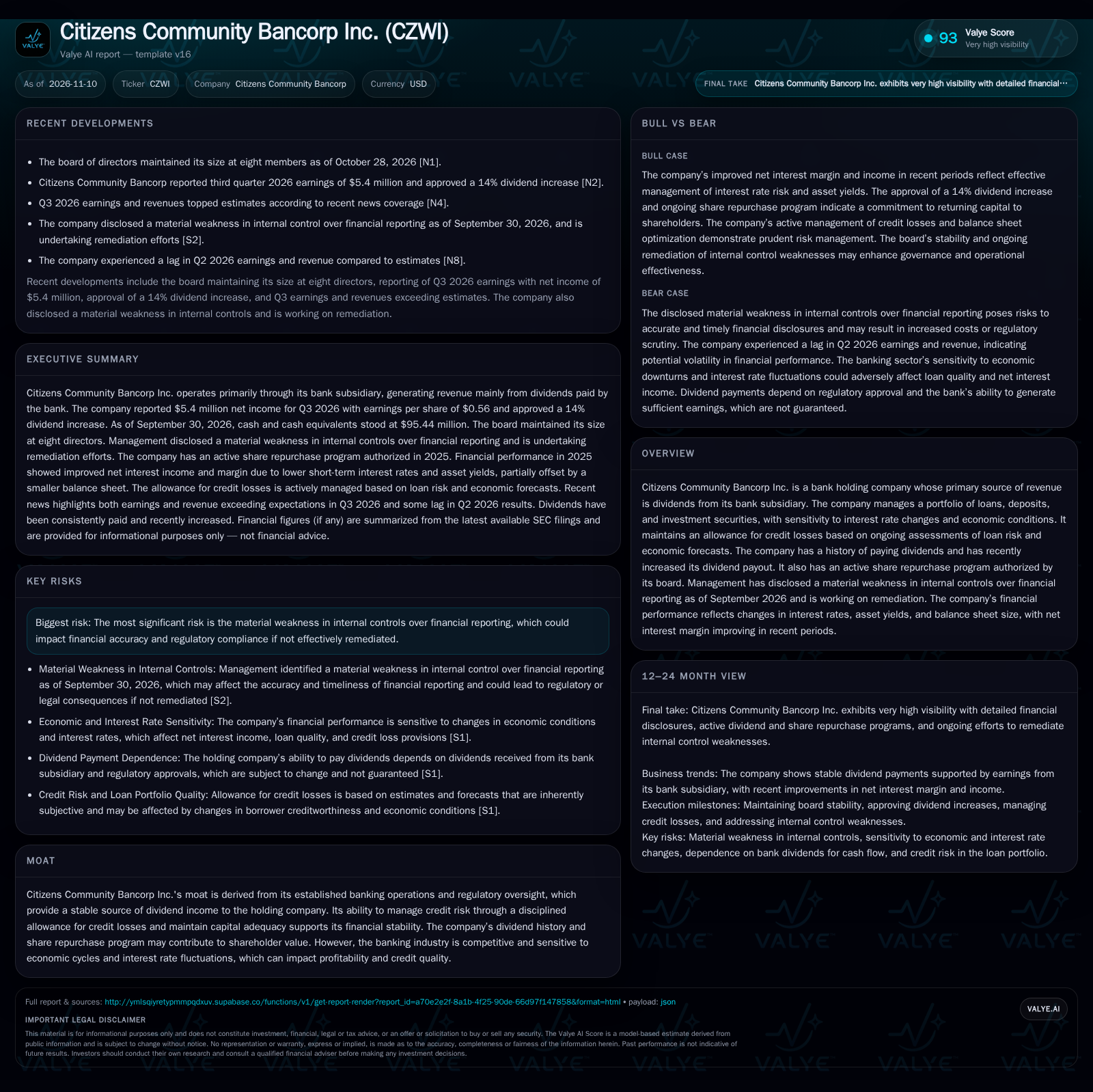
Citizens Community Bancorp Inc. is navigating a complex landscape defined by recent margin recovery, capital return initiatives, and a significant internal controls challenge. The company’s Q3 2026 results showed net interest margin improvement and a dividend increase, suggesting management is adjusting to a changing interest rate environment. However, a newly disclosed material weakness in internal controls over financial reporting raises questions about governance and future financial accuracy. The company’s next chapters will hinge on its ability to resolve these issues while sustaining credit quality and capital flexibility in a volatile macro environment.
Recent Margin Gains and Governance Challenges Shape the Near-Term Outlook
The company reported cash and liquidity metrics for the period; these figures do not by themselves establish operating runway, investment capacity, financial flexibility, or financing capacity. [S2] The most material recent development is the company’s disclosure of a material weakness in internal controls over financial reporting as of the latest quarter, with management actively pursuing remediation [S2]. This governance issue arrives alongside improved net interest income and margin, attributed to lower short-term interest rates and asset yields, even as the balance sheet contracted [S2]. The company also increased its dividend in Q3 2026, underscoring a pattern of returning capital to shareholders [N2].
Together, these developments frame a business at an inflection: financial performance has rebounded, but operational risks tied to controls and sector-wide volatility remain front and center.
How Rate Sensitivity and Capital Return Programs Drive Earnings Volatility
Citizens Community Bancorp’s primary revenue source is dividends from its bank subsidiary, which are ultimately supported by net interest income—the spread between interest earned on loans/securities and interest paid on deposits and borrowings. This margin is highly sensitive to changes in the interest rate environment, asset mix, and competitive deposit pricing. While recent periods saw an improvement in net interest margin due to lower short-term rates and asset yields, the company’s overall balance sheet size declined, partially offsetting these gains [S2].
The business model leans on traditional banking economics: fixed costs (personnel, regulatory compliance, technology) are leveraged against variable revenue from loan and deposit activity. Operating leverage can improve with asset growth and stable credit quality but deteriorates if credit losses spike or deposit costs rise faster than asset yields. The allowance for credit losses is actively managed, but subjective forecasts and cyclical swings can lead to earnings volatility [S2].
The cited source reports dividend-related activity; that disclosure alone does not establish dividend-policy continuity, management confidence, or a material constraint on capital flexibility. [S2] [N2] These actions can enhance per-share earnings and signal confidence, but they also reduce retained capital that could buffer against future shocks or fund growth. The sustainability of these capital returns depends on the bank subsidiary’s ongoing profitability, regulatory capital requirements, and the macroeconomic climate.
Navigating a Crowded Banking Landscape Amid Technology and Regulatory Shifts
Citizens Community Bancorp operates in a highly competitive regional banking sector, facing pressure from both traditional banks and non-bank financial institutions. Its competitive position relies on established customer relationships, prudent credit risk management, and regulatory compliance. However, banking is structurally exposed to economic cycles and interest rate volatility, which can quickly erode margins or lead to asset quality deterioration.
Potential advantages include disciplined credit risk management (as reflected in the company’s active allowance for credit losses) and a track record of dividend payments. However, these are counterbalanced by the sector’s sensitivity to deposit disintermediation and the rise of fintech and non-depository competitors, which can compress spreads and siphon off core customers, especially in periods of rate instability.
Regulatory oversight provides both a moat and a constraint. While it can limit aggressive competition from less regulated players, it also raises compliance costs and restricts strategic flexibility. The recently disclosed material weakness in internal controls could further expose the company to regulatory scrutiny and reputational risk if not effectively remediated [S2].
Margin Expansion and Control Remediation Unlock Higher Returns
A favorable outcome for Citizens Community Bancorp would involve sustained improvement in net interest margin, driven by a stable or declining interest rate environment and successful repricing of assets and liabilities. If management completes the remediation of internal control weaknesses without further incident, regulatory scrutiny could ease, and investor confidence may rebound. Ongoing discipline in credit risk management would limit loan losses, allowing more capital to be returned to shareholders through dividends and buybacks.
Additional signs would include growth in non-interest income (if disclosed) and positive feedback from regulators or rating agencies. Conversely, widening credit losses, renewed control deficiencies, or macro-driven deposit outflows would falsify this scenario.
Steady Earnings with Episodic Volatility as Controls and Rates Remain in Flux
The most plausible path forward is a continuation of modest earnings growth, punctuated by periodic volatility tied to interest rate fluctuations and credit cycle dynamics. Management is likely to make progress on internal control remediation, but some lingering costs or distractions could persist into 2027. Net interest margin may remain above recent lows but is unlikely to expand dramatically unless the rate environment turns more favorable or the company accelerates loan growth.
Dividend payments and share repurchases are expected to continue, but their pace could moderate if earnings growth slows or regulatory capital buffers need strengthening. Signs of deviation would be a renewed spike in credit losses, regulatory actions related to controls, or sharp contraction in margins following unexpected rate moves.
Internal Control Setbacks or Credit Deterioration Trigger Regulatory and Earnings Pressure
Adverse outcomes could stem from delays or failures in remediating the material weakness in internal controls. This would increase the risk of financial misstatements, invite regulatory enforcement, and potentially restrict capital return actions. In parallel, if the macro environment worsens—through rising unemployment, sector downturns, or renewed interest rate volatility—loan delinquencies and credit losses could rise, eroding both margin and capital.
This scenario would be confirmed by: repeat or expanded disclosures of control deficiencies, negative regulatory findings, dividend cuts or suspensions, and a spike in non-performing loans or loan loss provisions. A rapid outflow of deposits or inability to sustain adequate capital ratios would further exacerbate downside risk. Conversely, prompt and successful remediation of controls and stable credit trends would mitigate these risks.
Markers That Will Define Citizens Community Bancorp’s Resilience and Upside
Progress and timeline of internal control remediation, including external audit opinions or regulatory updates on the material weakness disclosed as of September 30, 2026. [S2]
Quarterly net interest margin trends and management commentary on asset/liability repricing strategies. [S2]
Allowance for credit losses and underlying loan quality metrics—especially any changes in non-performing asset ratios or loan loss provisions. [S2]
Pace and scale of dividend increases or share repurchases, and any board commentary on capital return priorities. [N2] [S2]
Deposit growth or attrition rates, particularly in response to competitive pressure from digital banks or fintechs (if disclosed).
Regulatory capital ratios and any commentary on potential changes to dividend or buyback plans due to capital requirements (if disclosed).
Evidence of non-interest income growth or diversification beyond traditional lending (would help test the thesis if disclosed).
Market or regulatory reaction to any further disclosures related to internal controls or governance.
Disclaimer: This is research-only, informational analysis and not investment advice. It may include AI-generated interpretation and general industry context. Always verify important details using primary sources.

Comments