
Atea Pharmaceuticals: HCV and HEV Antiviral Ambitions Face Pivotal Clinical and Commercial Tests
Atea Pharmaceuticals, with late-stage clinical assets targeting hepatitis C and E, is entering a decisive period as it readies topline Phase 3 data and pursues a first-mover strategy in the underserved HEV market. Success hinges on clinical outcomes, regulatory timing, and its ability to carve out market share in a competitive antiviral landscape.
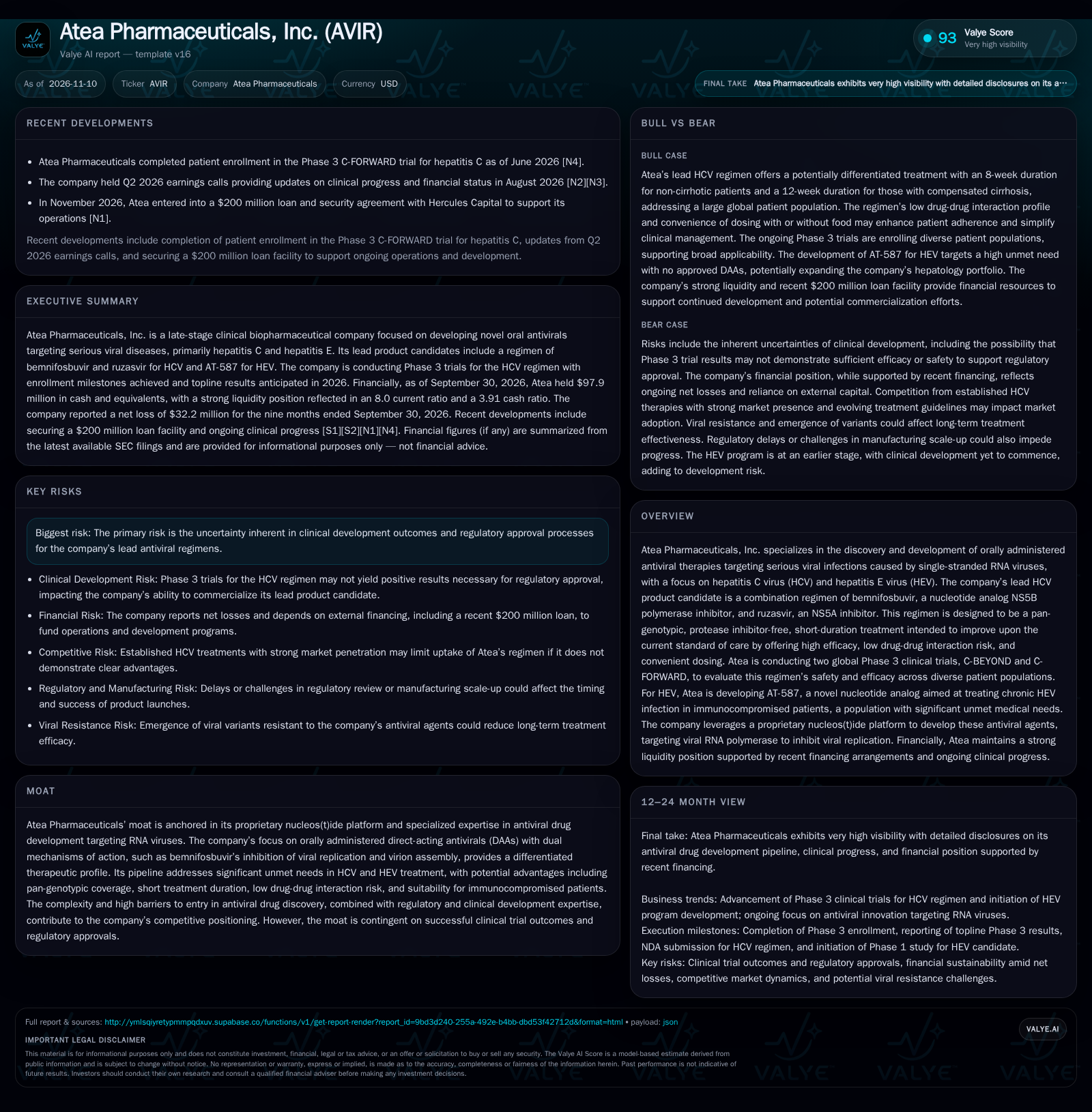
Atea Pharmaceuticals is approaching major clinical trial readouts for its lead hepatitis C regimen, with a proprietary platform also targeting hepatitis E. The company completed Phase 3 enrollment for its HCV candidate and secured a $200 million loan to support ongoing operations. As topline results and regulatory milestones approach, Atea’s prospects will depend on demonstrating clear clinical and commercial advantages over established therapies, while managing development risk and capital discipline. [S1] [S2] [N1] [N4]
Atea Pharmaceuticals is entering a critical stretch as it advances late-stage development of its oral hepatitis C regimen and prepares to launch first-in-class trials for hepatitis E. With Phase 3 enrollment completed for its HCV candidate and a substantial loan facility secured, the company now faces the pivotal challenge of translating clinical promise into regulatory approval and commercial traction. Its proprietary nucleos(t)ide platform targets high-barrier viral polymerases, but success will hinge on evidence of advantage over entrenched competitors and on execution in regulatory, manufacturing, and commercial domains. The next 12-18 months will define whether Atea’s pipeline can convert R&D investment into sustainable value.
Phase 3 HCV Trials and Financial Maneuvers Set the Stage for a Defining Year
Atea Pharmaceuticals’ most material developments center on its late-stage HCV program and strategic financing. The company completed enrollment in the pivotal Phase 3 C-FORWARD trial for its pan-genotypic, oral HCV regimen as of June 2026, with topline data for both C-FORWARD and C-BEYOND expected in mid- and late-2026, respectively. These results will directly determine the viability of its planned New Drug Application (NDA) submission in March 2027. [S1] [N4]
[S2] [N1] This substantial capital cushion is critical as the company reported a net loss of $32.2 million for the first nine months of 2026, reflecting its heavy R&D investment ahead of potential commercialization. [S2]
The upcoming topline readouts and the ability to maintain operational runway through these milestones are the central near-term variables that will shape Atea’s strategic trajectory.
Revenue Prospects and Cost Structure in a Late-Stage Biopharma Model
Atea’s business economics are defined by the high fixed costs and binary outcomes typical of late-stage clinical biopharma. Revenue generation is contingent on the successful approval and launch of the bemnifosbuvir/ruzasvir HCV regimen, with a plausible commercial window opening post-2027 if Phase 3 data and regulatory review are favorable.
HCV remains a large but maturing market, with patient volumes declining in developed countries due to successful treatment campaigns but remaining substantial globally. The company’s regimen is positioned as a short-duration, pan-genotypic, protease inhibitor-free alternative, potentially allowing for premium pricing or at least competitive parity with existing direct-acting antivirals (DAAs), provided efficacy and tolerability claims are substantiated. However, entrenched competitors may engage in price competition or bundled contracting, compressing achievable margins.
Variable costs are driven primarily by manufacturing, distribution, and post-approval sales investments, while R&D and clinical trial expenses dominate the current P&L. The company’s ongoing net losses reflect this R&D intensity, with the balance sheet now temporarily augmented by the Hercules Capital loan. If the HCV regimen is approved, operating leverage could be significant due to the relatively low incremental cost of goods for oral small molecules, but upfront commercial infrastructure buildout and possible milestone/royalty obligations could temper near-term profitability.
The economics of AT-587 for HEV are less certain, as the addressable market is smaller and less well-defined, but first-mover advantage could support premium pricing and favorable reimbursement if clinical need is proven.
Navigating a Crowded HCV Landscape and First-Mover Potential in HEV
Atea operates in an HCV market dominated by established DAAs from large pharmaceutical peers. Any new entrant must demonstrate clear clinical or economic advantages to displace incumbents. The company’s regimen aims to differentiate on multiple fronts: shorter treatment duration (8–12 weeks), pan-genotypic efficacy, absence of protease inhibitors (reducing drug-drug interaction risk), and convenient oral dosing. If these features translate into superior real-world outcomes, they could drive market share gains, especially among patients with comorbidities or those requiring simplified regimens.
However, competitive counterforces are formidable. Existing HCV therapies are highly efficacious, well-tolerated, and supported by strong payer relationships and distribution networks. Price competition, bundled contracts, and physician inertia could limit the uptake of a new regimen unless it delivers a step-change in outcomes or simplicity. Furthermore, the HCV market’s overall contraction in some regions due to effective public health initiatives may limit volume growth even with a differentiated product.
In contrast, Atea’s HEV program targets a market with no approved direct-acting antivirals, particularly for immunocompromised patients. If AT-587 demonstrates safety and efficacy, first-mover status could yield high barriers to entry and durable pricing power—at least until competitors emerge. Yet the commercial scale and reimbursement dynamics for HEV remain less predictable, requiring careful market development and stakeholder education.
Clear Clinical Superiority Unlocks Accelerated Adoption and Margin Expansion
The most favorable scenario for Atea is one in which both C-BEYOND and C-FORWARD Phase 3 trials deliver compelling efficacy and safety data, validating the company’s claims of pan-genotypic coverage, short-duration therapy, and low drug-drug interaction risk. This could enable the NDA to proceed on schedule in March 2027, with a rapid FDA review and commercial launch soon after. If the data support a best-in-class profile—such as higher cure rates in hard-to-treat populations or meaningfully improved tolerability—the regimen could win guideline inclusion and payer support, accelerating adoption.
Such success would likely drive operating leverage, as fixed costs are spread over growing volumes, and could establish Atea as a credible commercial player in antivirals. Early positive signals would include strong topline data, FDA acceptance of the NDA, and rapid formulary coverage decisions. For the HEV program, smooth Phase 1 initiation and promising early data would reinforce the company’s platform value and open the door to additional pipeline expansion.
Evidence confirming this scenario would be: clear statistical and clinical superiority in Phase 3 topline results, positive regulatory interactions, and early commercial traction or partnership interest post-approval.
Incremental Differentiation Yields Moderate Uptake Amid Intense Competition
The most plausible outcome is that Atea’s HCV regimen demonstrates non-inferiority or modest improvements over current standards, supporting approval but without a transformative clinical advantage. In this scenario, the product is launched but faces headwinds in displacing entrenched DAAs, with uptake driven primarily by niche populations (e.g., those with drug-drug interaction concerns or requiring shorter regimens). Pricing may be pressured by formulary negotiations and competitive responses, limiting margin upside.
The HEV program progresses to Phase 1 as planned, but commercial impact remains several years away and is dependent on successful clinical readouts and market development.
This scenario would be confirmed by Phase 3 results showing efficacy and safety comparable, but not superior, to leading DAAs, gradual NDA progress, and commercial launch metrics indicating moderate market penetration.
Clinical Setbacks or Regulatory Delays Erode Runway and Strategic Options
The most adverse chain involves disappointing Phase 3 results—either in efficacy or safety—which delay or derail the NDA process. Regulatory pushback could require additional studies or restrict the label, forcing Atea to extend its cash runway or pivot strategically. Even with approval, if data do not support clear differentiation, payers may deprioritize the regimen, leading to slow uptake and intensifying price competition. This would increase the risk of further dilution or challenging capital raises, especially as the $200 million loan adds leverage to the balance sheet.
The HEV program could also encounter setbacks if Phase 1 data reveal safety concerns or insufficient antiviral activity, postponing or curtailing development. In this scenario, Atea’s pipeline-driven model would likely face pressure to out-license or partner assets to conserve cash.
Downside evidence would include negative or equivocal topline trial data, FDA requests for additional studies, slower-than-expected enrollment or market uptake, and heightened cash burn without offsetting partnering or commercial revenue.
Milestones and Metrics That Will Determine Atea’s Antiviral Trajectory
Topline efficacy and safety results from the C-BEYOND and C-FORWARD Phase 3 HCV trials, especially in patient subgroups with high unmet need.
FDA acceptance for review and timelines for the NDA submission of the bemnifosbuvir/ruzasvir regimen.
Early commercial launch metrics: formulary access, physician adoption rates, and real-world adherence/persistence (if disclosed).
Evolution of cash burn and available liquidity, particularly as the company ramps up pre-commercial and commercial activities.
Progression and outcomes of AT-587 Phase 1 for HEV, including initial safety and pharmacokinetic data.
Emergence of new or modified treatment guidelines for HCV that could favor or disadvantage Atea’s regimen.
Competitive responses from incumbent HCV therapy providers, including changes in pricing, contracting, or new product launches.
Updates on potential partnering, licensing, or co-commercialization agreements that could de-risk commercialization or extend runway.
Disclaimer: This is research-only, informational analysis and not investment advice. It may include AI-generated interpretation and general industry context. Always verify important details using primary sources.

Comments