
Plug Power’s Hydrogen Ambitions: Revenue Growth, Restructuring, and the Stakes of Capital-Intensive Scale
Plug Power reported Q3 2026 revenue above expectations and positive net income, but restructuring and operational losses reflect the real costs of scaling hydrogen infrastructure.
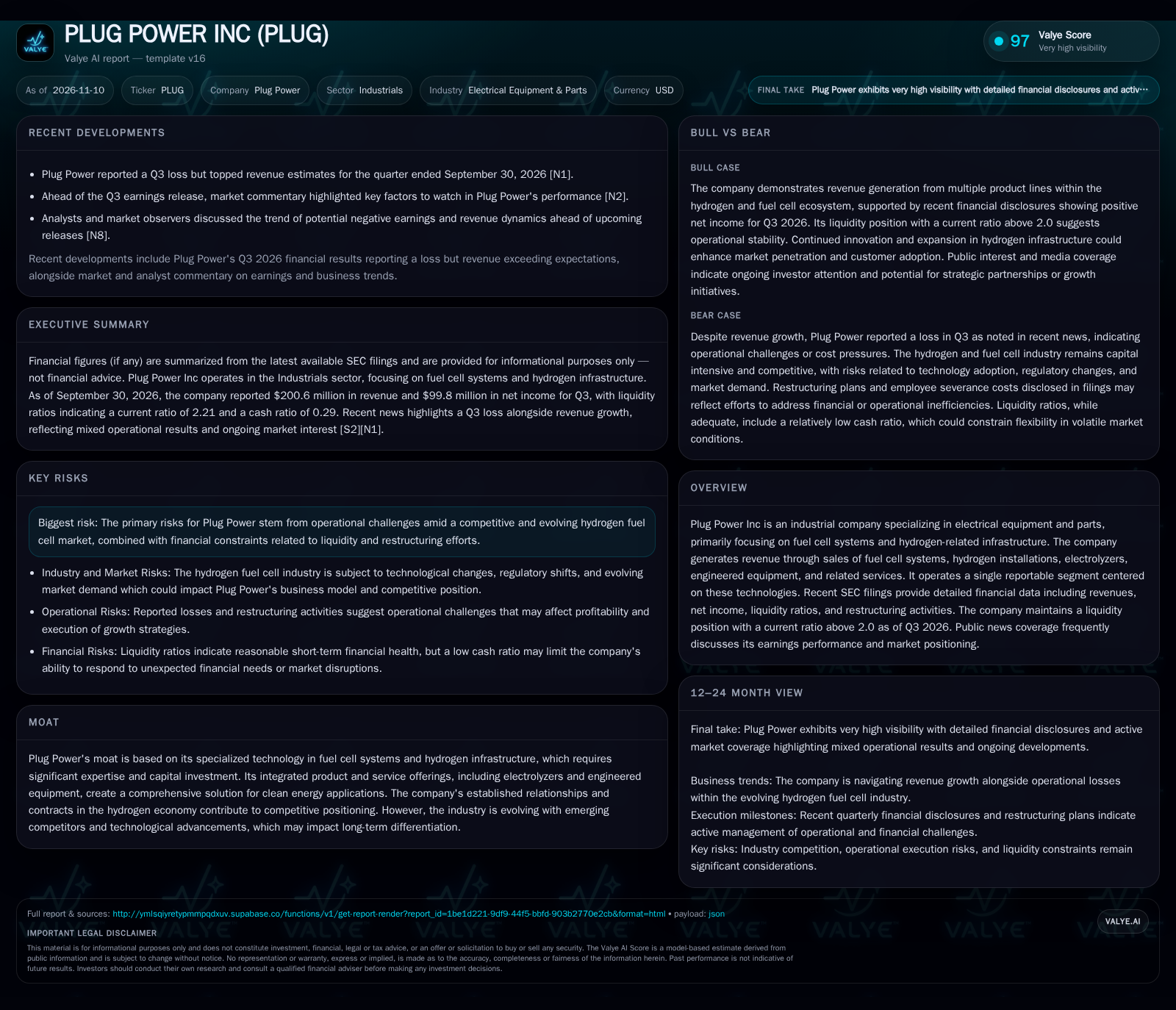
Plug Power’s Q3 2026 results showed revenue of $200.6 million and net income of $99.8 million, but operational losses and restructuring costs highlight the challenge of building a sustainable hydrogen business. Liquidity remains in focus, with a current ratio of 2.21. The company’s strategy depends on scaling fuel cell and hydrogen solutions amid intense competition and high capital needs, making execution and industry adoption pivotal for long-term value creation. [S2] [N1]
Plug Power’s Q3 2026 results encapsulate the promise and peril of the hydrogen economy. The company delivered revenue above expectations and reported positive net income, yet ongoing operational losses and recently disclosed restructuring costs reflect the real challenge of scaling a capital-intensive business in a fast-evolving market. Ultimately, its future will rest on the company’s ability to turn technological leadership into commercial durability—navigating the complex economics, competitive threats, and adoption hurdles that define the next phase of the hydrogen transition.
Recent Results: Revenue Growth, Net Income, and Operational Pressures
Plug Power reported Q3 2026 revenue of $200.6 million and net income of $99.8 million, with basic EPS of $0.07 and diluted EPS of $0.00. Despite topping revenue estimates, the company faced operational losses, and recent filings disclosed restructuring plans and employee severance costs, indicating ongoing internal adjustments. The company reported cash and liquidity metrics for the period; these figures do not by themselves establish operating runway, investment capacity, financial flexibility, or financing capacity. These data points are crucial because they highlight both the marketplace traction of Plug Power’s product lines and the persistent cost and cash flow challenges of running a capital-intensive business at scale. [S2] [N1]
How Plug Power’s Business Model Converts Innovation into Revenue—And Where Friction Remains
Plug Power’s revenue streams flow from the sale of fuel cell systems, hydrogen infrastructure, electrolyzers, engineered equipment, and related services, all reported within a single segment. This vertical integration could, in theory, allow the company to capture more value across the hydrogen supply chain, from production to point-of-use. However, the economics are complex: capital intensity is high, with significant up-front investment required for manufacturing, deployment, and ongoing service obligations.
The mix of hardware sales, project deployments, and service contracts likely creates a revenue profile that is lumpy and sensitive to project timing. Margins are pressured by the need to scale manufacturing, absorb R&D and SG&A, and compete on price against both incumbent and emerging technologies. Operating leverage is theoretically attainable as deployments scale, but achieving it requires managing cost discipline during growth and avoiding margin dilution from aggressive customer acquisition or competitive pricing. Plug Power’s recent restructuring and severance costs suggest ongoing attempts to streamline operations and realign cost structures with revenue realities. [S2]
The capital intensity inherent in Plug Power’s business model also introduces significant timing and financing risks. Large upfront expenditures in manufacturing capacity, electrolyzer production lines, and hydrogen refueling infrastructure require careful capital allocation and long-term planning. If market adoption lags or competitive dynamics force price reductions, the company may face underutilized assets or margin compression. Moreover, the integration of hardware sales with ongoing service contracts creates a complex revenue recognition and cash flow profile, where initial sales may be followed by extended service obligations. This dynamic necessitates a balanced approach to customer acquisition and contract structuring to avoid cash flow mismatches that could strain liquidity despite reported revenue growth.
Positioning Against Rivals: Technology, Integration, and Systemic Headwinds
Plug Power’s competitive edge rests on its deep specialization in fuel cell systems and hydrogen infrastructure, with a portfolio that spans electrolyzers, engineered equipment, and associated services. In principle, this breadth should create switching frictions for customers seeking end-to-end solutions. However, the hydrogen market is seeing rapid entrance by industrial conglomerates, energy majors, and aggressive startups, all vying for share as regulatory, technological, and commercial dynamics shift.
Substitutes—including battery-electric solutions and other renewable energy storage technologies—remain formidable, particularly in applications where hydrogen’s value proposition is not yet proven or cost-competitive. Plug Power’s moat is partly a function of technical know-how and established relationships, but these advantages are vulnerable to both technological leapfrogging and pricing pressure from better-capitalized or more nimble competitors.
In addition to direct competitive pressures, Plug Power must navigate systemic challenges such as supply chain constraints and evolving regulatory frameworks that impact hydrogen production costs and infrastructure deployment. The company’s vertical integration could mitigate some supply chain risks by internalizing critical components, but it also concentrates operational risk and capital exposure. Furthermore, regulatory incentives and mandates vary widely by region and sector, creating an uneven playing field that can advantage or disadvantage players depending on geographic focus. The ability to adapt quickly to these external variables, while maintaining technology leadership and cost competitiveness, will be critical to sustaining market share in a rapidly evolving hydrogen landscape.
When Scale and Adoption Accelerate: Pathways to Durable Profitability
A favorable scenario for Plug Power would see rapid, broad-based adoption of hydrogen solutions across logistics, transportation, and industrial sectors—driven by regulatory incentives, decarbonization mandates, and improved cost structures. As project volumes grow, Plug Power could achieve operating leverage, with fixed manufacturing and R&D costs spread over a larger base, and margins expanding as service, maintenance, and recurring infrastructure revenues increase.
Evidence that would confirm this scenario includes sustained sequential revenue growth, improving gross and operating margins, growing backlog or contract wins (if disclosed), and a declining ratio of restructuring or severance costs to total operating expenses. Strategic partnerships, multi-year supply agreements, or technology licensing deals would further validate Plug Power’s role as a platform provider rather than a commodity hardware vendor.
Navigating Market Volatility: Moderate Growth Amid Persistent Cost Pressures
The most plausible near-term outcome is continued revenue growth alongside operational volatility, as Plug Power contends with the realities of scaling in a still-maturing hydrogen ecosystem. Margins may remain under pressure due to ongoing cost of goods sold, SG&A, and restructuring, with periodic losses offsetting revenue wins.
Confirmation of this scenario would come from steady but unspectacular top-line growth, persistent restructuring or severance expenses, and flat or only modestly improving cash flow metrics.
When Capital Intensity and Competitive Pressures Overwhelm
The adverse scenario would see Plug Power’s cost structure outpacing its ability to grow revenue, with restructuring efforts failing to deliver sustained savings or operational improvements. In this case, competitive pressures—whether from lower-cost substitutes, price wars, or customer defection—could erode margins and lead to cash burn, forcing the company to seek dilutive financing or scale back growth initiatives.
Evidence confirming this trajectory would include rising or persistent restructuring costs, declining gross margins, sequential drops in cash or current assets, and any disclosure of stressed supplier or customer relationships. In this scenario, Plug Power could become a cautionary tale of a company unable to bridge the gap between technological promise and commercial self-sufficiency.
Milestones That Will Define Plug Power’s Hydrogen Trajectory
Sequential revenue growth by product line (fuel cell systems, electrolyzers, hydrogen infrastructure) if disclosed, to assess diversification and momentum.
Gross margin and operating margin trends, to evaluate whether scale is translating into profitability or if cost pressures remain entrenched.
Size and duration of restructuring and severance costs relative to total operating expenses, as an indicator of operational discipline and transition progress.
Liquidity trends—especially changes in cash, current assets, and current liabilities—to monitor potential financial flexibility and resilience.
Customer concentration and contract renewal rates (if disclosed), as a test of recurring revenue and customer stickiness.
New strategic partnerships or multi-year supply agreements, which would signal deeper market entrenchment and demand visibility.
Competitive developments—such as new technology launches, price reductions, or regulatory changes—that could alter the adoption curve or cost competitiveness for hydrogen solutions.
Progress on backlog conversion and project delivery timelines (if disclosed), providing insight into execution risk and revenue visibility.
Disclaimer: This is research-only, informational analysis and not investment advice. It may include AI-generated interpretation and general industry context. Always verify important details using primary sources.

Comments