
SmartFinancial’s Regional Banking Model: Sustaining Momentum Amid Efficiency and Risk Management Challenges
SmartFinancial Inc. continues to outperform earnings expectations while balancing the realities of efficiency pressures, credit risk, and regulatory constraints. With a multistate branch network and disciplined governance, the company is positioned for steady growth—but the next phase hinges on cost control, deposit dynamics, and the resilience of its risk management frameworks.
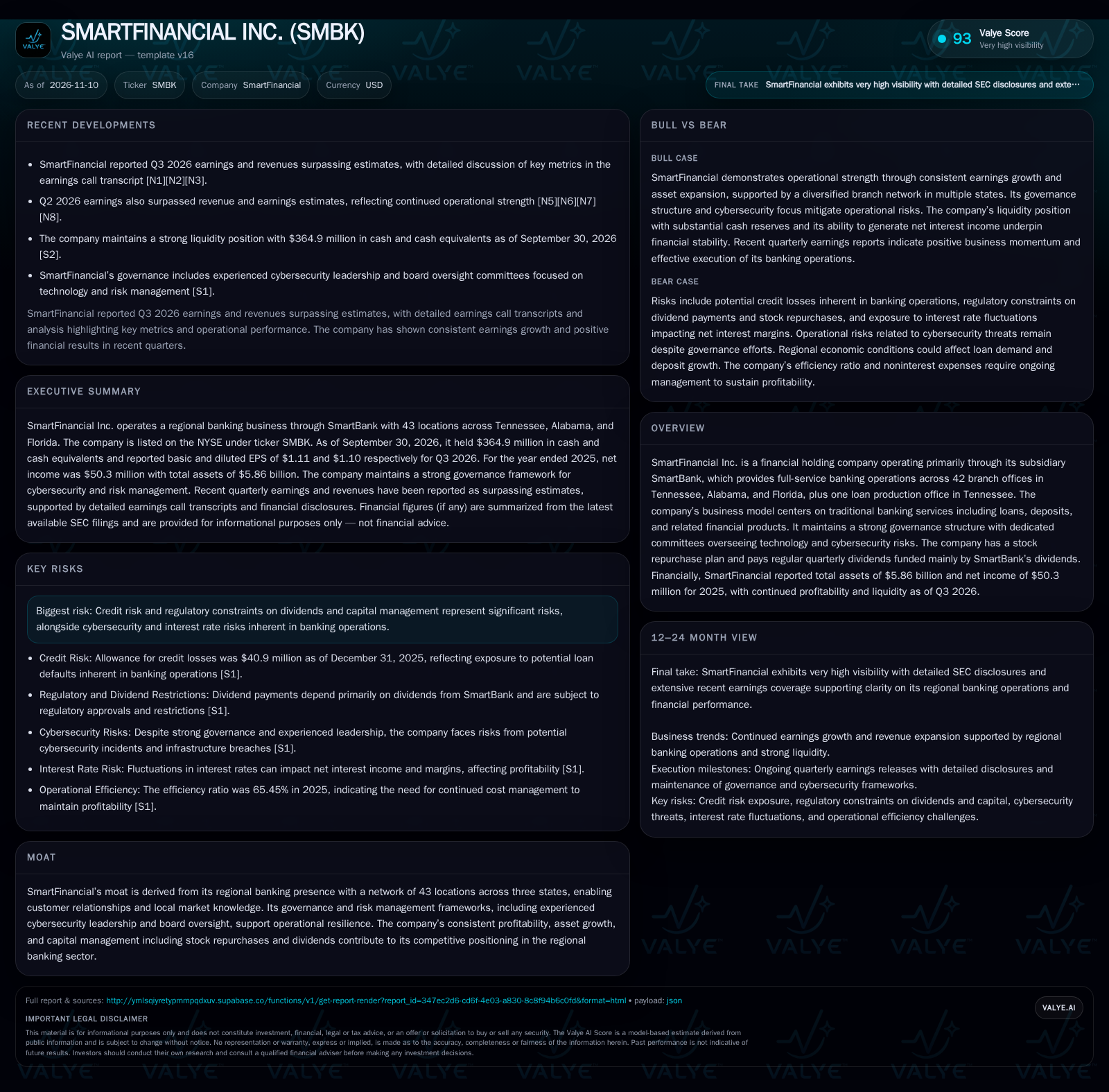
SmartFinancial has delivered consecutive quarters of earnings and revenue beats, underpinned by a $5.86 billion asset base, reported liquidity position, and a multistate branch footprint. Its ability to sustain above-average profitability will depend on managing noninterest expenses, defending net interest margin, and navigating credit and regulatory headwinds. Efficiency improvements and deposit retention are likely to be pivotal for future outperformance. [S1] [S2] [N2] [N3]
SmartFinancial Inc. is navigating a familiar but challenging landscape for regional banks: maintaining earnings momentum while managing expenses, credit quality, and regulatory oversight. Recent quarters have seen the company outpace earnings expectations, supported by a sizeable branch network and a disciplined approach to risk and governance. However, with a relatively high efficiency ratio and persistent sector headwinds—ranging from deposit competition to interest rate volatility—the next leg of SmartFinancial’s growth will likely be defined by its ability to achieve cost discipline, defend its net interest margin, and adapt to evolving regulatory and credit conditions.
Earnings Beats and Asset Scale Set the Stage for Regional Banking Ambitions
SmartFinancial reported that both Q3 and Q2 2026 earnings and revenues exceeded analyst estimates, signaling continued operational strength and momentum. This outperformance comes on the back of a $5.86 billion asset base and a network of 43 locations across Tennessee, Alabama, and Florida as of year-end 2025. The company’s net interest income of $166.1 million in 2025, alongside a net interest margin of 3.29%, underscores its ability to generate core banking profitability in a competitive regional market. Meanwhile, noninterest expense of $131.2 million and an efficiency ratio of 65.45% highlight cost pressures that could constrain future operating leverage. The company maintains a $40.9 million allowance for credit losses, reflecting ongoing risk management focus. [S1] [S2] [N2] [N3]
How Branch Banking Economics and Cost Efficiency Shape Profitability
SmartFinancial’s core business model relies on traditional spread banking: gathering low-cost deposits through its branch network and deploying those funds into loans and leases, which totaled $4.36 billion as of year-end 2025. Net interest income remains the primary revenue driver, with noninterest income (such as fees and service charges) providing a smaller but important supplement. The company’s net interest margin of 3.29% is solid for a regional bank, but future sustainability depends on defending funding costs as deposit competition intensifies and interest rates fluctuate.
A reported efficiency ratio of 65.45% indicates that noninterest expenses—primarily personnel, branch operations, and technology—consume a significant share of revenues. This level is above the sub-60% benchmark often targeted by high-performing regional banks, suggesting limited operating leverage unless cost control or revenue mix shifts materialize. The company reported cash and liquidity metrics for the period; these figures do not by themselves establish operating runway, investment capacity, financial flexibility, or financing capacity.
Fixed costs associated with a physical branch footprint and compliance infrastructure place a premium on achieving sufficient scale and transaction volume per location. The company’s ongoing stock repurchase program and regular dividends signal a commitment to shareholder returns, but these distributions depend on regulatory approval and the underlying earnings capacity of SmartBank.
Branch Density, Local Market Knowledge, and the Challenge from Digital-First Entrants
SmartFinancial’s competitive position is anchored in its regional focus and branch density across three southeastern states. This enables the bank to cultivate customer relationships, local market knowledge, and brand recognition—advantages that can drive deposit stickiness and underwriting discipline. However, these strengths are increasingly tested by digital-first banks and fintechs, which compete aggressively for both deposits and loan customers, often with lower cost structures and differentiated user experiences.
Peer competition includes other regional and community banks serving overlapping geographies, as well as national banks with digital platforms. The company’s ability to maintain deposit share and loan growth will depend on a combination of personalized service, technology adoption, and effective risk management. Notably, SmartFinancial’s governance framework and experienced cybersecurity leadership provide some insulation against operational risks, but do not eliminate the need to invest continually in digital channels and security infrastructure.
Switching costs for core retail and commercial banking customers are moderate, with inertia and relationship factors providing some retention, but not enough to guarantee long-term loyalty if service, rates, or digital offerings lag peers. The real test will be whether SmartFinancial can translate its regional presence into durable advantages as the competitive landscape evolves.
Efficiency Gains and Deposit Growth Could Unlock Superior Returns
A favorable scenario for SmartFinancial would see it leverage its branch network and local market expertise to drive both deposit growth and higher-yielding loan origination, while simultaneously achieving meaningful improvements in its efficiency ratio. This could come from digital process automation, branch rationalization, or targeted cost reductions, allowing more revenue to flow through to the bottom line.
If noninterest expenses are contained or reduced—bringing the efficiency ratio closer to 60%—and net interest margin remains resilient despite competitive and rate pressures, return on equity could rise above the current 9.67% level. Evidence for this scenario would include sustained or accelerating deposit inflows, stable or expanding loan balances, and sequential improvement in operating efficiency reported in future quarters. Outperformance on noninterest income, such as fee-based services, would further validate the upside case.
Confirmation would come from management reporting improved operating leverage, higher pre-provision net revenue, and positive commentary around digital adoption or branch productivity. Falsification would involve continued cost drift, margin compression, or deposit outflows.
Sustained but Measured Growth as Efficiency and Credit Risks Remain Front of Mind
The most plausible path forward for SmartFinancial is one of continued modest growth in loans and deposits, with profitability anchored by stable net interest income and prudent credit management. Operating efficiency is likely to improve only gradually, given the fixed cost base and ongoing investments in technology and compliance.
Net interest margin may face pressure if funding costs rise faster than loan yields, but the company’s diversified deposit base and local market focus could provide some insulation. Credit losses are expected to remain manageable, provided the broader regional economy holds up and underwriting remains disciplined. Dividend payments and share repurchases are likely to continue, though possibly at a measured pace given regulatory and capital requirements.
This scenario would be confirmed by quarterly disclosures showing steady or slightly improving core earnings, stable efficiency ratios, and no material deterioration in asset quality. Falsification would involve a spike in credit losses, sharp margin compression, or evidence of expense growth outpacing revenues.
Margin Pressure, Credit Deterioration, and Regulatory Headwinds Could Stall Progress
A negative scenario could develop if SmartFinancial faces sustained margin compression due to rising deposit costs and heightened competition for loans, while noninterest expenses remain elevated. If regional economic conditions weaken, credit losses could rise above the current allowance, leading to increased provisioning and downward pressure on net income.
Additionally, if the company fails to keep pace with digital innovation or suffers a significant cybersecurity incident, operational risk could crystallize into reputational or financial damage.
Evidence for this downside would include a rising efficiency ratio, sequential declines in net interest margin, upward revisions to credit loss allowances, or regulatory disclosures indicating heightened scrutiny or restrictions. Confirmation could come from management commentary highlighting deposit runoff, adverse credit migration, or unexpected technology-related expenses.
What Will Define SmartFinancial’s Next Phase of Banking Performance?
Quarterly net interest margin trends—deterioration or stability here will be a leading indicator of core profitability.
Sequential changes in the efficiency ratio; improvements would signal successful cost control or revenue leverage.
Deposit growth or attrition across core markets, especially in the face of rising interest rates or digital competition.
Net charge-offs and trends in the allowance for credit losses, as early warning signs of credit quality shifts.
Noninterest income growth or volatility, as increased fee-based revenue would reduce dependence on spread income.
Updates on technology investments, digital adoption rates, or branch optimization initiatives—if disclosed.
Regulatory developments affecting dividend capacity, capital requirements, or risk management expectations.
Cybersecurity incident disclosures or changes in risk posture, especially given the heightened threat environment.
Disclaimer: This is research-only, informational analysis and not investment advice. It may include AI-generated interpretation and general industry context. Always verify important details using primary sources.

Comments