
Nine Energy Service: Navigating Profitability Pressures Amid Shifting Natural Gas Dynamics
The company’s seasoned leadership and operational expertise provide resilience, but the real test lies in translating sector momentum into sustained margin improvement and capital discipline.
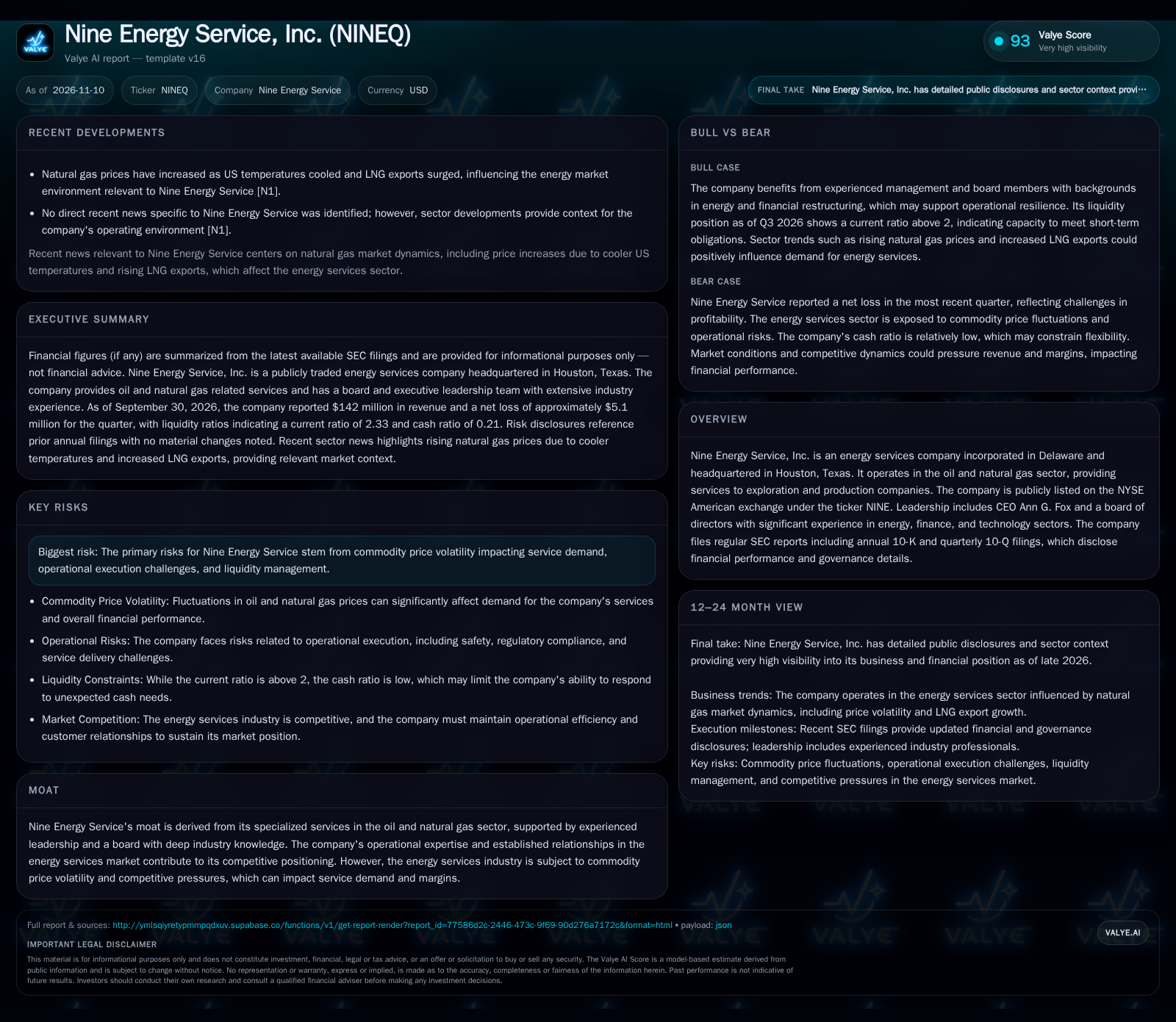
Nine Energy Service reported $142 million in Q3 2026 revenue but remains unprofitable, posting a net loss of $5.08 million.While the company reported liquidity-ratio trends of 2.33, its reported cash ratio highlights ongoing liquidity concerns. With sector conditions potentially improving due to stronger natural gas prices and LNG export growth, the company's ability to convert market opportunity into cash flow and earnings remains central to its investment case. Leadership depth and sector relationships may help, but commodity volatility and competition continue to weigh on the outlook. [S2]
Nine Energy Service, a publicly traded oil and gas services company, finds itself at a crossroads. As of Q3 2026, it is operating in an environment marked by a surge in natural gas prices and rising LNG exports—trends that could drive demand for well intervention and completion services. However, recent financial results show continued net losses and a balance sheet that, while adequate on a current basis, reveals limited near-term cash reserves. The company’s ability to leverage sector momentum, contain costs, and manage liquidity will determine whether it can break out of its loss-making cycle or remain at the mercy of commodity and operating headwinds.
Recent Performance: Revenue Growth Outpaced by Persistent Net Losses
For the quarter ended September 30, 2026, Nine Energy Service posted $142.0 million in revenue but reported a net loss of $5.08 million. This negative bottom line translated into basic and diluted earnings per share of -$0.36. Liquidity metrics present a mixed picture: while current assets of $176.58 million against current liabilities of $75.82 million yield a current ratio of 2.33, the cash and cash equivalents position stands at only $16.05 million, resulting in a cash ratio of 0.21. The company reported cash and liquidity metrics for the period; these figures do not by themselves establish operating runway, investment capacity, financial flexibility, or financing capacity. No material changes were noted in risk disclosures, indicating ongoing exposure to the same set of challenges outlined in previous filings. [S2]
Where Margins Are Made and Lost in Energy Services
Nine Energy Service’s business model is centered on providing specialized well completion, intervention, and production support services to oil and natural gas exploration and production companies. Revenue is fundamentally driven by the volume and complexity of projects, the pricing power tied to sector demand, and the company’s ability to control service delivery costs. Pricing in the energy services sector is highly sensitive to upstream capital spending cycles, which are in turn dictated by commodity prices, particularly oil and natural gas.
Fixed costs—such as equipment, skilled labor, and regulatory compliance—are significant, making operating leverage pronounced. When utilization rates are high, incremental revenue can flow through to the bottom line; conversely, periods of slack demand can quickly erode margins. Nine’s Q3 2026 net loss suggests that either pricing or utilization (or both) are not at levels sufficient to cover the fixed cost base. If sector tailwinds from higher natural gas prices materialize into increased drilling and completion activity, Nine could see both higher volumes and improved pricing. However, the capital intensity and exposure to cyclical downturns remain structural challenges.
Specialization and Relationships Versus Intense Sector Rivalry
Nine Energy Service’s competitive edge derives from its technical expertise, established customer relationships, and leadership bench with deep restructuring and industry experience. In the energy services sector, differentiation often comes from service quality, reliability, safety record, and the ability to deliver integrated solutions across the well lifecycle. However, the industry is crowded with both large diversified services firms and smaller regional specialists, all competing for a share of E&P capital budgets.
Barriers to entry are moderate: while technical know-how and equipment scale matter, customers can and do switch providers based on price and performance. Commodity price volatility further weakens customer lock-in, as E&P companies may rapidly alter spending, renegotiate contracts, or push for price concessions. Nine’s relationships and operational track record may help sustain business through cycles, but pricing power is ultimately constrained by broader market forces and customer bargaining strength.
If Sector Tailwinds Translate to Utilization and Pricing Gains
The most favorable scenario for Nine Energy Service is one where rising natural gas prices and sustained LNG export demand prompt a broad-based recovery in U.S. drilling and completion activity. In this environment, E&P companies would increase spending on well services, driving up both project volumes and service pricing. Nine could benefit disproportionately if its operational expertise, safety record, or integrated offerings allow it to win share from less nimble competitors.
Operating leverage would amplify the impact of higher utilization on margins, potentially swinging the company back to profitability and generating free cash flow to improve the cash ratio. Confirmation of this scenario would require evidence of sequential revenue growth outpacing cost inflation, visible margin expansion in quarterly filings, and increasing cash flow from operations. Conversely, if rising sector activity fails to translate into better pricing or if Nine’s costs rise commensurately, the upside case would be undermined.
Sector Volatility Keeps Recovery Uneven and Margins Under Pressure
The most plausible near-term outcome is a slow, uneven recovery where sector tailwinds provide some support to revenue, but margin pressures persist due to competition and inflation in labor and input costs. Nine Energy Service may be able to stabilize revenues or achieve modest growth as E&P activity responds to improved commodity pricing, but the transmission of sector strength to the company’s bottom line is likely to be partial and delayed.
Ongoing net losses or only marginal profitability would be consistent with this scenario, especially if pricing discipline remains elusive or if competition for contracts intensifies. Any step-change in profitability or a marked improvement in cash generation would challenge the base case.
Commodity Price Reversal or Cost Escalation Deepens Losses
The most adverse scenario for Nine Energy Service involves a reversal in natural gas prices or a cooling of LNG export demand, leading to a sharp pullback in drilling and completion activity. In this environment, E&P companies would slash service spending, intensifying competition and driving down pricing. Fixed costs would become a heavier burden, quickly eroding margins and potentially forcing Nine to operate below cash flow breakeven.
Liquidity would become an acute concern if cash burn accelerates and the company cannot access additional capital or credit facilities. Confirmation of this scenario would come from sequential revenue declines, widening net losses, negative operating cash flow, and further deterioration in the cash ratio. Conversely, resilience in top-line or evidence of cost containment would challenge the downside case.
Signals That Will Define Nine Energy Service’s Recovery Trajectory
Quarterly gross and operating margin trends: Sustained improvement would indicate pricing power or cost control; ongoing compression would signal persistent headwinds.
Cash flow from operations: Positive, growing cash flow would provide a buffer against liquidity risks; continued negative cash flow would intensify pressure.
Revenue growth versus sector activity: Outperformance relative to broader E&P spending trends would suggest market share gains or differentiated offerings.
Utilization rates and average project size (if disclosed): Rising utilization or larger project awards would confirm demand recovery.
Changes in customer concentration (if disclosed): Reduced reliance on a handful of E&P customers would lower revenue risk.
Debt covenant compliance and new financing activity: Any breach or emergency financing would signal deeper liquidity stress.
Sector-level indicators: U.S. natural gas prices, rig count, and LNG export volumes will directly influence Nine’s addressable market.
Disclaimer: This is research-only, informational analysis and not investment advice. It may include AI-generated interpretation and general industry context. Always verify important details using primary sources.

Comments