
Summit Midstream’s Post-Settlement Era: Preferred Dividend Payment, Customer Concentration, and the Midstream Margin Equation
The cited source reports dividend-related activity; that disclosure alone does not establish dividend-policy continuity, management confidence, or a material constraint on capital flexibility. The core question is whether the company’s asset base and volume growth can offset customer concentration and commodity-driven volatility in a capital-intensive, margin-sensitive midstream environment.
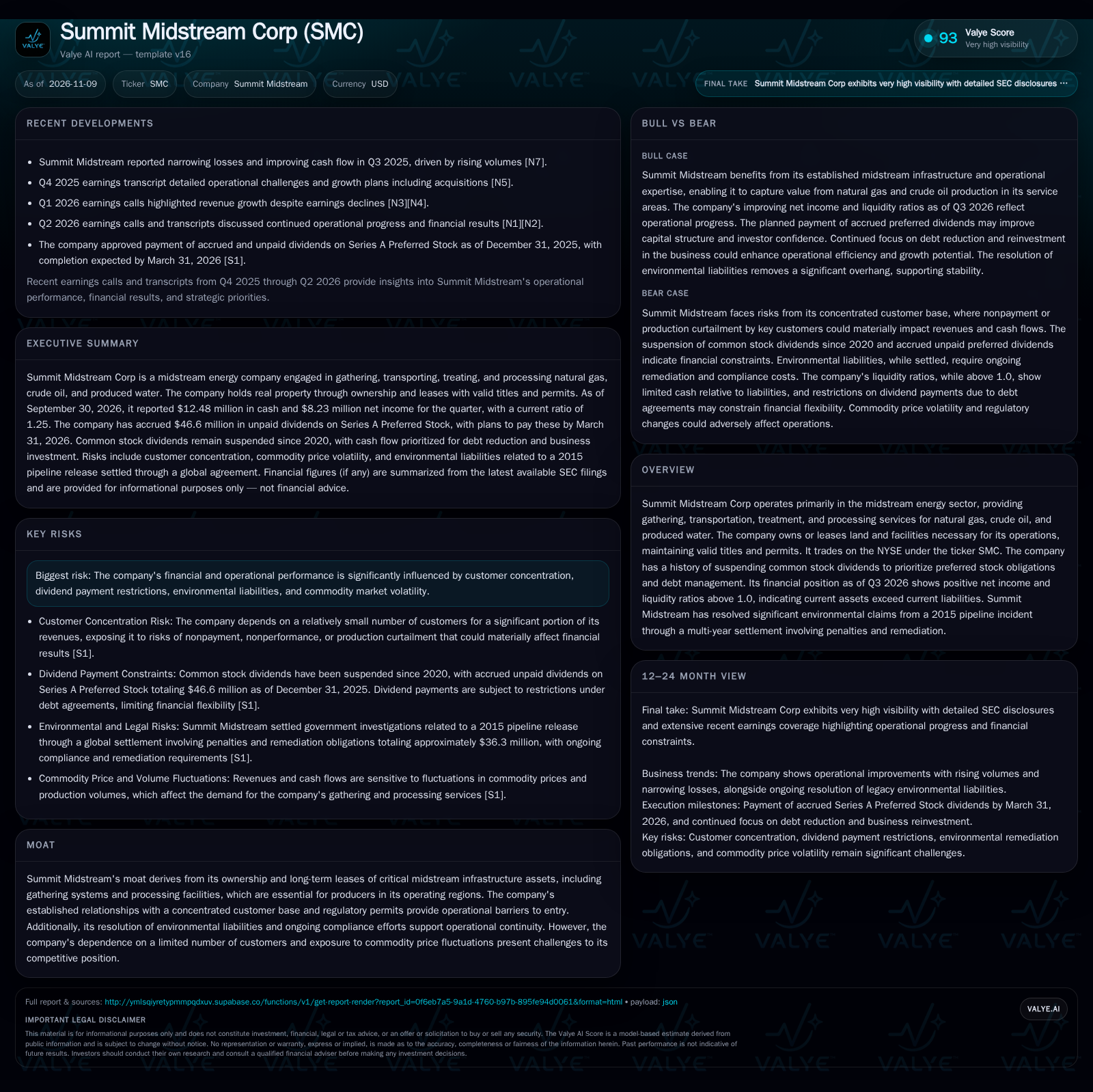
Summit Midstream Corp has returned to profitability and is poised to clear a major preferred dividend overhang by early 2026. However, its business remains exposed to a concentrated customer base, commodity price swings, and continuing environmental obligations. The next phase hinges on Summit’s ability to convert incremental volumes and cost discipline into sustainable free cash flow while reducing leverage and managing structural risks [S1] [S2].
Summit Midstream Corp is at a crossroads typical of midstream operators emerging from a period of financial and operational constraint. With net income turning positive and a plan to eliminate a $46.6 million preferred dividend backlog by March 2026, Summit is poised to reset its capital structure and potentially refocus its balance sheet. Yet, the company’s reliance on a handful of major customers, lingering environmental remediation costs, and exposure to commodity-driven volume swings underscore the persistent fragility of its position. The next 12-18 months will reveal whether operational improvements can translate into durable free cash flow and a more resilient business model—or whether structural risks will continue to limit its strategic options.
Dividend Overhang Resolution and Recent Profitability Shape Summit’s Near-Term Outlook
The company reported cash and liquidity metrics for the period; these figures do not by themselves establish operating runway, investment capacity, financial flexibility, or financing capacity. [S2] The company’s Board has approved payment of $46.6 million in accrued and unpaid Series A Preferred Stock dividends by March 31, 2026, addressing a longstanding capital structure challenge [S1]. Common stock dividends remain suspended, with management prioritizing debt reduction and internal investment over shareholder payouts [S1]. Meanwhile, Summit continues to make payments on a $36.3 million environmental settlement stemming from a 2015 pipeline release, with compliance and remediation obligations extending through 2026 [S1]. These developments point to a company stabilizing after years of constraint, but still navigating significant cash flow commitments and risk exposures.
Volume-Driven Margins, Fixed Infrastructure Costs, and Capital Allocation Tradeoffs
Summit Midstream’s core business—gathering, transporting, treating, and processing natural gas, crude oil, and produced water—relies on high-fixed-cost infrastructure with variable revenue tied to throughput and utilization rates. The fundamental economic engine in midstream is operating leverage: incremental volumes can drive disproportionate EBITDA gains once fixed costs are covered, but declines in volume or contract renegotiations can quickly erode profitability.
Pricing power is often limited, especially for companies with concentrated customer exposure, as large producers may negotiate aggressively or curtail production in response to commodity prices. Summit’s cash generation is thus sensitive to both upstream production trends and commodity price volatility, which determine the volumes moving through its systems. Capital needs remain elevated due to ongoing maintenance, periodic expansion, and regulatory compliance—particularly in light of environmental settlement obligations and the need to maintain asset integrity.
With common dividends suspended and cash flow earmarked for debt reduction and preferred dividend payments, Summit has little immediate flexibility for discretionary growth or shareholder returns. The capital allocation challenge is to balance deleveraging against the need to invest in system reliability and, potentially, selective growth opportunities that could diversify the customer base or expand margins.
Asset Location, Customer Reliance, and the Limits of Midstream Moats
Summit’s competitive positioning is anchored by ownership or long-term leases of pipelines and processing assets in key production basins. These physical assets and their regulatory entitlements create barriers to entry for would-be competitors, as duplicating infrastructure is capital-intensive and subject to permitting hurdles.
However, Summit’s moat is constrained by its dependence on a small number of customers, which can weaken its negotiating leverage and expose it to counterparty risk. In the broader midstream landscape, competitors range from diversified national pipeline operators to private equity-backed regional players, many of whom have greater scale, more diversified customer portfolios, or superior cost structures.
Technological substitution risk remains modest in the short term—pipeline transportation remains the most efficient way to move large volumes of hydrocarbons—but longer-term threats could emerge from decarbonization efforts, electrification, or shifts in energy demand. For now, the company’s local network effects and regulatory entitlements support a degree of stability, but pricing, retention, and renewal terms are likely to remain under pressure absent broader customer or asset diversification.
If Volume Growth and Cost Discipline Translate to Free Cash Flow, Capital Structure Could Reset
The bull case for Summit Midstream is that rising throughput from core customers—driven by stable or improving commodity prices—combines with cost discipline to generate sustained free cash flow. Successful payment of the preferred dividend arrears by March 2026 would resolve a major overhang, potentially unlocking access to lower-cost capital or paving the way for a resumption of common dividends if debt is also reduced.
Incremental volume growth would allow Summit to leverage its fixed asset base, driving margin expansion and improved return on invested capital. If the company can also modestly diversify its customer base—either through organic growth or targeted acquisitions as hinted in recent operational updates [N5]—the risk profile would improve further.
Evidence that would confirm this scenario includes continued net income growth, rising system volumes, visible debt reduction, and a shift from remediation payments toward discretionary capital allocation. Conversely, evidence of persistent customer churn, flat or declining throughput, or an inability to reduce leverage would undermine the upside thesis.
Incremental Progress Amid Enduring Constraints: The Most Plausible Trajectory
The most likely scenario is one of incremental improvement rather than transformation. Summit is expected to complete its preferred dividend payment by early 2026 while maintaining positive net income and reported liquidity position above minimum thresholds. Cash flow will remain tightly managed, with the bulk of free cash applied to remediation, debt service, and essential maintenance.
Operational progress could continue—particularly if commodity prices remain supportive—but customer concentration and limited pricing power will constrain Summit’s ability to capture the full upside of any volume recovery. Common dividends are unlikely to be reinstated in the near term, as potential financial flexibility remains limited and debt metrics will remain a focus for both management and creditors.
Confirmation of this base case would include stable or gradually increasing system volumes, continued profitability, and adherence to debt reduction targets. Falsifying evidence would be a renewed downturn in commodity prices, major customer loss, or unexpected capital needs (such as further environmental or regulatory obligations) that pressure liquidity or force asset sales.
Customer Loss, Commodity Shocks, or Regulatory Surprises Could Quickly Erode Stability
The principal downside risks for Summit are abrupt customer loss or renegotiation, sharp commodity price declines, or new regulatory or environmental shocks. The company’s dependence on a handful of customers means that a single nonpayment, bankruptcy, or production curtailment could significantly reduce volumes and cash flow.
In a severe commodity downturn, upstream operators might reduce output, directly impacting Summit’s revenue base and utilization rates. Additional regulatory or environmental events—such as new pipeline incidents or penalties—could impose further cash obligations or require capital expenditures not currently budgeted.
Evidence confirming a downside scenario would include unexpected volume declines, customer bankruptcies, covenant breaches, or the need to raise dilutive capital. Conversely, stability in customer contracts, no new regulatory issues, and at least flat system volumes would argue against this scenario materializing in the near term.
How to Gauge Whether Summit Midstream’s Structural Risks Are Easing or Deepening
Quarterly system throughput and utilization rates—if disclosed—would help test whether incremental volume growth is materializing or reversing.
Progress on debt reduction and leverage ratios: Are proceeds from operations being consistently applied to deleveraging, and are debt covenants being maintained?
Timing and completion of the Series A Preferred Stock dividend payment by March 31, 2026, will indicate whether the capital structure reset is on track.
Any evidence of new or renewed customer contracts, or disclosure of customer concentration metrics, would clarify the degree of revenue risk.
Updates on environmental remediation progress and any new regulatory or compliance requirements would signal whether legacy risks are truly receding.
Disclosures around capital expenditures versus maintenance needs would illuminate the tradeoff between asset integrity and growth investment.
Board or management commentary on the potential resumption of common dividends or shifts in capital allocation priorities would be an indicator of confidence in underlying cash flow stability.
Disclaimer: This is research-only, informational analysis and not investment advice. It may include AI-generated interpretation and general industry context. Always verify important details using primary sources.

Comments