
Novanta’s Regulatory Complexity and Innovation Cycle: Navigating Cyclical Demand in Advanced Medical Devices
Recent quarters show Novanta delivering modest profitability and maintaining a liquidity cushion amid cyclical end-market demand, inflationary cost pressures, and increasingly complex regulatory and cybersecurity landscapes. The company’s ability to innovate and manage product transitions in regulated sectors remains central to sustaining growth and defending its market position.
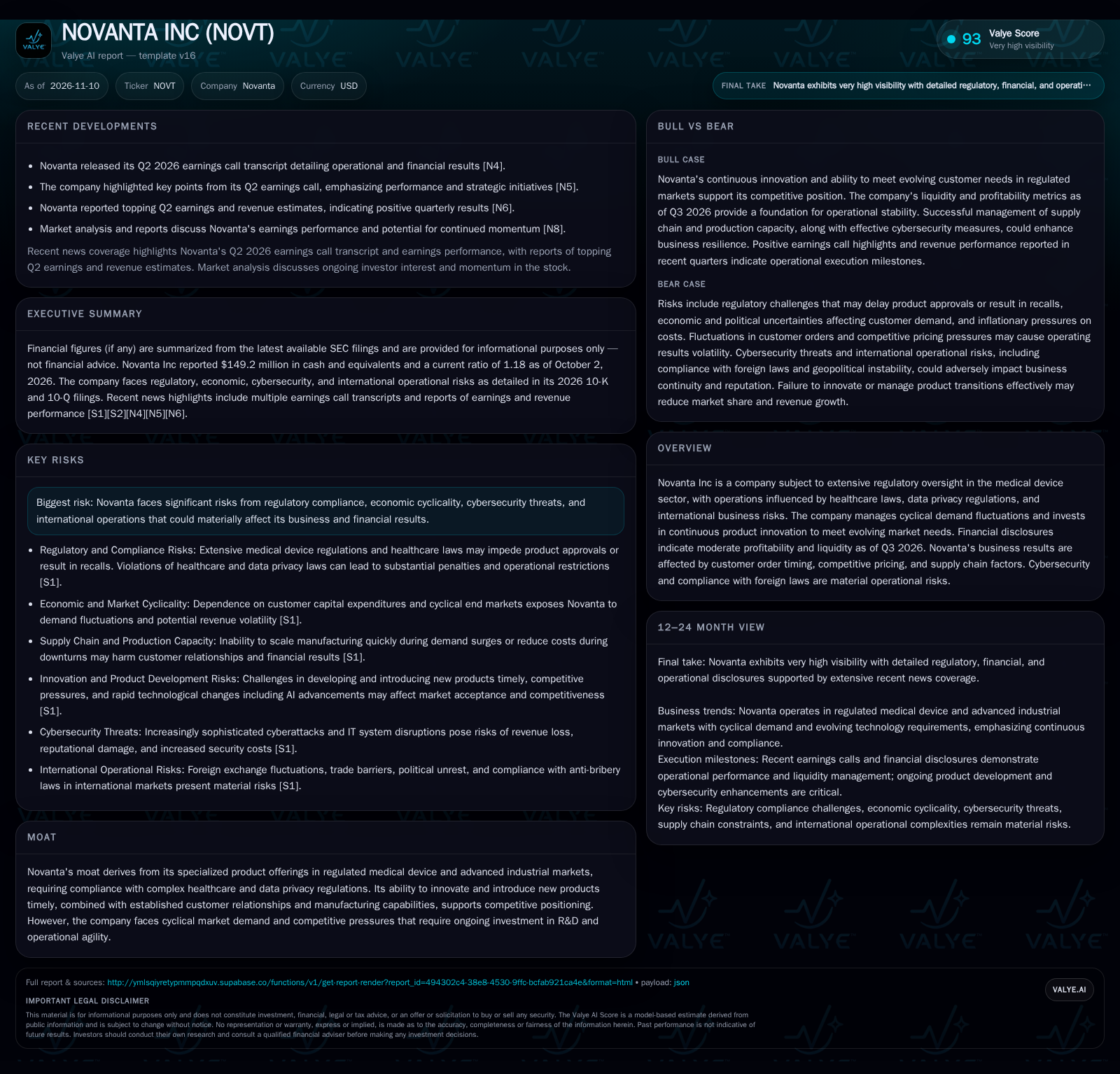
As of Q3 2026, Novanta reported $149.2 million in cash and a current ratio of 1.18, with net income of $2.0 million and EPS of $0.05. The company operates under extensive regulatory and data privacy frameworks, faces inflation-driven cost pressures, and has recently topped Q2 earnings and revenue estimates. Its performance is closely tied to cyclical customer demand, particularly in medical device and advanced industrial markets, and hinges on continuous product innovation and operational agility. [S2] [N4] [N5] [N6]
Novanta Inc’s latest operating snapshot reveals a company balancing modest profitability and liquidity against a backdrop of intense regulatory scrutiny, cyclical end-market demand, and persistent inflationary pressures. With a $149.2 million cash position and $2.0 million in quarterly net income as of October 2026, Novanta’s near-term stability appears intact. Yet the company’s future trajectory will be shaped by its ability to innovate within regulated medical and industrial markets, manage cost pressures, and navigate the increasingly complex risks of global compliance and cybersecurity. Its operational execution—recently evidenced by earnings beats—remains critical as both an opportunity and a vulnerability. [S2] [N6]
Recent Financial Performance and Regulatory Pressures Define Novanta’s Present Position
As of October 2, 2026, Novanta reported $149.2 million in cash and cash equivalents, with current assets of $622.3 million and current liabilities of $528.2 million, yielding a current ratio of 1.18. Net income for the quarter reached $2.0 million, translating to basic and diluted EPS of $0.05. The company reported cash and liquidity metrics for the period; these figures do not by themselves establish operating runway, investment capacity, financial flexibility, or financing capacity. [S2]
The company operates within a heavily regulated environment, subject to U.S. and international healthcare, data privacy, and anti-bribery laws. The regulatory complexity introduces both compliance costs and the risk of product delays, recalls, or legal penalties, directly impacting operational and financial outcomes. [S1]
Recent news coverage highlights that Novanta topped Q2 2026 earnings and revenue estimates, drawing attention to its operational execution and ability to outperform short-term expectations despite challenging conditions. [N6]
Revenue Drivers and Cost Structure in a Cyclical, Regulated Industry
Novanta’s revenue is tied to the sale of specialized products and solutions primarily for medical device and advanced industrial markets. These sectors are characterized by cyclical capital spending patterns, meaning that customer order timing and macroeconomic health can drive significant swings in quarterly results. [S1]
Pricing power is constrained by competitive pressures and customer sensitivity, particularly in inflationary environments. The company has responded to rising material and component costs by raising prices, but the extent to which these increases are accepted by customers is uncertain and may not fully offset input cost inflation. [S1] This dynamic can compress margins if costs outpace pricing actions.
The business model likely involves a mix of higher-margin proprietary systems and lower-margin components or consumables, although the precise revenue breakdown and contract structure are not disclosed. Fixed costs related to regulatory compliance, R&D, and manufacturing infrastructure mean that operating leverage can be high during periods of strong demand—but also expose the company to downside risk during downturns if costs cannot be flexed quickly.
Defending Share in Regulated Markets: Innovation, Compliance, and Customer Integration
Novanta’s competitive position is shaped by several reinforcing factors: specialized product offerings tailored for regulated medical and industrial applications, a track record of compliance with complex healthcare and data privacy requirements, and established customer relationships. These attributes create moderate switching frictions, as customers in regulated industries tend to prefer proven suppliers who can reliably navigate approval and certification processes.
However, the moat is partially offset by cyclical demand, rapid technological change (including the acceleration of AI-driven innovation), and the presence of both large diversified industrial companies and niche specialists targeting similar end markets. The need to continuously invest in R&D and to manage product transitions becomes a cost of maintaining relevance and defending share.
Substitution risk exists both from direct competitors and from technology shifts—such as new modalities in medical imaging or automation—that could erode demand for legacy products. The company’s ability to integrate new features, comply with evolving regulations, and offer seamless customer support remain key differentiators, but could be challenged if larger players accelerate their own innovation cycles or regulatory environments shift abruptly.
If Innovation Outpaces Inflation and Demand Cycles, Margin Expansion Is Plausible
A favorable outcome for Novanta would involve successful product launches that achieve rapid market acceptance, enabling the company to capture share in growing segments of the medical and industrial technology landscape. If the company’s R&D investments lead to differentiated solutions that command premium pricing or create new recurring revenue streams (for example, through service or software add-ons), gross margins could expand.
This scenario also assumes that Novanta’s price increases are largely accepted by customers, offsetting input cost inflation and supporting operating leverage as fixed regulatory and R&D costs are spread over a larger revenue base. Additional upside could come from smooth execution on supply chain scaling—allowing Novanta to capitalize on surges in demand without material disruptions.
Evidence that would confirm this scenario includes: sustained revenue and margin expansion in quarterly filings, positive customer adoption metrics for new products (if disclosed), and continued outperformance versus consensus earnings estimates. Watch for disclosures on new contract wins, expansion into adjacent markets, and management commentary on successful product transitions.
Navigating Cyclical Volatility with Incremental Innovation and Cost Management
The most plausible trajectory for Novanta is continued exposure to cyclical swings in end-market demand, particularly from medical device manufacturers and industrial customers. Revenue and operating results are likely to fluctuate quarter-to-quarter based on customer order timing, supply chain dynamics, and the pace of product innovation.
Incremental product improvements and moderate price increases may help offset some cost inflation, but margin expansion is likely to be limited by competitive pressures and customer resistance to higher prices.
Confirmation of this scenario would come from relatively stable but unexceptional financial results, ongoing references to supply chain management and incremental R&D progress in earnings calls, and a lack of major step-change announcements in product or market strategy. A useful metric would be the trajectory of gross and operating margins over several quarters, as well as commentary on order pipeline health.
Regulatory Disruption or Demand Shock Could Trigger Margin Erosion and Strategic Retrenchment
A negative scenario would be triggered by a major regulatory setback—such as a product recall, failed certification, or legal action under healthcare or data privacy laws—that disrupts sales and imposes significant compliance costs. Alternatively, a sharp and prolonged contraction in customer capital expenditures (for example, due to macroeconomic recession or industry-specific downturn) could expose the company’s fixed cost base and compress margins.
If customers resist further price increases or switch to alternative suppliers/technologies, Novanta could face both revenue declines and the need for price concessions, further pressuring profitability. Cybersecurity incidents or international operational disruptions could amplify downside risks by damaging customer trust and triggering additional compliance or remediation expenses.
Evidence supporting this scenario would include sudden drops in revenue or margins, explicit disclosure of regulatory investigations or product withdrawals, and management guidance cuts. Watch for spikes in compliance or legal costs, negative order trends, and any indication of customer attrition or lost contracts.
Factors That Will Determine Whether Novanta Can Sustain Its Strategic Edge
Quarterly gross and operating margin trends—improving, stable, or declining margins would test whether pricing actions and innovation are offsetting cost and competitive pressures (if disclosed).
New product launch cadence and adoption metrics—frequency of launches and customer uptake would indicate whether R&D is translating into commercial success (if disclosed).
Order pipeline and backlog health—changes in order flow or backlog size would help gauge end-market demand visibility (if disclosed).
Incidence of regulatory or compliance events—any product recalls, failed certifications, or legal actions would materially alter the risk profile.
Customer concentration and retention—shifts in major customer relationships or evidence of churn would be significant for revenue stability (if disclosed).
Supply chain disruptions or cost inflation—material changes in input cost trends or supplier reliability could impact execution.
Cybersecurity breach or IT system incident—any such event would test operational resilience and could trigger both direct and reputational impacts.
International revenue mix and currency impact—exposure to foreign exchange volatility or geopolitical disruptions could influence reported results (if disclosed).
Disclaimer: This is research-only, informational analysis and not investment advice. It may include AI-generated interpretation and general industry context. Always verify important details using primary sources.

Comments