
Camber Energy’s Patent Portfolio: Commercialization Hurdles and the Stakes of Liquidity Constraint
Camber Energy holds patented and exclusive rights in medical waste treatment, electrical grid safety, and carbon capture systems, aiming to leverage these for future growth.
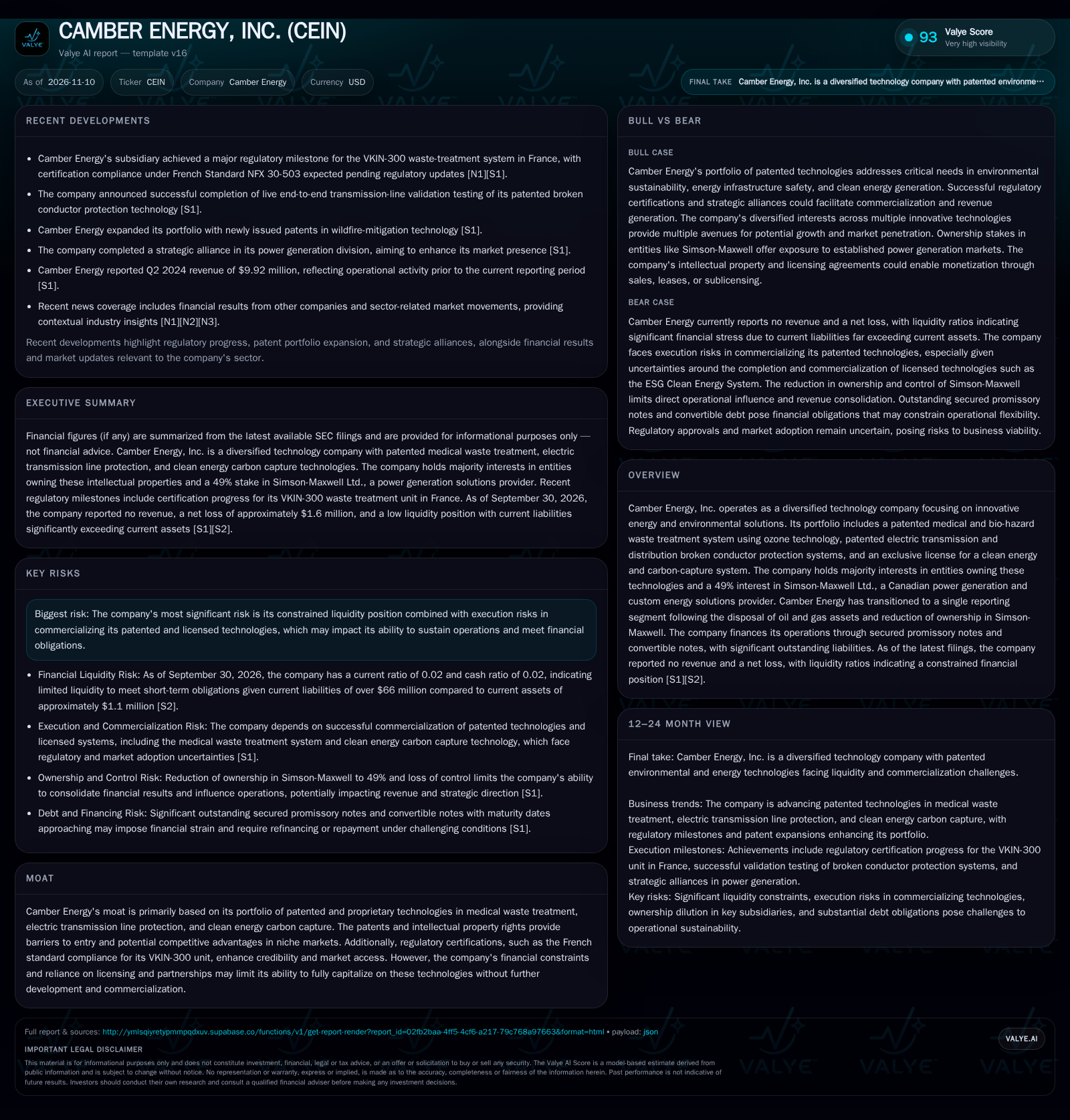
Camber Energy holds patented and exclusive rights in medical waste treatment, electrical grid safety, and carbon capture systems, aiming to leverage these for future growth. Execution risk is high: regulatory milestones in France and strategic alliances may enable future commercialization, but the company’s financial constraints and reduced control over key assets like Simson-Maxwell pose existential challenges. The core question is whether Camber can monetize its intellectual property before liquidity runs out. [S1] [S2]
Camber Energy, Inc. has amassed an array of patented and proprietary technologies spanning ozone-based medical waste treatment, electrical grid safety, and carbon capture. With regulatory advances in France and newly issued patents in wildfire mitigation, the company is positioning itself as a provider of innovative environmental and energy solutions. The company’s future now hinges on converting intellectual property into marketable products before its liquidity evaporates—a race against time complicated by a loss of control over key subsidiaries and heavy debt obligations. [S1] [S2]
Liquidity Crisis and Commercialization Uncertainty Define Camber’s Present
The most material current facts are: (1) Camber Energy reported zero revenue and a net loss of approximately $1.6 million for the period ending September 30, 2026; (2) the company’s cash and equivalents stood at roughly $1.17 million, but current liabilities exceeded $66 million, yielding a current ratio of 0.02; (3) Camber no longer controls Simson-Maxwell, now holding a 49% interest and accounting for it at fair value; (4) the VKIN-300 medical waste pre-treatment system passed French acceptance review, with formal certification pending. [S1] [S2]
These facts matter because they frame a company with potentially valuable intellectual property but a critical liquidity shortfall, no revenue, and diminished influence over its power generation affiliate. The regulatory milestone in France could open new markets, but without revenue or a credible path to funding, Camber’s ability to capitalize on these opportunities is severely constrained.
Monetization Mechanisms: Intellectual Property, Licensing, and the Economics of Scale
Camber’s business model is centered on monetizing patented technology via direct sales, licensing, or strategic alliances. With the VKIN-300, revenue could plausibly come from unit sales, equipment leasing, or recurring service contracts—if the product achieves regulatory approval and customer adoption. The electric grid protection and carbon capture technologies may follow a similar model, where upfront license fees, royalties, or recurring service/maintenance contracts drive income.
However, the company currently reports no revenue, suggesting that none of these models have yet been commercialized at scale. Fixed costs related to R&D, compliance, and debt servicing appear to dominate the cost structure, while variable costs would only become relevant if product sales or licensing deals commence. The company’s reliance on secured and convertible debt to fund operations indicates negative operating leverage: each dollar spent increases losses unless and until commercialization occurs.
The capital needs for regulatory clearance, manufacturing, and go-to-market execution are significant, especially in medical and utility sectors with long adoption cycles. Without external capital or rapid licensing wins, the business is structurally vulnerable to cash shortfalls.
Patent Barriers Versus Execution Gaps in Fragmented Niche Markets
Camber’s main competitive advantage is its portfolio of granted and pending patents in medical waste treatment, grid safety, and carbon capture. These patents and regulatory milestones create theoretical barriers to entry in niche markets, particularly for the VKIN-300 system in the EU and proprietary grid protection technology for North American utilities.
However, actual competitive strength depends on the ability to commercialize. In medical waste treatment, competition includes established autoclave, incineration, and alternative disinfection providers—many with entrenched hospital and municipal contracts. For grid protection, large incumbents and specialty engineering firms offer both competing and substitute safety systems. The carbon capture space is crowded with well-funded players and diverse technological approaches. Camber’s limited financial resources and lack of commercial track record may put it at a disadvantage in securing contracts, scaling production, and supporting customers, even if its intellectual property is strong.
The reduction in Simson-Maxwell ownership diminishes access to an established customer base and recurring power solutions revenue, further weakening Camber’s competitive position in energy markets.
If Regulatory Milestones Unlock Commercial Deals, Revenue and Funding Could Follow
A favorable scenario would see Camber leveraging its recent regulatory progress in France to secure initial sales or licensing agreements for the VKIN-300 system, potentially opening the door to broader EU adoption. Simultaneously, successful demonstrations of its grid protection and carbon capture technologies could attract utility or industrial partners, leading to upfront licensing payments or pilot deployments.
This scenario would be confirmed by announcements of commercial contracts, licensing deals, or customer-funded pilot projects, along with an increase in reported revenues. Additional validation would come from new equity or strategic funding—perhaps from a partner incentivized by Camber’s exclusive IP rights. Evidence falsifying this scenario would be another quarter of zero revenue, loss of exclusivity, or withdrawal of regulatory approval.
Technological Progress Continues, But Revenue Lags and Liquidity Remains the Bottleneck
The most plausible path is that Camber continues to achieve technical and regulatory milestones—such as additional certifications or patent issuances—without translating these into immediate commercial traction. The company may announce further alliances or pilot demonstrations, but revenue generation remains delayed due to long sales cycles, regulatory hurdles, and customer skepticism toward new, unproven providers.
This scenario would be confirmed by ongoing news of regulatory or technical achievements, but continued reporting of zero or negligible revenue and persistent net losses. Additional debt or dilutive equity financing may be required to extend runway, but the ability to raise capital under such strained conditions could prove increasingly difficult. Falsification would come from a material contract or recurring revenue, or from a liquidity crisis forcing asset sales or bankruptcy protection.
Liquidity Exhaustion Forces Asset Sales or Bankruptcy Before Commercialization
An adverse scenario sees Camber unable to secure commercial contracts or additional funding before its limited cash resources are depleted. Mounting debt obligations and lack of revenue could force the company to sell key intellectual property or subsidiary stakes at distressed prices—or to file for bankruptcy protection.
Confirmation would come from missed debt payments, asset fire sales, or bankruptcy filings. Additional warning signs would include resignation of key personnel, legal actions from creditors, or the loss of regulatory approvals. Falsification would require the unexpected announcement of a significant funding round or a commercial breakthrough that materially improves liquidity and future prospects.
Milestones That Will Determine Whether Camber’s IP Can Be Monetized in Time
Announcement of the first commercial sale, licensing agreement, or recurring service contract related to the VKIN-300 or other core technologies would be a critical inflection point.
Updates on the status and timing of formal certification for the VKIN-300 system in France and entry into other regulated markets.
Any reported revenue, even if modest, would indicate progress in commercialization and market acceptance.
Changes in the company’s current liability structure, including refinancing, debt restructuring, or asset-backed borrowing, would inform solvency risk.
If disclosed, customer pipeline metrics—such as pilot projects, letters of intent, or signed MOUs—would help test the thesis of near-term commercialization.
Announcements of further reductions in ownership or outright sale of stakes in subsidiaries like Simson-Maxwell could signal distress or a shift in strategic focus.
Evidence of additional patent issuances or regulatory milestones, while positive for long-term optionality, would need to be weighed against immediate funding and revenue needs.
Disclaimer: This is research-only, informational analysis and not investment advice. It may include AI-generated interpretation and general industry context. Always verify important details using primary sources.

Comments