
Ares Commercial Real Estate: Profitability, Disclosure Gaps, and the Real Stakes of CRE Market Cycles
Recent positive net income and active investor communications set a baseline for Ares Commercial Real Estate Corp, but limited disclosure on sector specifics and capital structure complicates a clear view of risk, resilience, and upside. The company’s ability to navigate commercial real estate headwinds will hinge on loan performance, funding access, and portfolio management—none of which are fully illuminated in current filings.
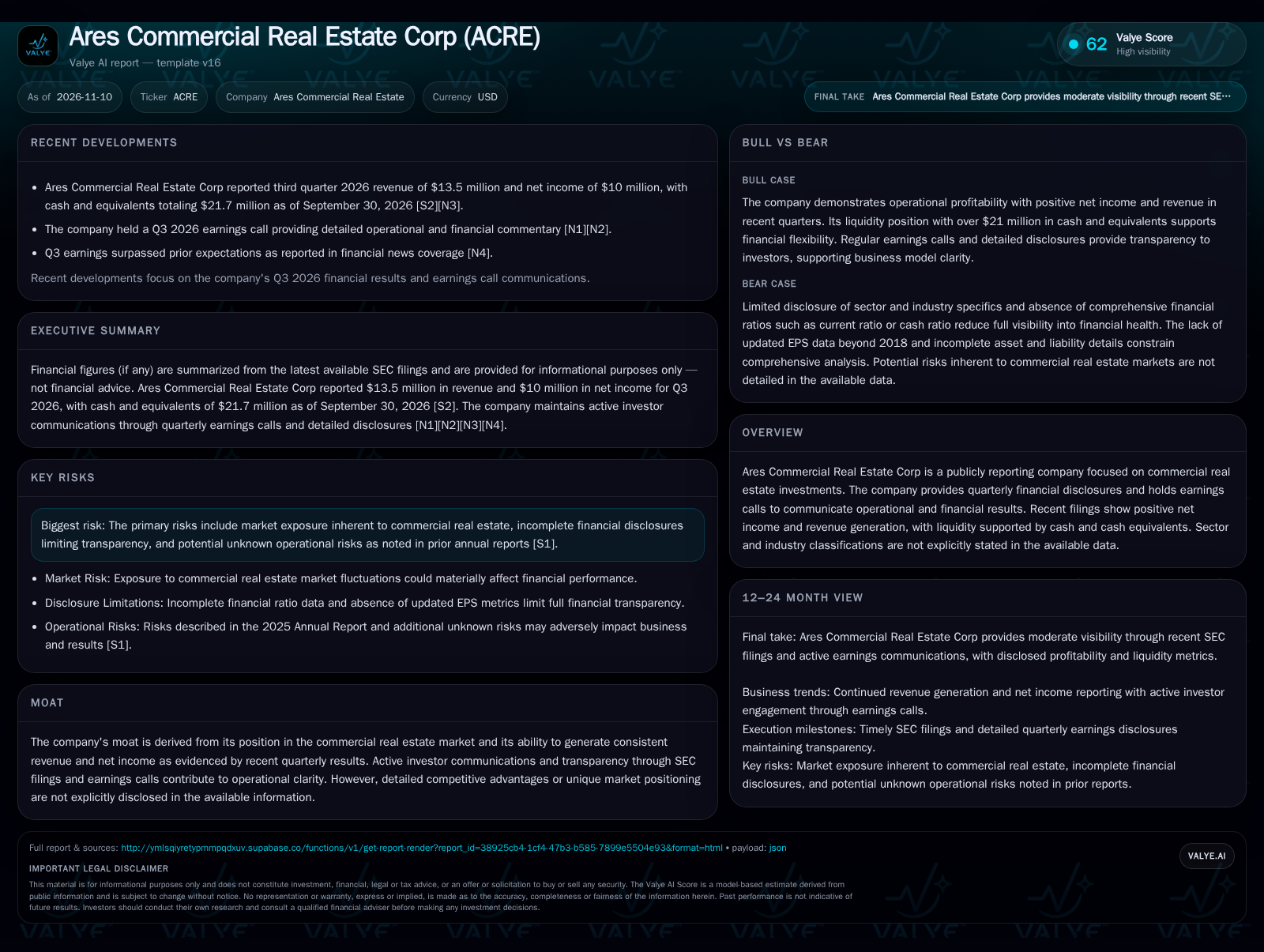
Ares Commercial Real Estate Corp reported $13.5 million in Q3 2026 revenue and $10 million in net income, signaling operational profitability and ongoing business activity [S2]. However, the lack of detailed disclosures on portfolio composition, leverage, and sector exposures leaves open questions about risk and resilience in a volatile CRE market. The company’s future will depend on how it manages credit quality, refinancing, and capital allocation as market cycles evolve.
While headline numbers suggest a stable business, the absence of granular disclosures on sector mix, leverage, and portfolio performance leaves the true resilience of Ares’s business model an open question. As commercial real estate markets remain in flux, the company’s ability to manage credit quality, funding, and asset values will determine whether recent profitability is sustainable or fleeting.
Recent Results Highlight Profitability, But Leave Risk Exposures Unclear
Ares Commercial Real Estate Corp reported $13.5 million in revenue and $10 million in net income for the third quarter of 2026, with cash and equivalents of $21.7 million as of September 30, 2026 [S2]. These figures indicate operational profitability and suggest ongoing business activity in a challenging commercial real estate environment. The company also continues to hold regular earnings calls and provide detailed financial communication to investors [N1] [N2] [N3] [N4]. However, the absence of updated EPS beyond 2018 and limited disclosure on asset mix, debt levels, and portfolio composition mean that current risk exposures and resilience to market volatility remain opaque. As a result, while headline profitability is positive, the durability and quality of those earnings are difficult to assess with the available information.
How Ares Commercial Real Estate Could Generate Sustainable Returns
As a commercial real estate lender or investor, Ares Commercial Real Estate Corp’s core economics likely depend on net interest margin, credit performance, and the ability to efficiently deploy capital. The company’s revenue is plausibly derived from interest and fee income on a portfolio of commercial mortgage loans or real estate-related assets, while expenses would include funding costs, potential credit losses, and operating overhead. Operating leverage is typically present in CRE finance platforms: higher loan volumes or asset balances can drive incremental revenue with a relatively stable cost base, but losses or write-downs can quickly erode profitability.
Without details on loan yields, funding sources, or leverage, it is unclear whether recent profitability reflects recurring core spreads, one-time gains, or unusually low credit costs. The absence of current ratio or cash ratio disclosures limits visibility into short-term liquidity management. Capital needs for CRE finance companies are typically driven by loan growth, refinancing obligations, and covenant requirements, any of which could pressure liquidity if market conditions deteriorate. The real test for Ares will be its ability to maintain asset quality and funding access as CRE cycles evolve.
Commercial Real Estate Lenders Face Intense Competition and Structural Shifts
Ares Commercial Real Estate operates in a highly competitive market, facing both traditional banks and non-bank lenders as peers. Larger institutions may benefit from lower-cost funding and broader origination platforms, while alternative lenders often target niches or higher-yielding segments. The company’s affiliation with the Ares brand could provide sourcing advantages or capital markets access, but these are not detailed in the available disclosures.
In the current environment, competition is shaped by tightening credit standards, rising rates, and increased scrutiny of CRE collateral—especially in sectors like office and retail. Substitution risk is elevated as borrowers seek alternative capital sources, and asset values are vulnerable to broader economic shifts. Without clear disclosure of portfolio mix, loan-to-value ratios, or duration, it is difficult to assess whether Ares’s portfolio is positioned defensively or exposed to stressed segments. The company’s ability to differentiate will depend on underwriting discipline, cost of capital, and risk management—all of which remain largely untested by current filings.
If Credit Quality Holds and Capital Remains Accessible, Earnings Momentum Could Build
The most favorable outcome for Ares Commercial Real Estate would result from stable or improving credit performance across its loan portfolio, coupled with continued access to attractively priced funding. In this scenario, core net interest margins remain intact, credit losses are minimal, and the company is able to deploy capital into new loans at attractive risk-adjusted yields. Portfolio growth or rotation into higher-yielding assets could further boost revenue and net income.
Confirmation of this scenario would require disclosure of low non-performing loan ratios, stable or growing book value per share, and evidence of new loan originations at healthy spreads. Continued positive earnings surprises, as noted in recent news coverage [N4], and transparent capital allocation updates would also support the bull thesis. Falsification would come from a spike in credit losses, a decline in net interest margin, or signals that funding costs are eroding profitability.
Core Earnings Persist, But Market Volatility and Disclosure Gaps Limit Visibility
The most plausible trajectory is that Ares maintains positive net income and revenue generation, but faces intermittent headwinds from market volatility, refinancing needs, and sector-specific risks. The company continues to communicate headline results through earnings calls and filings, but incomplete disclosure on leverage, credit quality, and portfolio mix leaves investors with partial information.
In this base case, earnings remain positive but may fluctuate as asset values and funding conditions shift. The company’s ability to sustain profitability will depend on prudent credit management and opportunistic capital deployment, but the absence of detailed KPIs or risk metrics means that investors are likely to apply a discount for opacity. Ongoing reporting of net income and regular financial communication would confirm this scenario, while sudden negative surprises—such as credit losses or funding constraints—would challenge it.
Stress in CRE Markets or Funding Could Quickly Erode Profitability
Ares Commercial Real Estate’s earnings could come under pressure if commercial real estate market conditions deteriorate, leading to higher loan defaults, asset write-downs, or funding stress. In a downside scenario, rising vacancies, declining collateral values, or sector-specific shocks (such as office or retail distress) could drive up credit losses and reduce net interest income. Simultaneously, tighter credit markets could increase funding costs or restrict new loan origination, further compressing margins.
Downside confirmation would include a spike in non-performing loans (if disclosed), a sharp drop in net income or revenue, and negative revisions to book value. Any inability to refinance liabilities or access new funding would also be a clear warning sign. The lack of granular disclosure on these metrics exacerbates the risk, as problems could emerge before investors have time to react.
Testing the Resilience of Ares Commercial Real Estate’s Earnings Model
Loan portfolio composition by sector, geography, and risk rating—if disclosed—would clarify exposure to stressed CRE segments.
Non-performing loan ratio and credit loss provisions are critical to assess underlying asset quality and risk management.
Net interest margin trends, if provided, would help determine whether profitability is sustainable or eroding.
Changes in book value per share and tangible equity would signal the impact of market cycles on capital preservation.
Details on funding sources, maturity ladders, and cost of capital would illuminate refinancing and liquidity risk.
Disclosure of loan origination volumes and pipeline would show whether the company is maintaining growth or retrenching.
Management commentary on market outlook, underwriting standards, and risk appetite would help test scenario assumptions.
Disclaimer: This is research-only, informational analysis and not investment advice. It may include AI-generated interpretation and general industry context. Always verify important details using primary sources.

Comments