
OPAL Fuels: RNG Expansion, Attribute Volatility, and the Stakes of Capital Access
OPAL Fuels delivers strong RNG and fuel station growth, but faces margin and regulatory headwinds as renewable power revenues decline and management transitions loom. The company’s ability to monetize environmental attributes and secure funding will shape its resilience in a competitive, policy-driven sector.
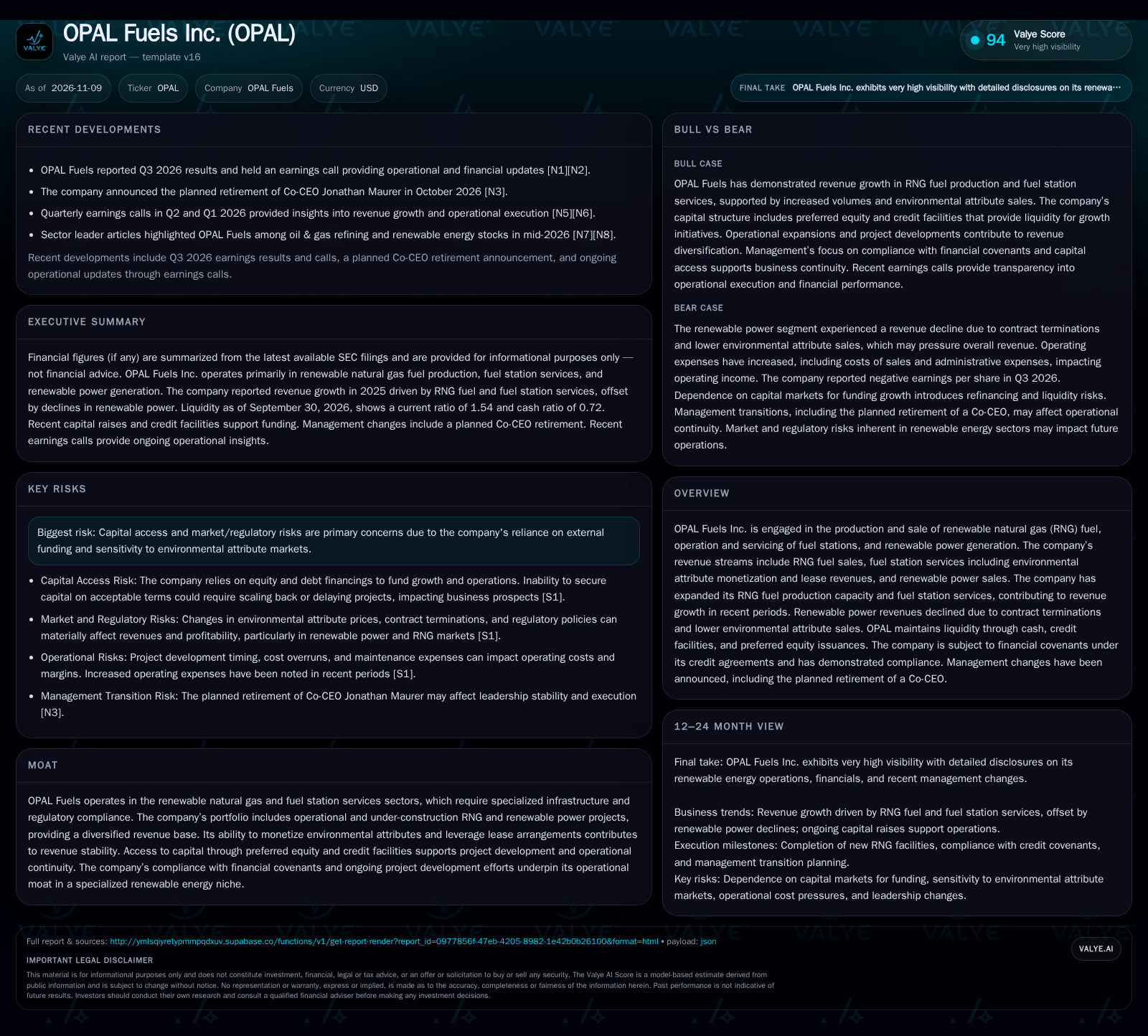
OPAL Fuels’ revenue growth in RNG fuel and fuel station services is offset by a sharp decline in renewable power and rising operating expenses. The business relies on capital markets and environmental attribute pricing, making execution and regulatory stability critical. Management changes and ongoing project development will test the company’s ability to sustain momentum and operational discipline over the coming year. [S1] [S2] [N1] [N3]
OPAL Fuels has posted robust growth in renewable natural gas (RNG) fuel and fuel station services, even as its renewable power segment contracts sharply. The company’s model—monetizing environmental attributes and expanding RNG supply—depends on volatile policy and market conditions, as well as continued access to external capital. With operating expenses rising faster than revenue and a leadership transition on the horizon, OPAL’s next phase will hinge on its ability to manage cost discipline, regulatory change, and the capital intensity of new project development. The company’s trajectory over the next year will reveal whether its operational breadth provides resilience or exposes it to heightened financial risk. [S1] [S2] [N3]
Recent Performance: Growth, Revenue Mix Shifts, and Near-Term Challenges
OPAL Fuels reported $348.98 million in revenue for 2025, up 16% from the prior year, driven primarily by a 15% increase in RNG fuel revenue and a 29% jump in fuel station services. RNG fuel volumes rose to 4.9 million MMBtus from 3.8 million, reflecting successful project ramp-ups and expanded capacity. However, renewable power revenues declined 27% to $32.77 million, mainly due to a terminated carbon credit contract and lower environmental attribute sales, highlighting the volatility inherent in attribute-dependent segments. Operating expenses increased 23%, outpacing revenue growth and pressuring margins, while Q3 2026 earnings per share turned negative ($0.03), reflecting these cost and mix headwinds. The company announced the planned retirement of Co-CEO Jonathan Maurer, introducing uncertainty around leadership continuity during a pivotal period. [S1] [S2] [N3]
RNG-Driven Revenue, Attribute Monetization, and the Cost Structure Dilemma
OPAL Fuels’ economics center on producing renewable natural gas from waste sources, selling RNG fuel to transportation and utility markets, and monetizing environmental attributes such as Renewable Identification Numbers (RINs), Low Carbon Fuel Standard (LCFS) credits, and carbon credits. The company also operates and services RNG fueling stations, generating revenue from construction, leasing, and environmental attribute sales. These segments are capital-intensive: new RNG facilities require upfront investment and long development cycles, while fuel station services demand ongoing maintenance and construction expertise.
RNG projects benefit from scale as marginal operating costs drop with higher throughput, but project-level economics are highly sensitive to environmental attribute pricing and contract stability. The fuel station segment provides recurring revenue through leases and operations, but construction revenue can be lumpy. Fixed costs—including SG&A and project development—have risen, and variable costs (feedstock, logistics, compliance) can fluctuate with energy and labor markets. The sharp decline in renewable power revenue underscores OPAL’s exposure to contract renewal risk and attribute-price volatility.
On the funding side, OPAL relies on a mix of cash, revolving credit, and preferred equity. As of September 2026, liquidity is supported by $86 million in cash, a $450 million credit facility (with $128.4 million drawn), and a new $180 million preferred equity commitment ($120 million issued). This access allows continued project development but introduces sensitivity to capital market conditions and covenant compliance. [S1] [S2]
Specialized Infrastructure, Regulatory Moats, and Evolving Sector Dynamics
OPAL Fuels operates in a niche segment of the renewable energy market, where barriers to entry include permitting, feedstock sourcing, and the technical complexity of RNG production and fuel station operation. The company’s ability to monetize environmental attributes and manage complex regulatory compliance requirements provides some insulation from undifferentiated commodity competition, but also exposes it to shifts in policy and credit pricing.
Competitors span vertically integrated energy firms, pure-play RNG developers, and alternative clean-fuel technology providers (such as hydrogen or electrification solutions). The primary competitive advantage for OPAL lies in its portfolio of operational and in-development RNG projects, established customer relationships, and demonstrated ability to secure funding for growth initiatives. However, the decline in renewable power revenue and rising costs suggest that OPAL’s moat is contingent on maintaining project execution discipline, attribute monetization, and continued regulatory support for RNG as a decarbonization lever.
Switching frictions are moderate: customers reliant on RNG for compliance or decarbonization may be sticky in the short term, but alternative fuels and evolving policy could erode this advantage over time.
What Sustained RNG Volume and Attribute Premiums Could Unlock
A favorable scenario for OPAL Fuels would involve continued expansion of RNG production capacity, strong demand from transportation and utility end-markets, and stable or rising environmental attribute prices. If the company can consistently ramp new projects, maintain high utilization at existing sites, and secure long-term offtake agreements, it could drive further revenue growth and operating leverage.
Upside would be confirmed by sequential increases in RNG fuel volumes, stable or improving margins despite rising costs, and resilience in environmental attribute pricing. Evidence of new long-term contracts, successful project completions, and regulatory tailwinds (such as enhanced LCFS or RFS mandates) would further validate the thesis. Additionally, if management transitions are handled seamlessly and capital is deployed efficiently from recent preferred equity and credit lines, OPAL could outpace peers in project delivery and cash flow generation.
Managing Growth: Capital Intensity and Margin Headwinds Define the Middle Ground
The most plausible scenario is that OPAL Fuels sustains moderate RNG volume growth and continued expansion of fuel station services, but faces persistent margin pressure from rising operating expenses and volatile environmental attribute pricing. The renewable power segment may stabilize, but is unlikely to return to prior revenue levels unless new contracts or regulatory changes emerge.
This outcome would be characterized by steady but uneven revenue growth, periodic swings in reported profitability tied to attribute markets, and ongoing reliance on capital markets for project funding. Management’s ability to control costs, execute on new project timelines, and navigate the leadership transition will be key confirming factors. Conversely, margin compression, missed project milestones, or tightening credit could signal a less favorable trajectory.
If Environmental Attribute Prices Fall or Capital Access Tightens
In an adverse scenario, OPAL Fuels could face a combination of falling environmental attribute prices (RINs, LCFS, carbon credits), further contract losses in its renewable power segment, and restricted access to external capital. This would compress margins, limit the ability to fund new projects, and potentially force a retrenchment or delay in the project pipeline.
Downside evidence would include sharp declines in attribute-related revenue, increasing project development delays or cancellations, covenant breaches on credit facilities, or a need to raise dilutive capital at unfavorable terms. Leadership disruption from the Co-CEO transition could further exacerbate operational execution risk. In this environment, OPAL’s business model—dependent on both policy and funding—would be severely tested.
Testing OPAL’s Resilience: Metrics and Developments That Will Shape the Next Chapter
Quarterly RNG fuel volumes and revenue, segmented by project, to assess production ramp-up and utilization trends. [S1] [S2]
Environmental attribute sales and average realized prices (RINs, LCFS credits, carbon credits), if disclosed, to gauge exposure to credit market volatility.
Operating expense trends and gross/EBITDA margins, to determine whether cost inflation is being contained or outpacing revenue growth.
Announcements of new long-term RNG supply or fuel station contracts, which would provide revenue visibility and test customer demand.
Preferred equity and credit facility drawdowns, as well as covenant compliance updates, to monitor capital access and funding runway. [S1] [S2]
Progress and timelines for new RNG and renewable power projects, including any disclosed delays or cost overruns.
Leadership transition updates and any changes in strategic direction or operational execution following the Co-CEO retirement. [N3]
Regulatory or legislative developments affecting RNG or environmental attribute markets, as these could rapidly alter the revenue mix or project economics.
Disclaimer: This is research-only, informational analysis and not investment advice. It may include AI-generated interpretation and general industry context. Always verify important details using primary sources.

Comments