
RadNet’s Multi-Modality Platform, AI Expansion, and the Stakes of Regional Density in Diagnostic Imaging
With record revenue and a raised outlook, RadNet stands at the intersection of scale-driven operational leverage and digital transformation in U.S. diagnostic imaging. The company’s regional density, diversified payor mix, and AI initiatives present both insulation from reimbursement volatility and new integration risks as it absorbs acquisitions like OnRad.
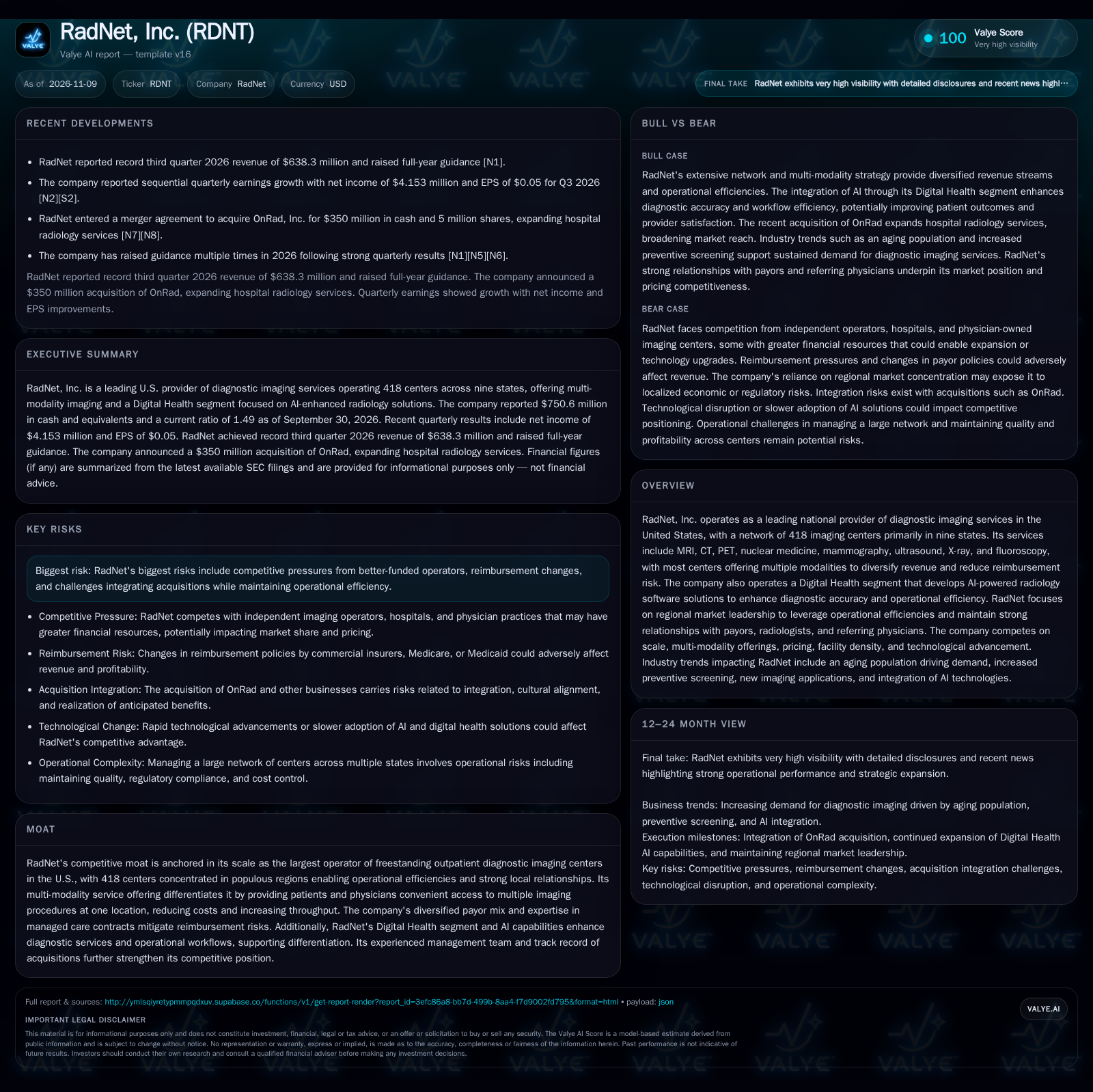
RadNet, Inc. reported record Q3 2026 revenue of $638.3 million and has raised full-year guidance multiple times in 2026, reflecting sequential earnings growth. Its platform spans 418 imaging centers across nine states, emphasizing multi-modality services and a growing Digital Health segment focused on AI-powered radiology solutions. The company’s regional concentration and diversified payor mix support operational efficiencies and reduce reimbursement risk, but heightened acquisition and integration activity—such as the pending OnRad deal—raises questions about future margin stability and execution.
RadNet, Inc. is pushing the boundaries of U.S. outpatient diagnostic imaging by combining regional scale, multi-modality centers, and a growing AI-powered Digital Health segment. Recent record quarterly revenue and multiple guidance raises in 2026 underscore the operational momentum behind this strategy. Yet, as RadNet expands through acquisitions such as OnRad and deepens its investment in AI-driven workflow tools, the company faces a new set of integration and execution risks. The interplay between regional density, technology adoption, and reimbursement dynamics will define whether RadNet’s current momentum translates into durable economic advantage—or exposes it to the pitfalls of operational complexity.
Record Revenue, Guidance Upgrades, and the Next Phase of Expansion
RadNet reported record third quarter 2026 revenue of $638.3 million, marking sequential earnings growth and a net income of $4.153 million with EPS of $0.05 [N1] [N2] [S2]. Management has raised full-year guidance multiple times in 2026, citing continued operating strength [N1] [N5] [N6]. As of September 30, 2026, RadNet held $750.6 million in cash and equivalents and reported liquidity-ratio trends of 1.49 [S2]. The company operates 418 imaging centers across nine states, specializing in multi-modality diagnostic imaging and increasingly emphasizing AI-enabled digital health solutions [S1]. These developments set the stage for RadNet’s next phase, which involves both organic growth and the integration of newly acquired assets such as OnRad [N8].
How RadNet’s Model Converts Scale and Modality Breadth into Margin Opportunity
At its core, RadNet monetizes diagnostic imaging procedures across a broad payor mix, with revenue streams diversified by modality (MRI, CT, PET, X-ray, mammography, and more) and geography [S1]. The multi-modality strategy enables each center to serve a wide range of diagnostic needs, increasing per-location utilization and smoothing reimbursement volatility. By concentrating networks in major population centers, RadNet can centralize scheduling, optimize staffing, and share costly imaging equipment across facilities—key contributors to potential operating leverage as incremental volume flows through fixed-cost assets.
The company’s Digital Health segment, led by DeepHealth and further expanded via acquisitions like Aidence and Quantib, aims to introduce software-driven margin enhancement. AI-based tools for image interpretation and workflow management could reduce radiologist time per scan, improve diagnostic accuracy, and automate administrative tasks. If these solutions achieve wide clinical adoption and reimbursement support, they may unlock a higher-margin, recurring software revenue stream to complement the capital-intensive imaging center network.
RadNet’s capital needs are significant due to equipment, facility, and IT investment requirements. The pace of AI integration and acquisition activity (e.g., OnRad) may increase near-term capital intensity and integration costs, but also set the stage for future scale benefits if managed effectively.
Regional Density, Multi-Modality, and AI: Sources and Limits of Advantage
RadNet’s competitive position is anchored in its status as the largest operator of outpatient imaging centers in the U.S. by location count and annual imaging revenue [S1]. Regional density enables operational efficiencies—such as flexible scheduling and resource pooling—and strengthens relationships with payors, referring physicians, and radiology groups. The multi-modality model offers a one-stop shop for physicians and patients, reducing leakage to competitors and supporting higher throughput per facility.
The Digital Health segment’s AI tools aim to differentiate RadNet on clinical quality and efficiency, but the impact depends on radiologist adoption, payor acceptance, and regulatory clarity. Larger hospital systems and independent imaging operators with strong capital positions could respond by investing in their own AI or digital capabilities, pressuring RadNet’s pricing and forcing ongoing technology investment.
RadNet also faces risk from reimbursement compression, as both governmental and commercial payors seek to control imaging costs. Its diversified payor mix and managed care expertise may buffer some volatility, but sudden policy changes could still impact margins. Physician-owned practices and hospital networks remain formidable competitors, particularly in markets where RadNet lacks density or entrenched relationships.
AI-Driven Workflow Gains and Successful OnRad Integration Fuel Margin Expansion
If RadNet successfully integrates OnRad and realizes anticipated synergies, the combined platform could achieve greater scale in hospital radiology services and extend its multi-modality approach to new regions [N8]. Widespread adoption of DeepHealth’s AI tools—both within RadNet’s own centers and potentially through licensing to external providers—could improve radiologist productivity, reduce diagnostic errors, and support incremental revenue from software and workflow solutions.
In this scenario, ongoing demand tailwinds from an aging population and expanded screening guidelines drive steady volume growth, while software-driven efficiency gains allow RadNet to expand margins even in the face of reimbursement headwinds. Confirmation would come from accelerating operating income growth, expanding gross margins, and evidence of AI adoption in both internal and external customer settings.
Scale and Payor Diversification Sustain Growth, But Integration and Cost Pressures Persist
The most plausible trajectory is that RadNet continues to grow imaging volumes and revenue in line with industry trends, supported by its multi-modality, regional density, and payor-mix strategies. The Digital Health segment contributes incrementally, but AI-driven margin expansion is gradual as adoption remains mostly internal and reimbursement for AI-assisted diagnostics develops slowly.
Acquisition integration (including OnRad) presents challenges but does not materially disrupt operations. Operating leverage is realized primarily through volume growth and cost containment, offset by ongoing investments in technology and compliance. This scenario would be confirmed by steady (but not accelerating) margin trends, moderate EPS growth, and incremental expansion of the AI/software revenue base. Signs of integration friction or cost overruns would challenge this outcome.
Reimbursement Compression and Integration Missteps Undermine Margin Structure
RadNet’s downside scenario emerges if reimbursement rates for key modalities are cut more deeply or quickly than expected, particularly if commercial payors follow Medicare in tightening imaging payments. Integration of acquisitions like OnRad could prove more complex or costly than planned, with operational disruptions, cultural misalignment, or slower-than-expected synergy realization.
If AI and digital solutions fail to gain traction—either due to regulatory hurdles, radiologist resistance, or lack of payor support—the Digital Health segment may not deliver expected margin or revenue gains, leaving RadNet more exposed to the capital intensity and margin compression of traditional imaging. Evidence for this scenario would include declining gross margins, flat or shrinking earnings despite volume growth, and negative commentary on integration progress or AI adoption.
What Will Determine RadNet’s Edge in Diagnostic Imaging and AI-Enabled Radiology?
Sustained sequential revenue and earnings growth as new centers and acquisitions are integrated.
Gross and operating margin trends, especially in the wake of reimbursement changes or integration milestones (if disclosed).
Adoption rates and clinical impact of DeepHealth AI tools within RadNet centers and through external licensing—metrics on radiologist efficiency or diagnostic accuracy improvements would help test the thesis.
Pace and quality of OnRad integration—updates on cross-selling, operational synergies, and retention of hospital/health system customers (if disclosed).
Evidence of payor acceptance or improved reimbursement for AI-assisted diagnostic services.
Capital expenditure and free cash flow trends as the company balances technology investment with network expansion (if disclosed).
Regulatory developments impacting imaging reimbursement or AI application in clinical radiology.
Disclaimer: This is research-only, informational analysis and not investment advice. It may include AI-generated interpretation and general industry context. Always verify important details using primary sources.

Comments