
Ameresco’s Integrated Energy Solutions: Recurring Revenue, Performance Risk, and the Stakes of Scale
Ameresco’s model combines energy efficiency project delivery, renewable asset ownership, and recurring O&M contracts, positioning it at the intersection of the decarbonization push and rising resilience demands. With performance-based contracts, a multi-segment footprint, and asset-backed recurring revenue, the company’s future will hinge on its ability to manage contract risk, scale development, and sustain project economics amid competitive and regulatory volatility.
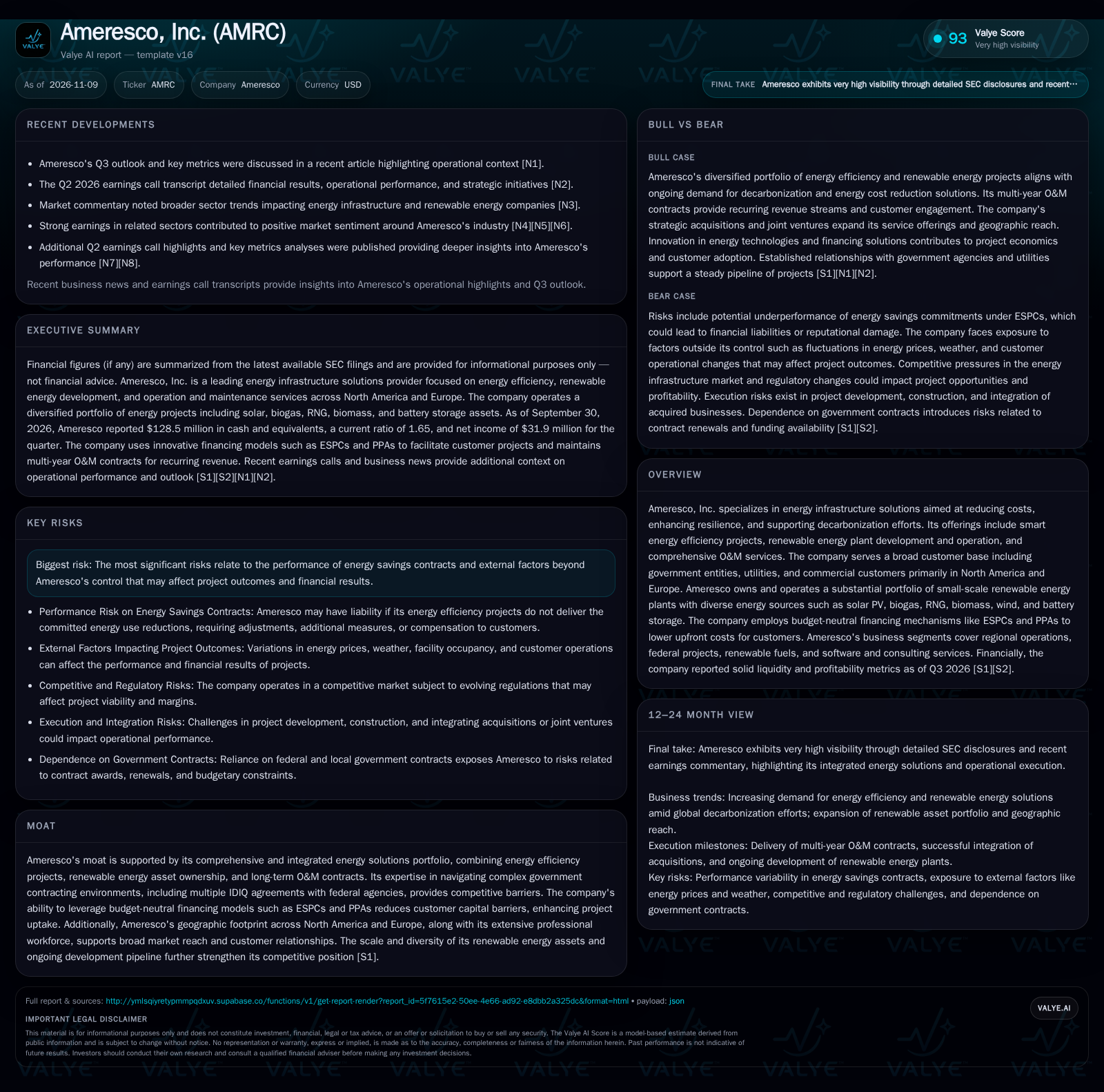
Ameresco delivers energy infrastructure solutions through a blend of project design, renewable asset ownership, and long-term O&M contracts. Its diversified customer base and budget-neutral financing drive adoption, but future value will depend on managing performance risks in energy savings contracts, expanding its renewable asset base, and navigating competitive and regulatory headwinds. Recent results show ongoing profitability and a sizable project pipeline, but also underline the importance of execution and external factors in sustaining growth [S1] [S2].
Ameresco stands at a critical juncture in the global energy transition, offering a portfolio that bridges energy efficiency retrofits, distributed renewable energy development, and long-term operational support. With approximately $7 billion sourced in project financing and over $18 billion in solutions delivered since inception, the company’s scale and financial visibility are clear. Yet, as performance-based contracts proliferate and asset ownership grows, Ameresco’s ability to manage both operational complexity and contract risk will be decisive in determining whether recurring revenues translate into durable shareholder value [S1] [S2].
Recent Performance and Strategic Footprint: What the Numbers Reveal
The company reported cash and liquidity metrics for the period; these figures do not by themselves establish operating runway, investment capacity, financial flexibility, or financing capacity. [S2] Quarterly net income reached $31.9 million, with basic EPS of $0.60 and diluted EPS of $0.59 [S2]. The company’s revenue base is geographically and operationally diversified: 45.8% North America Regions, 27.4% Europe, 15.1% U.S. Federal, 8.2% Renewable Fuels, and 3.5% All Other in 2025 [S1]. Ameresco’s asset base includes 227 small-scale renewable plants totaling approximately 838 MWe, supporting ongoing recurring revenue and customer engagement [S1]. These facts establish Ameresco as a profitable, multi-segment operator with a significant presence in both energy efficiency projects and renewable asset ownership.
How Ameresco Converts Project Delivery into Recurring Value
Ameresco generates revenue from three primary streams: (1) upfront project delivery (design, engineering, installation for energy efficiency and infrastructure upgrades), (2) recurring operation and maintenance (O&M) contracts, and (3) energy sales from owned renewable assets [S1]. The use of energy savings performance contracts (ESPCs) and power purchase agreements (PPAs) allows customers to avoid large upfront capital outlays—Ameresco either guarantees energy savings or supplies renewable energy, recouping investment over time. This budget-neutral model expands the addressable market, especially for public sector and institutional customers.
The economic engine relies on a blend of fixed and variable cost structures. Project delivery is capital-intensive and subject to execution risk, but recurring O&M and energy sales provide higher visibility, smoothing cash flows. Multi-year O&M contracts, often attached to completed projects, create annuity-like revenue. However, ESPCs introduce contingent liability: if committed energy savings are not achieved, Ameresco may need to compensate customers or invest further to meet targets. Asset ownership (solar, biogas, RNG, battery storage) adds capital intensity but, if well-managed, delivers attractive returns and inflation-linked revenue streams.
Operating leverage is plausible as the installed base of O&M contracts and renewable assets grows, but this is counteracted by the need for continued project origination and disciplined asset management. Capital requirements remain significant, especially as Ameresco scales asset ownership and navigates development cycles that can be long and regulatory-driven.
Integrated Offering and Financing Innovation: Barriers and Counterforces
Ameresco’s competitive position is underpinned by its integrated solutions—combining project engineering, asset development, and O&M under one roof. Its expertise in navigating complex government procurement and its ability to structure ESPCs and PPAs at scale create entry barriers for smaller or less specialized peers. The company’s geographic reach (North America, Europe) and multi-sector customer base (federal, state/local, utilities, data centers, education, health care) spread risk and broaden its project pipeline [S1].
However, the market is crowded, with competition from global engineering firms, specialized energy service companies (ESCOs), utilities’ unregulated subsidiaries, and emerging tech-driven energy platforms. Regulatory shifts—such as changes in subsidy regimes, energy market rules, or carbon pricing—could alter project economics or create new compliance costs. The requirement to guarantee performance in ESPCs and the capital intensity of asset ownership also limit how fast Ameresco can scale without stretching its balance sheet or risk appetite.
From Project Flow to Platform: How Asset Expansion and O&M Growth Could Compound Value
If Ameresco successfully executes on its growing pipeline of energy efficiency projects and renewable asset development, the installed base of O&M contracts and owned assets could expand rapidly. This would increase the proportion of predictable, high-margin recurring revenue—potentially driving operating leverage and valuation multiples more aligned with infrastructure or platform business models.
A favorable scenario would see robust ESPC and PPA origination, disciplined project execution, and effective risk management on performance guarantees. Regulatory support for decarbonization (e.g., new incentives, stricter mandates) could spur further demand from public and private sectors. Confirmation of this scenario would come from sustained O&M contract wins, growth in owned asset MWe, increasing recurring revenue as a share of total revenue, and evidence of margin expansion without a commensurate rise in contingent liabilities or capital constraints.
Falsification would occur if O&M portfolio growth stalls, asset utilization lags, or if performance guarantee liabilities materially erode project-level returns.
Balancing Growth and Performance Risk in a Fragmented Market
The most plausible outcome is that Ameresco maintains a steady project flow and incremental growth in its O&M and renewable asset base, while navigating the inherent risks of performance-based contracts. The company’s broad customer mix provides a buffer against isolated shocks, but competitive intensity and regulatory variability will likely cap margin expansion.
In this scenario, Ameresco’s financial results continue to show profitability and moderate growth, with recurring revenue gradually increasing as a proportion of the total. External shocks—such as energy price volatility or regulatory delays—may periodically impact project flow or asset returns, but are offset by the company’s diversification and experience in contract structuring. Confirmation would come from stable or rising O&M backlog, consistent net income, and no material increase in performance guarantee liabilities relative to revenue.
The scenario would be challenged if contract underperformance, regulatory headwinds, or capital constraints lead to project delays, O&M attrition, or margin compression.
When Performance Guarantees Backfire: Contract Risk and Capital Strain
A negative scenario could unfold if Ameresco’s ESPC projects systematically underdeliver on energy savings, triggering financial penalties, reputational damage, and increased cost to remediate underperforming contracts. This could coincide with project execution missteps, regulatory setbacks, or adverse shifts in customer funding—particularly in the government sector.
Such a scenario would likely see rising contingent liabilities, margin erosion, and possible constraints on capital available for new asset development. If project delays or cost overruns become common, O&M contract renewal rates could fall, and Ameresco’s competitive position would weaken. Evidence confirming this scenario would include a spike in performance-related compensation payments, notable O&M attrition, and a deceleration in new project wins or asset development.
Falsification would be visible if performance risk remains contained, contract renewal rates are stable, and capital deployment into new assets remains disciplined and accretive.
Milestones and Metrics That Will Clarify Ameresco’s Value Trajectory
Growth rate and composition of O&M contract backlog—an increasing, diversified backlog would support the case for rising recurring revenue.
Net additions of owned renewable energy assets (MWe/year)—steady growth would indicate effective capital deployment and asset management.
Incidence and dollar value of performance guarantee adjustments or compensation payments—if disclosed, a spike would signal rising risk to project economics.
Gross margin trends in both project delivery and recurring segments—convergence or divergence would help test the scenario of operating leverage.
Retention and renewal rates for multi-year O&M contracts—sustained high rates would indicate customer satisfaction and stickiness.
Proportion of total revenue from recurring sources (O&M + energy sales)—a rising share would confirm the annuity thesis.
Capital expenditure and funding mix for new asset development—high leverage or equity raises could signal capital strain or growth opportunity.
Regulatory developments affecting ESPC, PPA, or renewable asset economics—major changes could shift both upside and downside probabilities.
Disclaimer: This is research-only, informational analysis and not investment advice. It may include AI-generated interpretation and general industry context. Always verify important details using primary sources.

Comments