
Princeton Capital’s Strategic Limbo: Liquidity Strength Meets Prolonged Uncertainty
With substantial liquidity and a specialized focus on small and lower middle-market debt investments, Princeton Capital Corporation remains in a holding pattern as its multi-year strategic review drags on, raising questions about future direction, operating leverage, and competitive positioning in a consolidating BDC landscape.
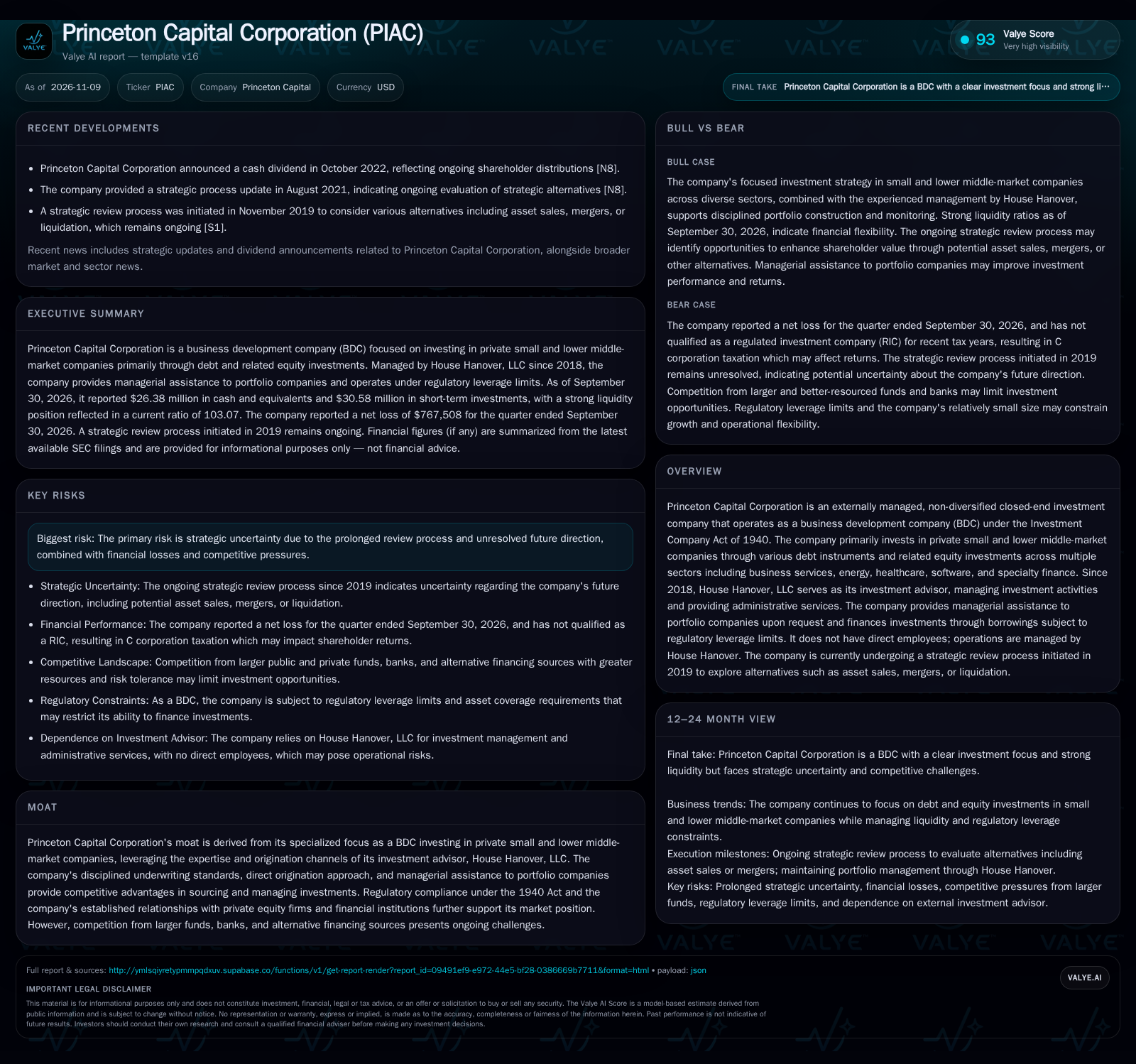
Princeton Capital Corporation stands out for its reported liquidity position, externally managed BDC structure, and focus on small and lower middle-market lending. However, a multi-year unresolved strategic review and persistent net losses cloud its outlook. [S2]
Princeton Capital Corporation finds itself at an inflection point. On one hand, it boasts unusually reported liquidity position for a business development company (BDC), with over $57 million in cash and short-term investments versus minimal current liabilities. On the other, the company is mired in a strategic review process that has dragged on for seven years, with persistent operating losses and unresolved questions about its long-term direction. As industry competition intensifies and regulatory leverage constraints persist, the real test for Princeton Capital is whether its potential financial flexibility can be converted into lasting shareholder value—or if indecision and structural headwinds will erode its position.
Liquidity Outpaces Operations, But Strategic Drift Continues
As of September 30, 2026, Princeton Capital Corporation reported $26.38 million in cash and equivalents and $30.58 million in short-term investments, with current assets totaling approximately $33.08 million and current liabilities of just $320,942. This yields a striking current ratio of 103.07 and a cash ratio of 96.11, positioning the company among the most liquid BDCs in the sector. However, this liquidity is juxtaposed against an ongoing net loss of $767,508 for the quarter and a lack of RIC (regulated investment company) status, leading to C corporation taxation. Most notably, the company’s strategic review—initiated in November 2019 to evaluate alternatives from asset sales to mergers or liquidation—remains unresolved, signaling ongoing uncertainty over its future structure and strategy. [S2]
How Princeton Capital’s Model Converts Capital into Returns—And Where the Friction Lies
Princeton Capital operates as an externally managed BDC, targeting private small and lower middle-market companies through debt and related equity investments. The company’s revenue model hinges on interest income from these investments, occasionally supplemented by equity upside from warrants or direct equity stakes. Operating leverage is structurally limited by the external management arrangement: House Hanover, LLC receives a base management fee of 1.00% annually on gross assets (excluding cash and equivalents net of indebtedness) but does not participate in an incentive fee. This structure aligns costs with assets under management but may reduce motivation for aggressive portfolio rotation or risk-taking.
The absence of direct employees and reliance on House Hanover for both investment management and administrative functions further compresses the company’s fixed operating cost base, but also limits potential for in-house origination expansion. Borrowings are subject to the 1940 Act’s 200% asset coverage requirement, which constrains leverage and potential investment scale. The company’s inability to maintain RIC status (due to net operating and capital loss carryforwards) means it is taxed at the corporate level, reducing distributable returns compared to RIC-qualified peers. Ultimately, Princeton’s ability to generate attractive net yields depends on its sourcing, underwriting, and monitoring capabilities—areas that may be challenged by limited scale and the protracted strategic review.
Specialization vs. Scale: Competitive Pressures in the Lower Middle-Market BDC Space
Princeton Capital’s niche lies in providing capital to small and lower middle-market companies, a segment often underserved by traditional banks and larger funds. Its competitive position is theoretically supported by House Hanover’s origination network, sector expertise, and willingness to provide managerial assistance to portfolio companies. However, the landscape has grown more competitive as larger BDCs and alternative lenders increasingly look down-market for yield, leveraging scale, brand, and broader sourcing channels.
The absence of incentive fees in the management contract can be a mixed blessing: it prevents excessive risk-taking but may also limit upside-seeking behavior. Regulatory leverage limits further restrict Princeton’s ability to scale or compete on price. The company’s relatively small asset base and the ongoing strategic review likely limit its negotiating leverage and ability to attract new deal flow, especially as prospective borrowers and sponsors may prefer partners with greater certainty and continuity. In this context, Princeton’s competitive advantage may be eroding unless the strategic review produces a decisive pivot—whether through consolidation, a merger, or a renewed growth mandate.
Catalysts That Could Unlock Value: Strategic Clarity and Portfolio Realignment
The most credible upside scenario for Princeton Capital is a resolution of its strategic review that catalyzes value creation. This could take the form of a sale of the portfolio to a larger BDC or private credit fund, a merger with a peer to achieve scale and cost synergies, or a liquidation that returns capital to shareholders above current market value. Alternatively, a successfully executed pivot—such as recapitalization, new capital raises, or a refreshed investment mandate—could reinvigorate asset growth and improve returns.
Confirmation of this scenario would require a formal announcement of a transaction, portfolio sale, or detailed plan for renewed growth. Evidence would include a narrowing of the strategic review’s scope, the engagement of a merger or restructuring advisor, or the initiation of significant new investments. Accelerating net investment income, restored RIC status, or a shift to positive quarterly earnings would further validate a successful transition.
Prolonged Stasis: Liquidity Preservation but Limited Growth or Value Realization
The most plausible near-term outcome is continued strategic limbo, with Princeton Capital preserving its high liquidity but failing to deliver growth or shareholder value realization. In this scenario, the company continues to generate modest interest income from its legacy portfolio, offset by operating costs and C corporation taxation, resulting in persistent—if shallow—net losses. New investments remain limited due to uncertainty, management caution, or lack of scale, while the strategic review proceeds without resolution.
This scenario would be confirmed by further quarters of minimal portfolio turnover, cash balances remaining high relative to assets, and no material announcements regarding mergers, asset sales, or major new investments. Absence of progress on RIC qualification and continued reporting as a C corporation would reinforce the status quo. Shareholder returns would likely lag sector peers, and the company would remain vulnerable to erosion of competitive relevance.
Value Erosion Through Prolonged Inaction or External Shocks
The adverse scenario is one in which strategic indecision persists, and Princeton Capital’s reported liquidity position is gradually eroded by ongoing net losses, administrative costs, and potentially adverse tax impacts. Without a clear path forward, asset quality could deteriorate, especially if economic or credit conditions worsen for its small-business portfolio. The lack of scale and persistent uncertainty could make it harder to attract new investment opportunities or retain capable external management, while competitive encroachment from larger, more aggressive BDCs and private lenders intensifies.
Confirmation of this scenario would include rising non-performing assets, declining net asset value per share, continued or deepening net losses, and a shrinking investment portfolio. Any regulatory changes that further constrain leverage or increase compliance costs could exacerbate the situation. If disclosed, a material reduction in portfolio company performance or write-downs would provide additional evidence of value erosion.
Milestones That Will Determine Whether Strategic Uncertainty Becomes Opportunity or Risk
Resolution—or continued extension—of the strategic review process. A formal outcome, transaction announcement, or detailed update would be pivotal. [S1] [S2]
Sustained changes in net investment income and operating profits. A return to profitability or persistent losses will clarify economic viability. [S2]
Restoration of RIC status and associated tax treatment, if disclosed, would materially impact distributable returns.
Material changes in portfolio composition, including new investments, asset sales, or significant repayments, would indicate either renewed growth or wind-down.
Shifts in cash and short-term investment balances: rapid drawdown may signal portfolio activity or distress, while continued stasis could imply inactivity.
Updates to the management agreement, fee structure, or relationship with House Hanover, as these would affect both cost base and operational alignment.
Disclosure of asset quality metrics such as non-accruals, write-downs, or realized losses, which would provide insight into underlying portfolio health.
Any regulatory or market developments affecting BDC leverage limits, funding costs, or small-business credit demand that could alter the company’s strategic calculus.
Disclaimer: This is research-only, informational analysis and not investment advice. It may include AI-generated interpretation and general industry context. Always verify important details using primary sources.

Comments