
Green Dot’s Revenue Concentration and Merger Dynamics: Embedded Finance Ambitions Meet Structural Constraints
Green Dot’s future hinges on the interplay between its dominant BaaS partnership, liquidity headwinds, and the uncertain completion of its merger with CommerceOne. The company’s embedded finance push faces both opportunity and risk, with revenue concentration and regulatory hurdles shaping outcomes.
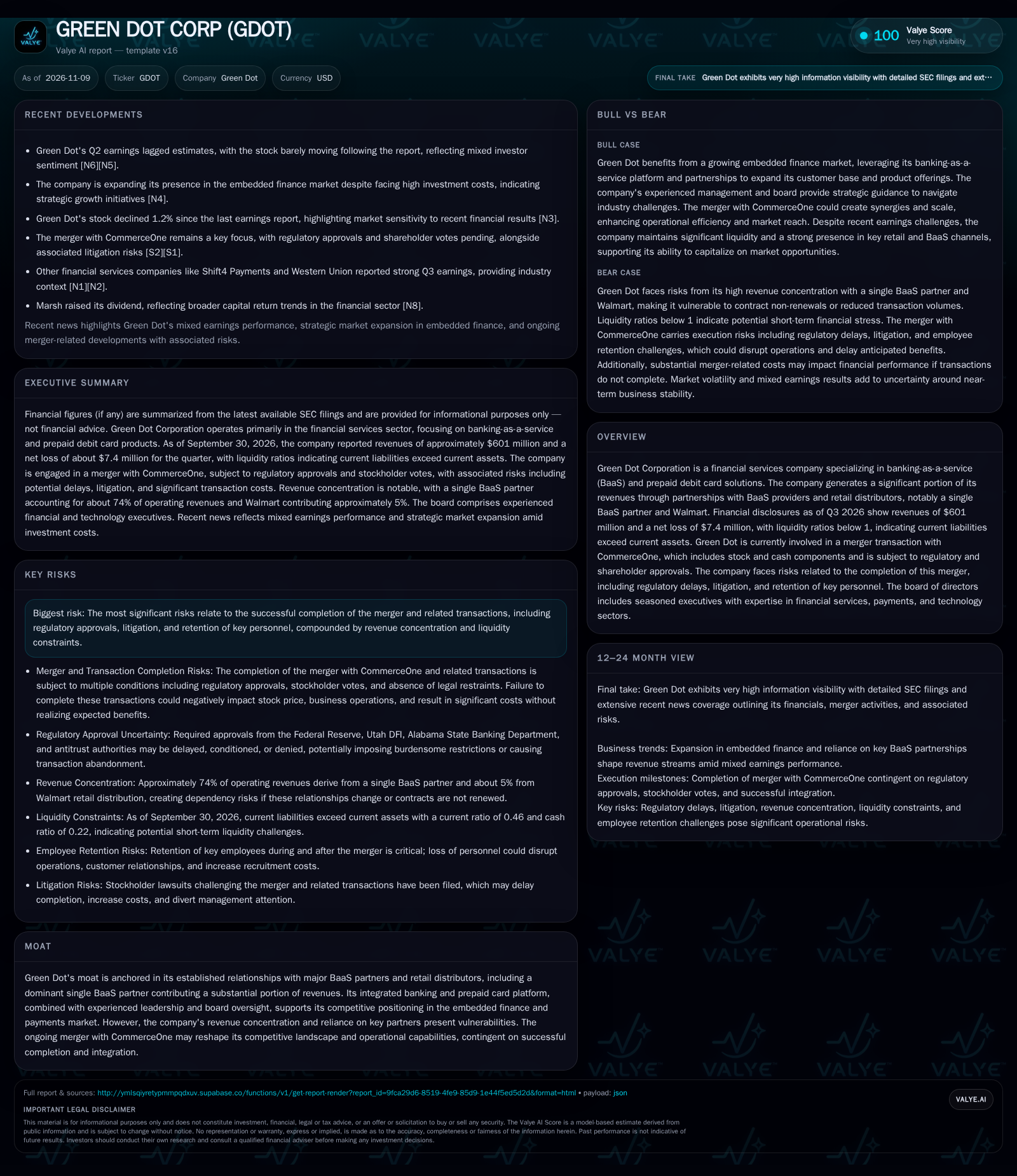
Green Dot’s business is defined by its heavy reliance on a single BaaS partner (74% of operating revenues), sub-1.0 liquidity ratios, and a pending merger with CommerceOne that could reshape its scale and capabilities. The company faces material risks from regulatory delays, litigation, and partner concentration, while seeking growth in embedded finance. Execution on the merger and diversification of revenue streams are central to the investment thesis. [S2] [N4]
Green Dot Corporation sits at a pivotal crossroads: its growth ambitions in embedded finance are constrained by high revenue concentration, liquidity pressure, and a high-stakes merger with CommerceOne. The company’s strategic future will be shaped by its ability to diversify beyond its largest BaaS partner, manage short-term financial stress, and execute a complex transaction amid regulatory and operational uncertainty. Investors must weigh the promise of scale and new market opportunities against the risks of concentrated revenue streams and unresolved merger hurdles.
Recent Financial Snapshot and Merger Uncertainty Define the Present
As of September 30, 2026, Green Dot reported $601 million in quarterly revenue and a net loss of $7.4 million. Most notably, 74% of Green Dot’s operating revenues came from a single BaaS partner, while Walmart contributed about 5%, highlighting substantial customer concentration risk. The company is in the midst of a merger with CommerceOne, a process subject to regulatory and shareholder approvals, and facing associated litigation and integration risks. These factors collectively create a business environment characterized by high dependency on key relationships, financial stress, and substantial uncertainty regarding future structure and governance. [S2]
How Revenue Concentration and Embedded Finance Shape Green Dot’s Economics
Green Dot’s business model is built on a banking-as-a-service (BaaS) platform and prepaid debit card offerings, generating revenue from account fees, transaction processing, and partner arrangements. The economics of BaaS can offer attractive operating leverage if customer volumes scale, as much of the platform’s infrastructure costs are fixed. However, Green Dot’s current economics are dominated by a single BaaS partner, making its revenue base fragile: any contract renegotiation or loss could result in an immediate and severe revenue decline.
The net loss in Q3 2026 suggests that current revenue levels and margin structure are insufficient to cover operating and transaction costs, especially as the company ramps up investment in embedded finance initiatives. If the merger with CommerceOne succeeds, there is potential for scale-driven cost efficiencies and broader product distribution, but such benefits are speculative until integration is achieved and revenue synergies materialize.
Beyond the immediate revenue concentration risk, Green Dot’s economics are also influenced by the structural dynamics of embedded finance investments. Embedded finance requires significant upfront capital allocation to technology development, compliance frameworks, and partner onboarding, which can suppress near-term margins. However, if these investments successfully create a scalable platform with diversified revenue streams, the fixed-cost base can be leveraged more effectively, potentially transforming the cost structure over time. This dynamic underscores a critical conditionality: the pace and success of partner diversification directly impact whether embedded finance initiatives evolve from a cost center to a profit driver.
Additionally, the interplay between transaction volume growth and pricing power is a key determinant of Green Dot’s economic sustainability. If the company can negotiate favorable fee structures with multiple partners, it may offset margin pressure from competitive pricing in the embedded finance space. Conversely, failure to achieve scale or to differentiate its technology could force Green Dot into a race-to-the-bottom pricing environment, eroding profitability. Thus, the company’s ability to maintain or improve pricing while expanding transaction volumes is a pivotal mechanism influencing its financial trajectory.
Competitive Landscape: Platform Leverage Versus Customer Dependency
Green Dot operates in a highly competitive sector that includes BaaS providers, challenger banks, legacy financial institutions, and fintech platforms offering embedded finance solutions. Its competitive advantage historically stemmed from established retail and partner relationships, integrated technology, and regulatory compliance experience. However, the overwhelming revenue dependence on a single BaaS partner weakens Green Dot’s bargaining power and exposes it to substitution risk, as competitors may lure away partners with better economics or technology.
The embedded finance market is expanding, with retailers, platforms, and non-banks seeking to integrate financial services into their ecosystems. This creates opportunity for BaaS providers, but also intensifies competition from both fintech upstarts and large incumbents with deeper capital reserves and broader distribution. Green Dot’s ability to diversify its customer base, enhance its technology stack, and deliver reliable service will be critical to defending and expanding its position post-merger.
The competitive pressure Green Dot faces is not solely from direct BaaS rivals but also from adjacent fintech ecosystems that integrate financial services as ancillary offerings. These ecosystems can bundle payments, lending, and banking services with core non-financial products, potentially capturing customer engagement more holistically. Green Dot’s competitive positioning will depend on its capacity to embed seamlessly into diverse client ecosystems and to innovate product features that align with evolving partner needs. Failure to adapt to this broader competitive landscape could limit its market penetration despite existing technological capabilities.
Moreover, regulatory compliance and risk management capabilities are increasingly becoming competitive differentiators in the embedded finance sector. As regulatory scrutiny intensifies, firms with robust compliance infrastructure may gain preferential access to partnerships and markets. Green Dot’s historical regulatory experience provides a foundation, but scaling embedded finance offerings will test whether its compliance and operational risk frameworks can keep pace with rapid growth and complexity. The effectiveness of these risk controls will condition its ability to sustain partnerships and avoid costly regulatory setbacks, thereby influencing its competitive resilience.
If Merger Execution Unlocks Synergies and Revenue Diversifies
A favorable outcome would see Green Dot completing the CommerceOne merger without major regulatory or litigation delays, successfully integrating operations, and leveraging the combined platform to attract new BaaS partners and retail distributors. If management retains key personnel and operational stability, the merged entity could realize cost synergies, benefit from enhanced scale, and invest more aggressively in embedded finance offerings. Revenue concentration would diminish as new partners are onboarded, and improved scale could support margin expansion through operating leverage.
Evidence that would confirm this scenario includes: regulatory approvals granted on schedule, rapid customer acquisition outside the current dominant BaaS partner, declining revenue concentration metrics, and a return to sustained profitability. Conversely, failure to diversify revenue or realize cost efficiencies would falsify this upside scenario.
Sustained Dependence and Gradual Progress Amid Merger Friction
The most plausible near-term path is a drawn-out merger process with incremental progress. Green Dot is likely to remain heavily dependent on its primary BaaS partner for the foreseeable future, with slow expansion in embedded finance and retail distribution. Earnings may remain volatile due to high investment costs and limited pricing power, especially if the company is forced to compete more aggressively for new partners. The merger with CommerceOne may eventually close, but integration could be hampered by employee attrition or operational friction.
This scenario would be confirmed by continued high revenue concentration, persistent liquidity pressure, and modest growth in new customer relationships without a material shift in revenue mix. Evidence of regulatory delays or ongoing litigation expenses would further support this outlook.
Disruption from Partner Loss or Failed Merger Execution
A negative scenario could materialize if Green Dot loses its largest BaaS partner, faces contract non-renewal, or suffers from significant customer attrition during the merger process. Failure to secure regulatory approval or resolve litigation could derail the CommerceOne merger, leaving the company exposed with a concentrated revenue base and ongoing liquidity challenges. In this case, Green Dot could be forced to cut investment, retrench operations, or seek emergency financing under unfavorable terms.
Confirmation of this scenario would include sharp revenue declines, further deterioration in liquidity ratios, failed or abandoned merger proceedings, and disclosure of partner losses or contract terminations. An inability to retain key employees or meet regulatory expectations would further increase downside risk.
Testing the Thesis: What Will Determine Green Dot’s Strategic Outcome?
Revenue concentration metrics—particularly the percentage of revenue from the top BaaS partner—should be monitored for signs of diversification or new partner wins. [S2]
Progress and outcomes on regulatory approvals for the CommerceOne merger, including updates from the Federal Reserve, Utah DFI, and antitrust authorities, will signal merger feasibility and timeline. [S2]
Net new BaaS partnerships or retail distribution agreements—any disclosed announcements or partnership wins—would help test the company’s ability to diversify revenue.
Updates on merger-related litigation, including resolution status and financial impact, will affect both the timeline and cost of the transaction. [S2]
Employee retention rates or management turnover (if disclosed) during and after the merger will be critical for operational continuity.
Quarterly profitability and margin trends—especially post-merger—would confirm whether scale or integration is driving improved economics.
Disclaimer: This is research-only, informational analysis and not investment advice. It may include AI-generated interpretation and general industry context. Always verify important details using primary sources.

Comments