
Teads Holding Co.: Losses in a Competitive Digital Advertising Landscape
Teads faces mounting financial and Nasdaq compliance pressures despite a diversified, platform-driven digital advertising business. Its ability to restore profitability and maintain market access will determine whether operational scale and global reach can be converted into durable value.
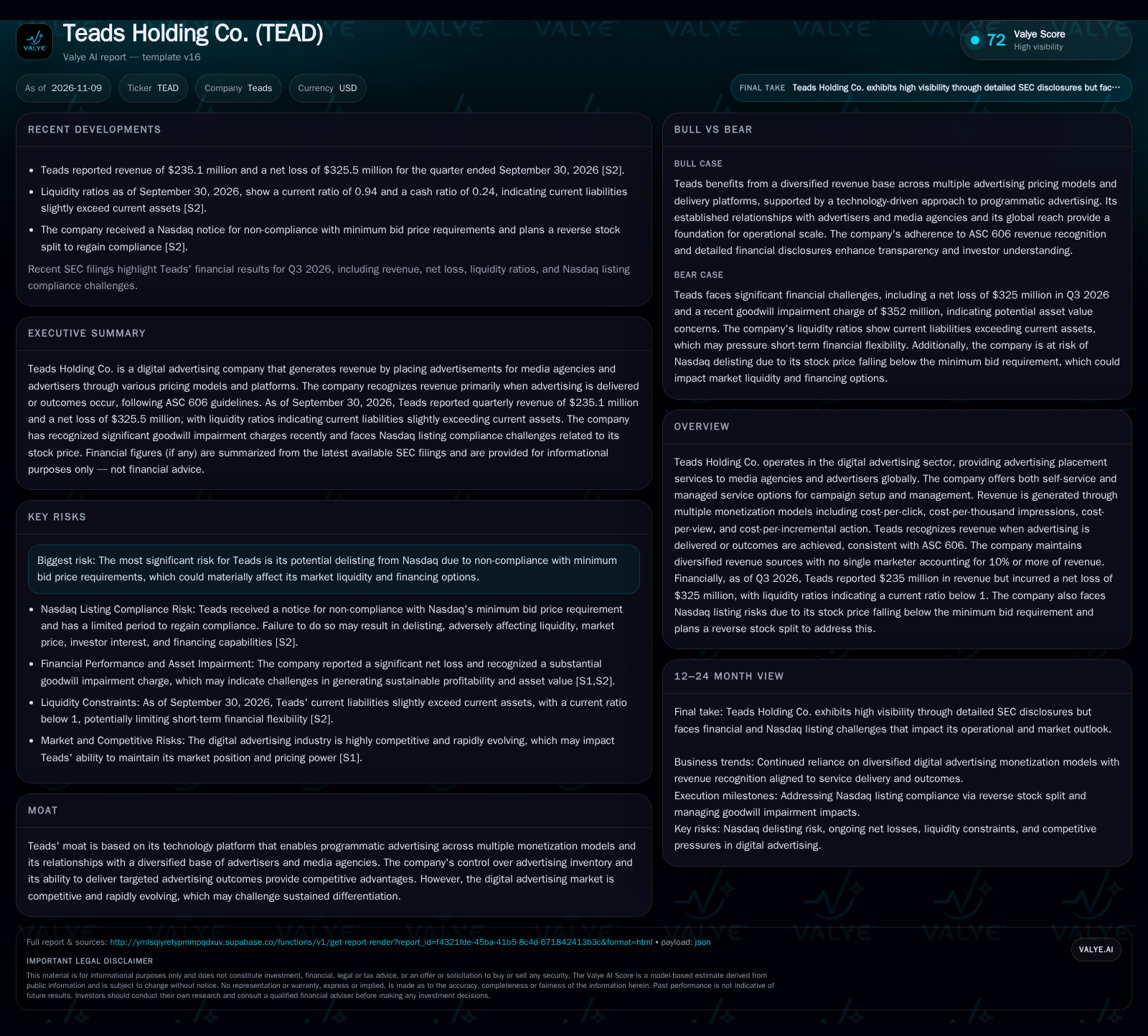
Teads Holding Co. reported $235.1 million in Q3 2026 revenue but a net loss of $325.5 million, with current liabilities slightly exceeding current assets and a current ratio below 1. The company is at risk of Nasdaq delisting due to minimum bid price non-compliance and plans a reverse stock split. [S2]
Teads Holding Co. sits at a precarious juncture: while its technology-driven digital advertising platform enables broad revenue diversification and global reach, the company is grappling with steep net losses, a sub-1.0 current ratio, and a Nasdaq delisting threat due to prolonged stock price weakness. Its Q3 2026 results reflect a business with scale but not yet sustainable profitability, raising the stakes for execution on both operational discipline and capital market compliance.
Near-Term Outlook Marked by Financial Losses, Liquidity Strains, and Listing Risks
Teads reported $235.1 million in revenue for Q3 2026 but incurred a net loss of $325.5 million, resulting in negative EPS of -$3.31. Teads also received a Nasdaq notice for falling below minimum bid price requirements and intends to pursue a reverse stock split to regain compliance. A $352.1 million goodwill impairment charge in 2025 further clouds asset quality and signals that prior growth or acquisition assumptions have been revised downward. Together, these facts create a picture of a company under immediate financial and capital market pressure, with both operational losses and external compliance threats demanding urgent attention. [S2]
Teads’ Monetization Model and the Economic Challenges It Faces
Teads’ core business is to connect advertisers and media agencies with premium digital ad inventory, monetizing impressions, clicks, views, or actions through models such as CPM, CPC, CPV, and CPA. This multi-metric approach allows for flexible campaign targeting and can, in principle, match advertiser objectives with publisher supply. Revenue is recognized when ads are delivered or outcomes occur, typically via monthly billing cycles with 30–60 day payment terms. Teads acts as principal in most deals, controlling inventory or rights, which means it bears both upside and downside risk on ad placements. Variable costs are driven by publisher payouts and technology infrastructure, while fixed costs include platform development, sales, and administrative overhead.
The digital ad market’s scale enables high absolute revenue, but fierce competition, pricing pressure, and the need for continual investment in ad tech and data analytics can compress margins, especially if demand-side or supply-side partners extract increasing value. The company’s recent net loss and significant goodwill impairment suggest that revenue scale has not translated into operating leverage or asset productivity. Without improved margin discipline or sustained top-line growth, persistent losses could challenge Teads’ ability to fund growth and service obligations.
Programmatic Advertising: Teads’ Strengths Amid Industry Headwinds
Teads’ competitive position rests on its technology platform, which enables programmatic ad placement, campaign optimization, and outcome-based billing across a diversified global client base. The absence of major customer concentration provides some insulation from individual account loss and signals broad market relevance. However, the digital advertising ecosystem is intensely competitive, with large integrated platforms (such as global search and social media giants), specialized ad tech firms, and publisher-direct relationships all vying for advertiser budgets.
Switching costs for advertisers and agencies are generally low, especially as programmatic tools and data standards become more interoperable. Teads’ ability to control inventory as principal may provide some negotiating leverage, but it also exposes the firm to inventory risk if demand softens or if yield management falters. The broader industry faces regulatory scrutiny, signal loss from privacy changes, and ongoing shifts in media consumption—all of which can disrupt established platform advantages. While Teads’ diversified revenue is a strength, the challenge is to sustain differentiation and margin in a market where technology and inventory advantages can erode quickly.
Profit Potential Hinges on Margin Control and Platform Differentiation
In a favorable scenario, Teads succeeds in leveraging its global reach, diversified client base, and platform flexibility to drive higher-margin, outcome-based campaigns—either through improved technology targeting, greater publisher exclusivity, or efficient cost management. If operating expenses are held in check and higher-value ad formats (such as video or interactive units) gain traction, operating leverage may emerge, turning revenue scale into positive cash flow. Successful execution of a reverse stock split could restore Nasdaq compliance, preserving access to public capital markets and investor confidence.
Evidence that would confirm this pathway includes: sequential improvement in gross and operating margins, reduction in net losses, positive operating cash flow, and stabilization or growth in the company’s share price post-split. Additional signs would be new exclusive publisher deals, product launches that command premium pricing, or evidence that Teads is gaining share in high-growth segments like mobile or connected TV. A reversal of goodwill impairment trends or asset write-ups could further signal a restored trajectory.
Restructuring and Compliance Provide Breathing Room Without Guaranteeing Profit
The most plausible near-term scenario is that Teads executes its planned reverse stock split and regains Nasdaq compliance, temporarily alleviating capital market pressures.
Confirmation of this scenario would include continued quarterly net losses (albeit with some potential moderation), ongoing reliance on short-term cost controls or asset sales, and neutral to modestly positive trends in revenue diversification. If the company is forced to seek external financing or renegotiate supplier terms, it would underscore the persistence of underlying economic pressures. The absence of new customer concentration or major competitive share loss would signal at least a stable, if challenged, operating base.
Delisting Risks and Cash Constraints Could Trigger a Downward Spiral
In a more adverse scenario, Teads fails to sufficiently improve its stock price post-split, resulting in Nasdaq delisting and further restricting access to public equity markets. In the event of deteriorating ad demand, publisher renegotiations, or further asset impairments, Teads’ balance sheet could come under acute stress, raising existential risk if new capital cannot be secured on acceptable terms.
Key confirming evidence would be further declines in cash and current ratios, acceleration of net losses, inability to complete the planned reverse split or regain listing compliance, and increased disclosures of going concern risks. A spike in accounts payable, delayed publisher payments, or asset sales at a loss would further validate this downside trajectory.
Key Developments Influencing Teads’ Path to Profitability and Market Position
Sequential trends in gross margin and operating expense ratios; improvement would indicate progress on operating leverage.
Completion and market reaction to the planned reverse stock split, as this will directly affect Nasdaq compliance and investor sentiment.
Quarterly net cash flow from operations; positive inflection would signal a move toward self-funding the business.
Any new publisher exclusivity agreements or strategic partnerships that could bolster platform differentiation.
Disclosure of customer retention, churn, or repeat business rates—if disclosed—to assess the durability of revenue streams.
Updates on goodwill or other asset impairments, as further write-downs would signal ongoing challenges in value creation.
Changes in working capital metrics, particularly accounts receivable and payable, which could foreshadow liquidity stress or relief.
External financing events or covenant changes, which would indicate pressure or flexibility in capital structure.
Disclaimer: This is research-only, informational analysis and not investment advice. It may include AI-generated interpretation and general industry context. Always verify important details using primary sources.

Comments