
Rani Therapeutics: Oral Biologics Platform at the Pivotal Clinical and Commercialization Crossroads
Rani Therapeutics advances its proprietary RaniPill oral delivery technology across obesity and immunology pipelines, buoyed by early clinical validation and strategic partnerships. The company’s ability to convert positive study data and platform differentiation into sustainable revenue remains contingent on execution, regulatory navigation, and capital discipline.
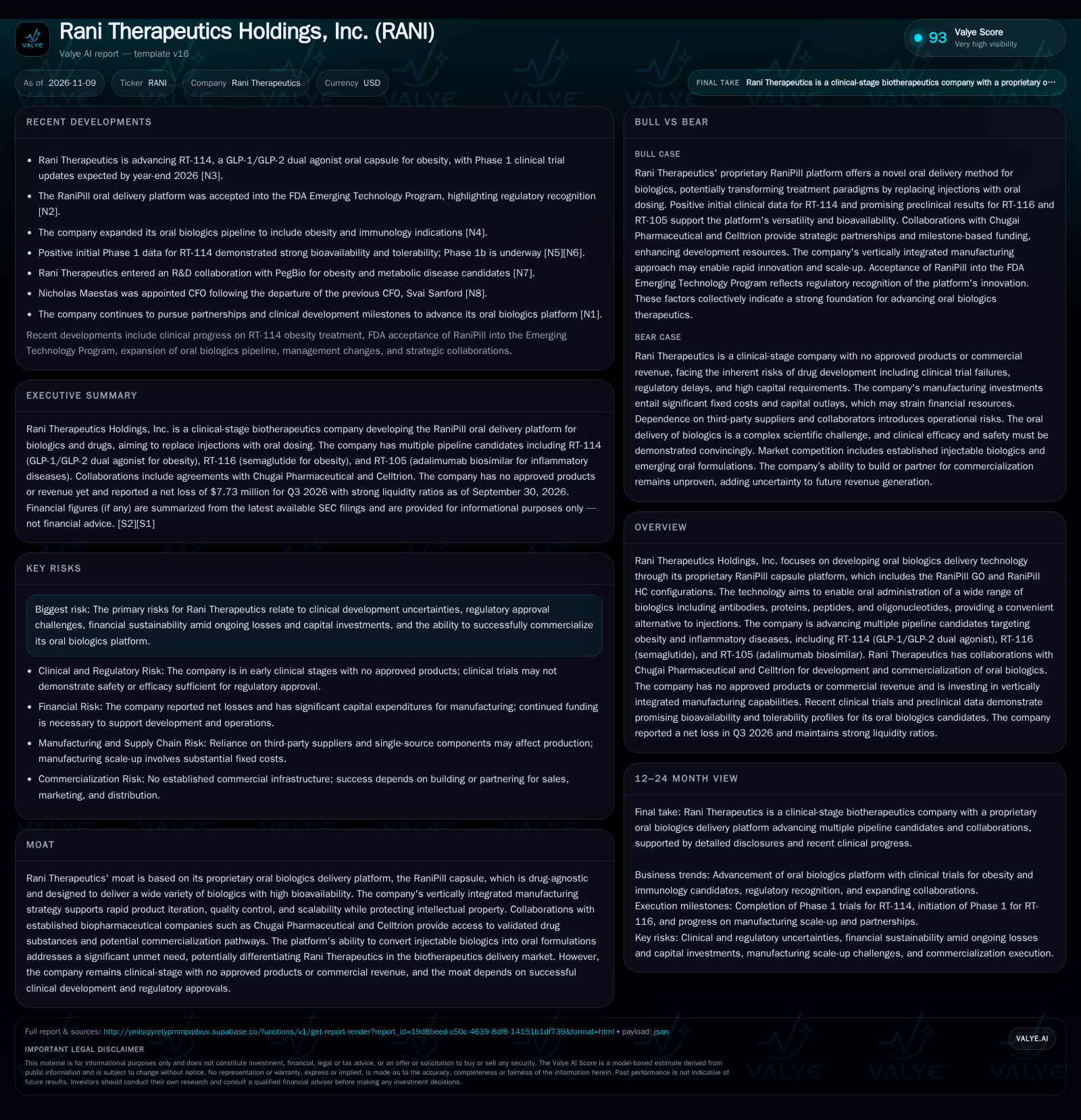
Rani Therapeutics is developing the RaniPill, an oral biologics delivery platform aiming to replace injections for large-molecule drugs. With promising early clinical data, a growing obesity and immunology pipeline, and collaborations with Chugai and Celltrion, the company is positioned for significant value creation if it can surmount clinical, regulatory, and commercialization hurdles. Financial losses continue as Rani invests in manufacturing and R&D, and no commercial revenue has yet been generated. The next 12–24 months hinge on clinical outcomes, partnership expansion, and proof that the technology can achieve regulatory approval and commercial adoption. [S1] [S2] [N1] [N2] [N4] [N5] [N6] [N7] [N8]
Rani Therapeutics stands at a critical juncture as it seeks to redefine biologics delivery through its proprietary RaniPill platform, offering the promise of oral administration for drugs traditionally given by injection. The company’s multi-candidate pipeline, strategic alliances, and initial clinical successes highlight the potential for disruption in large drug markets such as obesity and immunology. However, with no approved products, ongoing financial losses, and the need to scale manufacturing and commercial operations, Rani’s future will be determined by its ability to translate platform promise into regulatory approvals, sustained partnerships, and ultimately, commercial traction. [S1] [S2] [N1] [N2] [N4] [N5] [N6] [N7] [N8]
Recent Clinical Progress and Partnerships Shape Near-Term Prospects
Rani Therapeutics’ development focus is the RaniPill platform, designed to deliver biologics orally—addressing a key patient pain point by potentially replacing injections with pills. The platform has two configurations: RaniPill GO, which has completed three Phase 1 trials, and RaniPill HC, which supports larger molecule delivery and is in preclinical and early clinical stages. Notably, RT-114 (GLP-1/GLP-2 dual agonist) entered Phase 1 clinical trials in December 2025, and positive initial data demonstrated strong bioavailability and tolerability, with a Phase 1b underway. RT-116 (oral semaglutide) is also advancing toward clinical trials, with preclinical data showing pharmacokinetic comparability to injection. [S1] [N5] [N6]
Strategically, Rani has secured collaborations with Chugai Pharmaceutical (hemophilia) and Celltrion (adalimumab biosimilar), providing up to $185 million in potential milestone payments from Chugai plus royalties, and access to validated biologics for its pipeline. The company’s financials reflect its clinical-stage status: Q3 2026 net loss was $7.73 million, cash and equivalents were $3.62 million, and current ratio stood at 5.26. The FDA’s acceptance of RaniPill into the Emerging Technology Program further underscores regulatory recognition but does not equate to approval or de-risking. [S1] [S2] [N2] [N8]
How Rani’s Platform Could Reshape Biologics Economics
Rani’s business thesis is predicated on enabling oral dosing for biologics, a paradigm shift that could unlock patient preference, adherence, and market expansion—particularly in chronic conditions like obesity, diabetes, and autoimmune diseases. If successful, the platform would allow premium pricing versus generics and biosimilars, while capturing a share of the value currently lost to nonadherence and injection aversion.
The company’s economics, however, remain speculative. With no approved products or commercial revenue, near-term cash flow is entirely dependent on milestone payments from partners and periodic capital raises. Vertically integrated manufacturing (in-house design, prototyping, and pilot manufacturing) may yield long-run margin advantages through quality control and rapid iteration, but also brings high fixed costs and capital intensity before scale is achieved. If Rani’s platform is broadly adopted, incremental gross margins may be high due to the drug-agnostic nature of the capsule, but the path to positive operating leverage requires both regulatory approval and significant market penetration.
The structure of Rani’s alliances—with milestones and royalties—suggests a hybrid model: some products may be co-developed and commercialized with partners (lower risk, lower margin), while others could be advanced independently (higher risk, higher reward). The ultimate economics will depend on Rani’s ability to build or partner for commercial infrastructure, pricing power versus incumbent injectables, and the scale of manufacturing cost reductions as volume grows.
Assessing Rani’s Moat in a Crowded Biologics Delivery Landscape
Rani’s main differentiator is its proprietary RaniPill platform, which claims drug-agnostic oral delivery with high bioavailability—a sought-after capability not yet standard in the sector. If validated in later-stage trials, this could confer significant competitive advantage, particularly for drugs with large, chronic patient populations.
However, competition is intense. Established injectable biologics dominate current standards of care, and several large pharma and device companies are pursuing their own oral, patch, or minimally invasive delivery technologies. Rani’s collaborations with Chugai and Celltrion provide validation and access to branded molecules, but do not guarantee market exclusivity or commercial success. Intellectual property around the capsule design, manufacturing processes, and drug-device combinations is crucial; if competing approaches achieve similar bioavailability or if oral small-molecule alternatives emerge, Rani’s advantage could erode.
Switching frictions in chronic disease are significant—patients and physicians may be slow to switch from effective injectables, especially if payors are slow to reimburse new oral formulations. Thus, Rani’s moat will ultimately depend on clinical differentiation, regulatory exclusivity, and the ability to integrate into real-world clinical practice.
If Oral Delivery Proves Out, a Platform Play Unlocks New Markets
In the most optimistic scenario, Rani’s ongoing Phase 1 and future Phase 2/3 trials confirm robust efficacy, safety, and patient adherence advantages for RaniPill-based products (e.g., RT-114 and RT-116). Regulatory approval follows, with the FDA’s Emerging Technology Program support smoothing the path. Commercial partnerships expand, leveraging Chugai, Celltrion, and new collaborators to access global markets and additional indications.
This would position Rani as the enabling platform for oral biologics across multiple therapeutic areas. High-margin royalties and milestone payments, plus direct commercialization of select products, could drive rapid revenue growth and operating leverage. Evidence confirming this trajectory would include positive mid- and late-stage clinical trial readouts, expansion of partnership deals, regulatory filings/approvals, and early commercial traction (formulary wins, prescriber adoption, patient adherence data).
Falsification would occur if pivotal trials fail to replicate early data, if regulatory hurdles prove insurmountable, or if commercial partners withdraw or fail to advance programs.
Commercialization Remains Distant as Clinical and Financial Milestones Dominate
The most plausible near-term scenario is that Rani continues to advance its clinical pipeline, with incremental progress in early- and mid-stage trials for its lead obesity and immunology candidates. Partnerships provide some non-dilutive funding, but the company remains dependent on additional capital infusions to fund R&D, manufacturing, and eventual commercial build-out.
Manufacturing scale-up proceeds cautiously, balancing the need for quality and cost control with cash preservation. Rani may secure additional partnerships, but revenue remains limited to milestones and royalties until at least one product achieves regulatory approval—potentially several years away. The company’s ability to build or partner for commercial infrastructure is untested, and future dilution is likely.
This scenario would be confirmed by steady clinical progress, new or expanded partnerships, and continued but manageable operating losses. It would be falsified if clinical setbacks, regulatory delays, or partner attrition materially slow the pipeline or force drastic cost-cutting measures.
Clinical Setbacks or Capital Constraints Could Threaten Platform Viability
A more adverse scenario involves clinical trial failures, safety concerns, or insufficient bioavailability in later-stage studies—undermining confidence in the RaniPill platform. Regulatory agencies could raise concerns about device reliability or long-term tolerability, delaying or blocking approval.
Financially, persistent net losses and high fixed manufacturing costs could rapidly deplete cash reserves, especially if milestone payments are delayed or partners exit. The company could be forced to halt or scale back programs, pursue dilutive financings at unfavorable terms, or even seek strategic alternatives.
This scenario would be confirmed by negative or inconclusive clinical trial results, regulatory setbacks, withdrawal of key partners, or disclosure of going-concern risks in filings. Conversely, rapid clinical progress, additional non-dilutive funding, or a major strategic partnership would help falsify it.
Milestones That Will Determine Whether Rani’s Platform Can Disrupt Biologics Delivery
Clinical trial readouts for RT-114 (GLP-1/GLP-2 dual agonist) and RT-116 (oral semaglutide), especially mid- and late-stage efficacy, safety, and adherence data.
Progression of RaniPill HC from preclinical to human trials across additional biologics, and demonstration of consistent bioavailability versus injection.
Expansion or renegotiation of strategic partnerships (e.g., new indications, expanded territories, additional milestone payments).
FDA and ex-US regulatory feedback on RaniPill platform and candidate-specific submissions, including any breakthrough or fast-track designations.
Manufacturing scale-up achievements: ability to produce capsules at commercial quality and cost, and supply chain robustness (if disclosed).
Recruitment and retention of executive talent, particularly in clinical, regulatory, and commercial operations.
Cash runway disclosures, capital raise activity, and changes in burn rate as pipeline progresses through value inflection points.
If disclosed, early indicators of commercial traction: payer coverage decisions, prescriber adoption rates, and patient-reported experience with oral formulations.
Disclaimer: This is research-only, informational analysis and not investment advice. It may include AI-generated interpretation and general industry context. Always verify important details using primary sources.

Comments