
Solidion Technology: IP Leverage and Material Innovation in the High-Stakes Battery Race
Solidion Technology’s strong patent portfolio and proprietary silicon anode and fire-retardant electrolyte innovations position it as a differentiated contender in advanced battery materials. Yet, early-stage revenues, technical scale-up risks, and the challenge of commercializing new materials in a conservative supply chain may define its near-term trajectory.
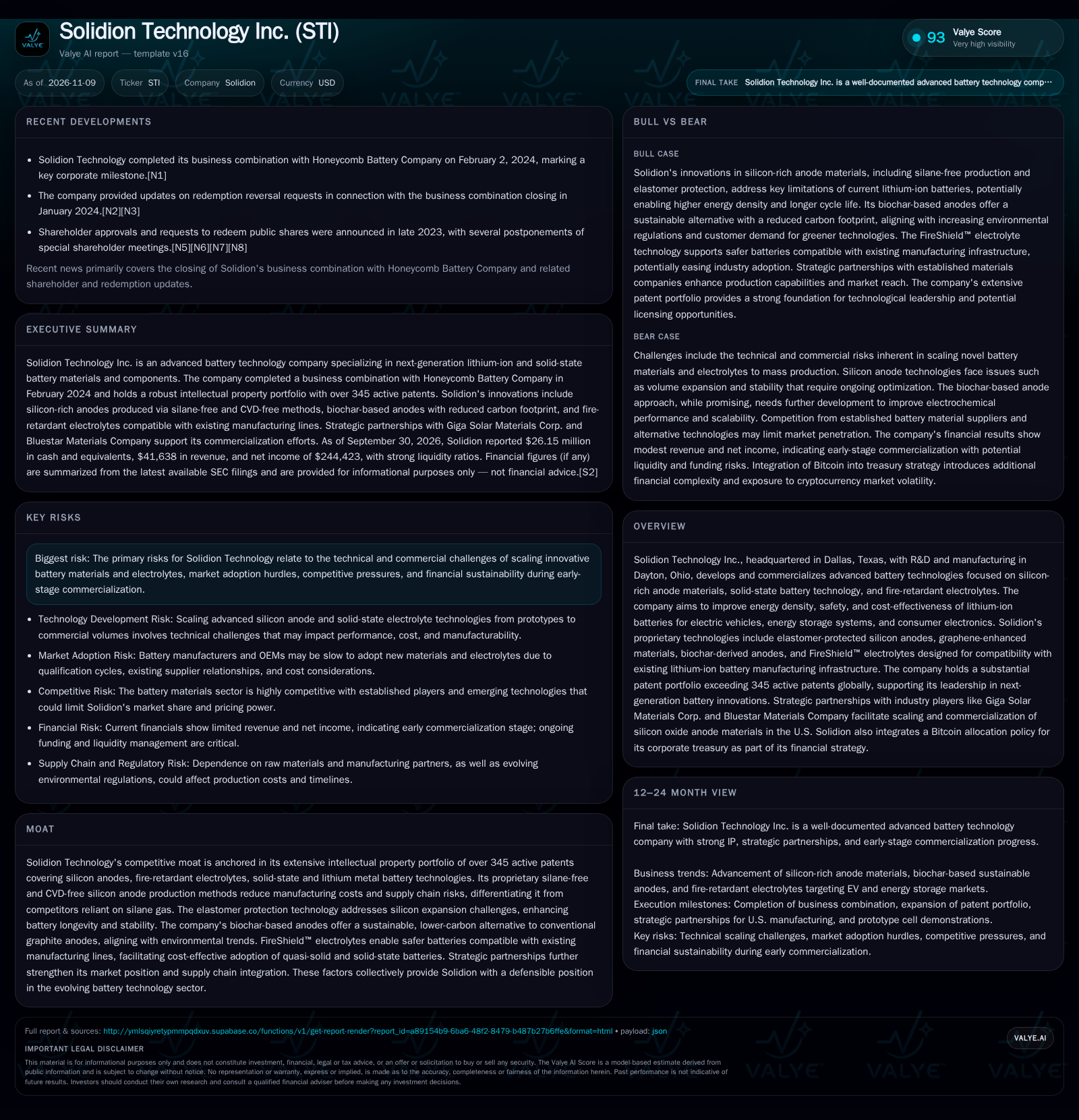
Solidion Technology Inc. is advancing silicon-rich anode, biochar-based, and fire-retardant electrolyte technologies for next-generation lithium-ion and solid-state batteries. With over 345 active patents and strategic partnerships supporting U.S. commercialization, the company’s technical foundation is robust. However, modest early revenues, technical scale-up hurdles, and the slow pace of battery supply chain adoption pose significant challenges to realizing its market potential. [S1] [S2]
Solidion Technology Inc. is building its case as a next-generation battery materials innovator, aiming to unlock higher energy density, improved safety, and sustainability for lithium-ion and solid-state batteries. Its portfolio spans silicon-rich anodes, fire-retardant electrolytes, and biochar-based alternatives—supported by over 345 patents and cost-saving production methods. While strategic partnerships and prototype demonstrations highlight technical progress, Solidion’s revenue remains modest, underscoring the steep commercialization curve for new battery materials in a risk-averse industry. The company’s future hinges on its ability to translate IP and R&D achievements into scalable, bankable supply relationships amid fierce competition and slow-moving qualification cycles. [S1] [S2]
Patent Strength and Early-Stage Commercialization Define 2026 Snapshot
As of September 30, 2026, Solidion Technology reported $26.15 million in cash and equivalents, $41,638 in revenue, and net income of $244,423, with a current ratio of 3.73. [S2] The company’s IP portfolio exceeds 345 active patents, including over 100 U.S. patents related to silicon anode materials, 35+ for fire-retardant electrolytes, and 70+ for solid-state and lithium metal batteries. [S1] Prototype cells using Solidion’s FireShield™ electrolytes have demonstrated 800–900 cycles with enhanced safety. [S1] Strategic partnerships with Giga Solar Materials and Bluestar Materials aim to scale U.S. production of silicon oxide anodes. [S1] These facts illustrate a business with a formidable technical foundation, reported liquidity position for current operations, but at an early stage of revenue generation and commercial adoption.
How Proprietary Materials Could Reshape Battery Cost and Performance
Solidion’s business model centers on monetizing advanced battery materials and components—primarily silicon-rich anodes, fire-retardant electrolytes, and biochar-based alternatives—for electric vehicles, grid storage, and consumer electronics. The company’s silane-free and CVD-free production methods for silicon anodes target a major cost driver in next-gen batteries: traditional silane gas-based processes are capital-intensive and hazardous, while Solidion’s method uses metallurgical-grade or reclaimed silicon, potentially lowering input costs and reducing supply chain concentration. If these materials can be produced at scale, they may offer battery manufacturers a compelling value proposition: higher energy density and longer cycle life at a lower or comparable cost.
The FireShield™ line of quasi-solid and hybrid solid electrolytes is engineered for drop-in compatibility with existing lithium-ion manufacturing lines, which could minimize customer switching costs and accelerate adoption if performance claims hold in commercial settings. The biochar-based anode materials, which claim a 30% reduction in CO2 emissions versus petroleum-derived graphite, may appeal to OEMs under regulatory or ESG pressure. However, the company’s current financials show minimal revenue, suggesting that commercial contracts, licensing, or royalty streams are not yet established at scale. The capital intensity of ramping up material production, coupled with the long qualification cycles typical in the battery supply chain, means operating leverage may remain muted until Solidion secures recurring supply agreements or licensing deals.
Defending a Moat in a Crowded, High-Stakes Battery Materials Arena
Solidion’s core competitive defense lies in its broad, deep patent portfolio across silicon anodes, solid-state batteries, and fire-retardant electrolytes. This IP, combined with proprietary production processes and elastomer encapsulation technology to mitigate silicon expansion, could provide leverage in negotiations with OEMs and battery manufacturers, as well as potential for licensing income. The sustainability angle of biochar-based anodes aligns with tightening environmental standards, potentially differentiating Solidion from traditional graphite suppliers.
However, the battery materials sector is fiercely competitive and risk-averse. Established suppliers (including global chemical majors and Asian battery materials giants) have entrenched relationships, manufacturing scale, and the ability to bundle solutions (cathode/anode/electrolyte) or offer bankable warranties. Startups and university spinouts are proliferating in silicon anodes and solid-state battery materials, sometimes focusing on niche performance attributes or regional supply chains. The main counterforce is the conservatism of battery OEMs: qualification cycles are long, failure tolerance is low, and switching costs—while not always contractual—are high in terms of technical risk and production downtime. Solidion’s partnerships could help de-risk these dynamics, but the challenge is to prove stable, cost-effective supply at commercial scale.
If Qualification and Scale Are Achieved: A Path to Licensing and Supply Agreements
A favorable scenario unfolds if Solidion’s silicon-rich anode and FireShield™ electrolyte technologies pass OEM qualification and pilot production at scale, enabling them to secure recurring supply contracts or lucrative licensing agreements. The key causal chain: prototype performance translates to commercial reliability → OEMs and battery manufacturers validate and qualify Solidion’s materials → manufacturing partners scale up production in the U.S. → revenue inflects through either direct material sales, royalties, or technology licensing.
Evidence that would confirm this scenario includes: announcements of multi-year supply or licensing agreements with major battery or automotive OEMs, significant revenue growth tied to material shipments or royalties, and customer validation of cycle life, safety, and cost advantages in commercial applications. Additional markers could include expansion of U.S. manufacturing capacity and disclosures of recurring revenue streams.
Commercial Pilots, Slow Revenue Build, and Ongoing Technical Hurdles
The most plausible near-term scenario is one in which Solidion continues technical progress—refining silicon anode and electrolyte formulations, demonstrating pilot-scale production, and supporting OEM qualification trials—while revenue builds slowly. In this path, the company may generate modest income from small-batch shipments, grants, or research collaborations, but large-scale supply contracts remain elusive due to the slow pace of supply chain adoption and the need for further performance validation.
Confirmation of this scenario would come from continued prototype announcements, technical milestones (e.g., improved cycle life, safety, or cost metrics), and incremental financial progress without a material step-change in revenues. Evidence to the contrary would be a sudden surge in revenue from commercial contracts or a major licensing deal, or a clear technical setback resulting in customer churn or failed pilot programs.
Failure to Scale or Qualify: Stalled Adoption and Funding Pressures
The adverse scenario is one where Solidion’s technologies encounter persistent technical or manufacturing hurdles, fail to meet OEM qualification standards, or are outcompeted by alternative materials or established suppliers. In this case, the company’s IP and prototype performance do not translate into commercial traction, leading to a prolonged period of low revenue and increasing funding needs.
Confirming evidence would include: repeated delays or lack of progress in customer qualification, technical issues with scale-up (e.g., inconsistent material quality, uncompetitive costs, or poor cycle life in commercial cells), and financial disclosures indicating higher burn rates or the need for additional capital raises. A lack of new strategic partnerships or customer pilots may also signal stalled market interest.
Milestones That Could Validate—or Undermine—Solidion’s Commercialization Thesis
The announcement of multi-year supply or licensing agreements with major battery or automotive OEMs.
Material, sustained growth in revenue directly attributed to battery material shipments or royalties—if disclosed.
OEM or manufacturing partner validation of cycle life, safety, and cost advantages for Solidion’s silicon anode and FireShield™ electrolyte technologies.
Expansion of U.S. pilot or commercial-scale production capacity with Giga Solar Materials or Bluestar Materials.
Disclosures of recurring revenue streams or backlog from battery materials customers—if disclosed.
Technical milestones, such as public demonstration of cell performance in commercial or automotive settings.
Evidence of increased R&D or capital expenditures tied to customer-driven scale-up.
Any regulatory or safety certification wins that could accelerate adoption, particularly in automotive or grid storage markets.
Disclaimer: This is research-only, informational analysis and not investment advice. It may include AI-generated interpretation and general industry context. Always verify important details using primary sources.

Comments