
Qualys: Profitability, Cloud Security Scale, and the Stakes of Innovation in a Crowded Cyber Market
Qualys has delivered another quarter of outperformance, raising revenue guidance and sustaining industry-leading margins. But as cloud-based cybersecurity becomes more crowded and customer needs evolve, the company’s ability to defend its platform economics and sustain differentiation faces new challenges in pricing, innovation, and enterprise renewal.
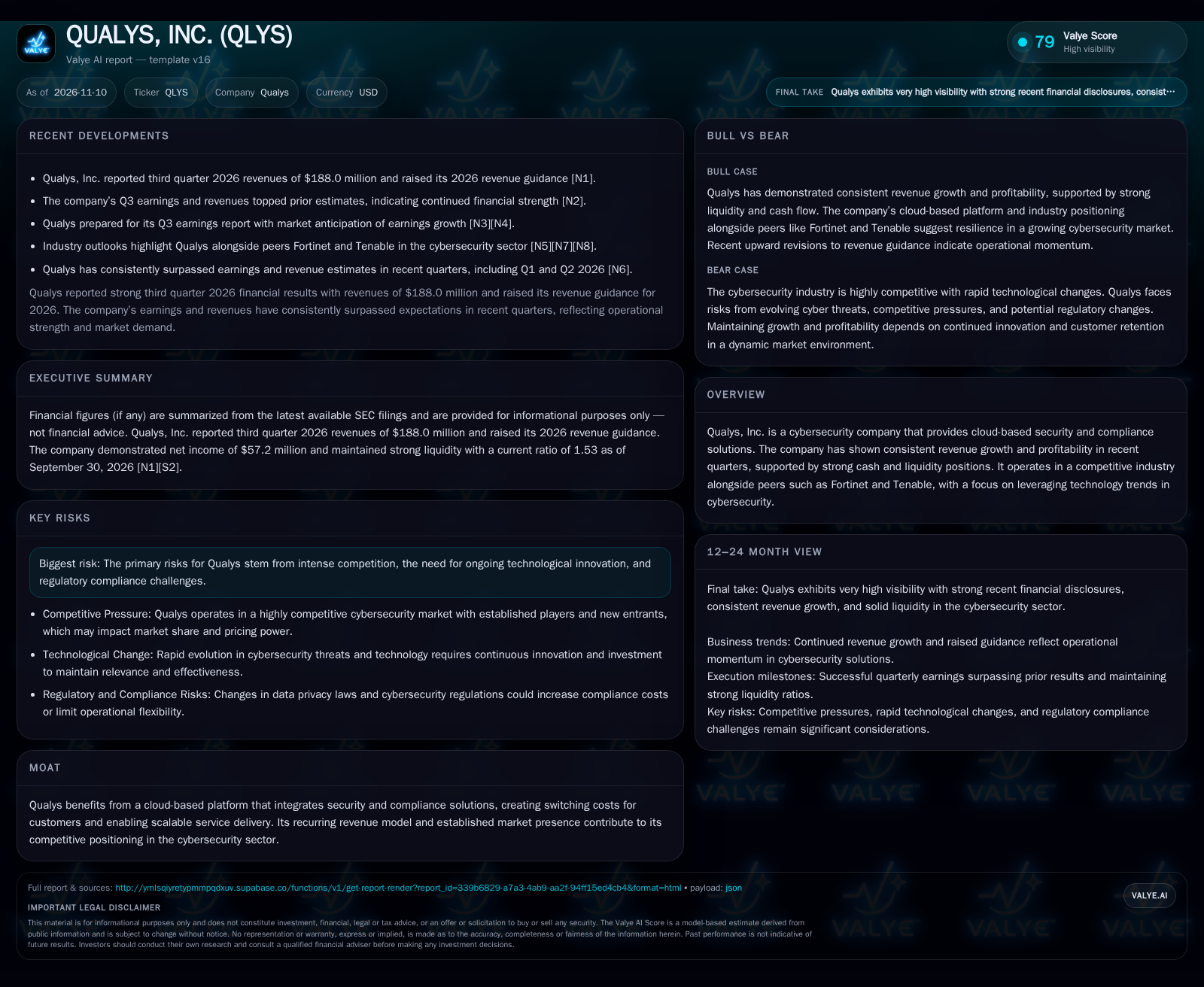
Qualys reported Q3 2026 revenues of $188.0 million, raised its full-year guidance, and posted net income of $57.2 million. The company maintains reported liquidity position, but must continue to innovate amid intense competition from peers such as Fortinet and Tenable. Its cloud-based platform model could support operating leverage, but pricing power and customer retention remain critical to the long-term outlook. [N1] [S2]
Qualys, Inc. stands out in the cybersecurity sector for its consistent financial outperformance and reported liquidity position, recently reporting Q3 2026 revenues of $188.0 million and raising its revenue outlook for the year. The company’s cloud-based security platform model has delivered sustained profitability, with net income of $57.2 million in the latest quarter. However, the same market forces driving sector growth—cloud adoption, evolving threats, and regulatory pressures—also amplify competitive intensity. The company’s future will be shaped by its ability to maintain platform differentiation, innovate at pace, and defend pricing and renewal economics as enterprise buyers face an expanding menu of options. [N1] [S2]
Recent Outperformance and Upward Guidance Reset the Baseline
Qualys reported third quarter 2026 revenues of $188.0 million and raised its full-year revenue guidance, marking a continuation of its trend of exceeding quarterly earnings and revenue expectations. Net income for the quarter reached $57.2 million, translating to basic EPS of $1.64 and diluted EPS of $1.62. As of September 30, 2026, the company held $357.2 million in cash and cash equivalents, with current assets of $723.0 million and current liabilities of $473.8 million. This yields a current ratio of 1.53 and a cash ratio of 1.6. The company reported cash and liquidity metrics for the period; these figures do not by themselves establish operating runway, investment capacity, financial flexibility, or financing capacity. However, the material facts most likely to shape the thesis are the combination of raised revenue guidance—implying upward revision of management’s near-term outlook—and the persistence of high profitability in a sector where intensifying competition could pressure margins. [N1] [S2]
Cloud Platform Model: Recurring Revenue, Margins, and Operating Leverage
Qualys’ core business model is built on a cloud-based platform delivering security and compliance as a service. In broad terms, this model is characterized by high gross margins, recurring revenue streams, and the potential for operating leverage as customer count and usage scale. Pricing is typically per asset, per endpoint, or by subscription tier, with upsell opportunities as customers expand coverage or adopt additional modules. Variable costs are relatively low, with the main expense drivers being R&D, sales and marketing, and cloud infrastructure. If Qualys maintains pricing power and renewals, incremental revenue should largely drop through to the bottom line after fixed costs.
However, as the cybersecurity landscape matures and competitors push aggressive pricing or bundled offerings, the risk is that price competition could compress margins or force increased sales and marketing spend to defend share. The capital intensity of the model is moderate—cloud infrastructure is scalable, and R&D is critical but not as lumpy as hardware-centric models.
Platform Differentiation, Switching Frictions, and the Reality of Cybersecurity Substitution
Qualys is positioned among leading cloud-native cybersecurity vendors, with direct competition from peers such as Fortinet and Tenable, and indirect competition from broader enterprise security suites and emerging platform consolidators. Its integrated platform—spanning vulnerability management, compliance, and endpoint protection—creates some switching costs for customers who have standardized workflows and reporting on Qualys. Integration with enterprise IT environments and regulatory frameworks also increases friction for migration.
Nonetheless, switching costs in SaaS security are not absolute. Buyers are increasingly sophisticated, often running multi-vendor strategies or evaluating best-of-breed modules. The risk is that as other vendors expand their own platform breadth or undercut on price, Qualys could see deceleration in new logo wins or increased churn at renewal. Competitive advantage will hinge on the pace of product innovation, efficacy in threat detection, and the ability to demonstrate ROI to enterprise customers. The company’s established brand and track record are assets, but the sector’s dynamism means no positioning is permanent.
Sustained Innovation and Enterprise Expansion Unlock Margin Acceleration
In the most favorable scenario, Qualys leverages its balance sheet strength and operational momentum to accelerate investment in both core platform capabilities and adjacent security modules. Successful innovation—such as AI-driven threat analytics or seamless integration with cloud-native infrastructure—could deepen customer engagement and drive expansion within existing accounts. If enterprise customers consolidate spend on the Qualys platform, renewal rates could rise and average contract values could expand, supporting both revenue growth and incremental margin expansion as fixed costs are leveraged.
Evidence for this scenario would include continued outperformance on revenue and earnings, rising net retention rates (if disclosed), and visible adoption of new modules or features. Analyst upgrades, customer case studies, and increased wallet share among large enterprise accounts would further validate the thesis. Confirmation would also come from the company maintaining or even expanding its gross and operating margins in the face of competitive pressure.
Platform Growth Continues, but Competitive Intensity Caps Margin Upside
The most plausible trajectory is that Qualys continues to grow revenues at a moderate pace, supported by secular demand for cloud-native cybersecurity and regulatory-driven compliance spending. While the company’s platform model enables recurring revenue and operational stability, competitive intensity from peers and new entrants likely forces increased investment in R&D and sales, limiting further margin expansion.
In this scenario, renewal and retention rates remain healthy, but average selling prices may face pressure as procurement teams push back or as alternative vendors offer bundled discounts. Confirmation would come from revenue growth tracking management guidance, stable gross margins, and operating expenses rising in line with or slightly ahead of revenue. Falsification would occur if revenue growth stalls or if margin compression accelerates beyond peer benchmarks.
Price Compression and Churn Erode Profitability Amid Shifting Buyer Preferences
A more adverse outcome could emerge if competitive pricing, bundled offerings, or technological disruption drive a wave of customer churn or force Qualys to discount aggressively to defend its installed base. In this scenario, renewal rates deteriorate and net new growth slows, while operating expenses rise as the company expends more to retain share and keep pace with innovation. The result would be margin compression—potentially eroding the historic profitability advantage.
Evidence would include a downward revision to revenue guidance, declining gross or operating margins, and any disclosure of elevated churn or lower net retention rates (if disclosed). Negative analyst commentary, customer loss announcements, or a visible slowdown in module adoption would further confirm this scenario. The key question is whether Qualys can pivot quickly enough to offset such pressures with new value-added services or targeted acquisitions.
Signals That Will Define the Durability of Qualys’ Platform Model
Net retention rate trends (if disclosed) would provide direct visibility into customer expansion and churn dynamics, testing the stickiness of the platform.
Gross and operating margin evolution relative to both historical levels and peer benchmarks will indicate whether competitive and pricing pressures are eroding profitability.
R&D and sales and marketing expense as a percentage of revenue: sustained increases could signal intensified competition or the need for accelerated innovation.
Average contract value and upsell/cross-sell rates (if disclosed) would reveal the company’s success at deepening customer relationships and expanding wallet share.
Any changes in management’s revenue guidance or commentary on demand trends, especially around enterprise renewal cycles, would be material.
Evidence of accelerated customer adoption of new modules, such as AI-driven analytics or cloud-native integrations, would signal successful innovation.
Announcements of customer wins or losses—especially among large enterprises—would help gauge competitive positioning.
Regulatory or industry developments impacting cybersecurity budgets or compliance requirements could either boost demand or increase operational complexity.
Disclaimer: This is research-only, informational analysis and not investment advice. It may include AI-generated interpretation and general industry context. Always verify important details using primary sources.

Comments