
biote Corp.: Platform Leverage, Practitioner Network Dynamics, and the Sustainability of Hormone Optimization Economics
biote Corp. blends practitioner training, proprietary practice management, and branded supplements to address hormone imbalance, but faces legal uncertainties and credit covenant constraints. The business model’s scalability depends on expanding its certified provider base, deepening practitioner loyalty, and navigating operational risks that could disrupt growth.
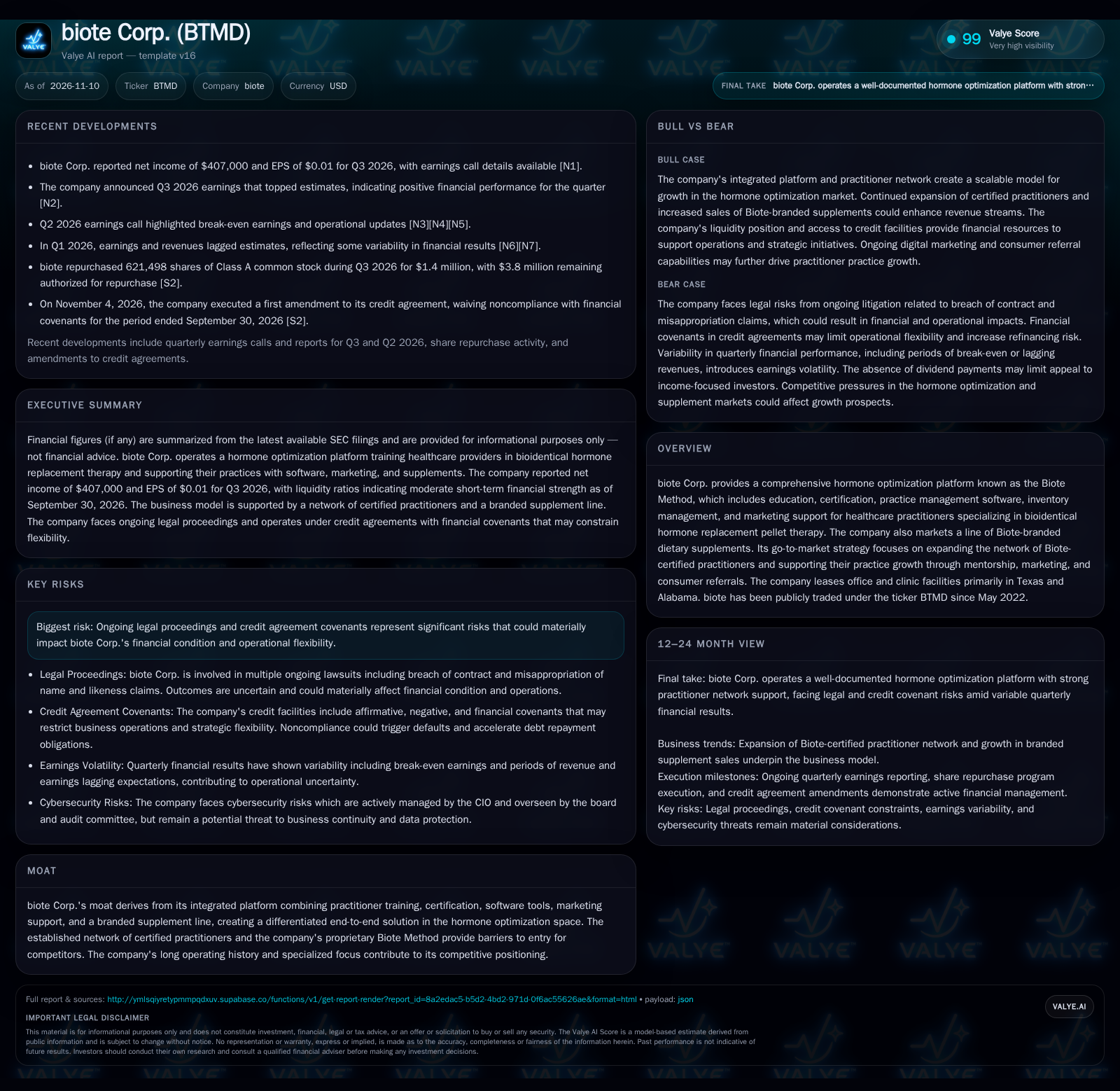
biote Corp. operates an integrated hormone optimization platform, combining practitioner education, certification, and proprietary software with a growing suite of branded supplements. Recent earnings outperformed estimates in Q3 2026, but credit agreement amendments and ongoing legal proceedings highlight operational and financial risks. The company’s ability to expand its practitioner network and drive recurring supplement sales will be central to sustaining growth.[S2] [N2]
biote Corp. sits at the intersection of medical practice enablement and health optimization, offering a turnkey platform for hormone replacement therapy practitioners. Its model extends beyond product sales, embedding itself in the workflows of certified providers through training, software, and branded supplements. This integrated approach offers a pathway to sticky, recurring revenues—if biote can continue to grow its practitioner network and deepen customer engagement. However, recent credit covenant waivers and ongoing legal disputes underscore the fragility of its operating environment. As the hormone optimization market becomes more competitive, the durability of biote’s differentiation and the scalability of its model will be put to the test.
Recent Performance, Legal Tensions, and Potential Financial Flexibility in Focus
biote Corp. reported Q3 2026 earnings that exceeded expectations, providing a short-term boost to its financial narrative after a period of earnings volatility—including break-even results in Q2 and underperformance in Q1.[N2] [N4] [N7] This operational momentum is partly offset by a recent amendment to its credit agreement, which waived noncompliance with financial covenants for the period ended September 30, 2026.[S2] The need for such an amendment suggests that biote’s potential financial flexibility is under scrutiny, with potential implications for future borrowing or investment capacity.
As of September 30, 2026, biote held $8.85 million in cash and $41.76 million in current assets against $30.5 million in current liabilities, yielding a current ratio of 1.37 and a cash ratio of 0.95. The company reported cash and liquidity metrics for the period; these figures do not by themselves establish operating runway, investment capacity, financial flexibility, or financing capacity. [S2]
Ongoing legal proceedings—including lawsuits for breach of contract and misappropriation—remain unresolved, introducing uncertainty around potential financial and reputational impacts. The company’s decision to repurchase 621,498 shares in Q3 2026, with $3.8 million remaining under its buyback authorization, demonstrates an active capital management stance in the face of these risks.[S2]
How Platform Integration and Practitioner Growth Drive Revenue Streams
biote’s core economic engine is its multi-pronged platform for hormone optimization practitioners. Revenue is generated through training and certifying providers, licensing proprietary practice management and inventory tools, and selling a portfolio of 26 branded dietary supplements.[S2] The platform’s economics are predicated on expanding the number of active Biote-certified practitioners, each of whom represents a recurring channel for both software and supplement sales.
The underlying business model appears to blend upfront practitioner onboarding revenues with ongoing, lower-churn subscription or usage fees for software and recurring supplement purchases. If the company succeeds in embedding its software and product suite into practitioner workflows, switching costs could increase, supporting pricing power and high retention. However, the specific commercial mechanics—such as contract duration, recurring revenue proportion, or practitioner churn—are not disclosed and remain critical unknowns.
Operating leverage could materialize as the practitioner base scales, given that training content, software, and marketing infrastructure are largely fixed-cost investments. However, supplement sales likely carry variable costs and may be exposed to margin compression if competition intensifies or if practitioners opt for alternative suppliers. The business also faces capital requirements tied to technology updates, legal contingencies, and maintaining compliance with lender covenants—each of which can influence free cash flow and reinvestment capacity.
Differentiation Through Integration: Barriers and Threats in the Hormone Optimization Market
biote’s primary differentiation lies in its integrated, end-to-end platform—spanning practitioner education, certification, proprietary software, inventory management, and a branded supplement line. This holistic approach reduces friction for providers seeking to enter or expand within the hormone optimization niche and may increase switching costs if practitioners become reliant on biote’s ecosystem for compliance, workflow, and patient engagement.
Barriers to entry for new competitors include the need to replicate biote’s practitioner network, develop proprietary training and software, and build regulatory credibility in a sensitive segment of medical practice. However, the landscape is fluid: larger healthcare IT vendors, specialty pharmaceutical suppliers, or vertically integrated telehealth platforms could target the same practitioner segment with bundled offerings or lower-cost alternatives.
Within the supplement market, biote faces competition from both established nutraceutical brands and direct-to-consumer wellness startups. The company's success will depend on its ability to maintain practitioner loyalty and demonstrate superior clinical or business outcomes—advantages that may erode if rivals offer more flexible, innovative, or cost-effective solutions.
Network Effects and Platform Stickiness Could Unlock Scalable Growth
A favorable scenario for biote hinges on accelerating practitioner adoption of its platform, driving compound growth in both onboarding revenues and recurring supplement sales. If biote can demonstrate strong practitioner retention and increased per-practitioner sales—potentially through deeper integration of its software, enhanced marketing support, or superior clinical outcomes—the business could achieve operating leverage and margin expansion.
Evidence that would confirm this scenario includes sustained growth in the number of active Biote-certified practitioners, rising average revenue per practitioner, and disclosure of high retention or low churn rates. Additional confirmation would come from supplement sales outpacing practitioner growth, suggesting increasing wallet share per provider. Demonstrated pricing power or new product launches that command premium positioning would further reinforce the upside thesis.
This scenario could be falsified if practitioner expansion stalls, if churn rates rise (if disclosed), or if supplement revenues plateau despite network growth—indicating limited cross-sell or stickiness.
Provider Expansion and Legal Uncertainty Define the Most Likely Trajectory
The most plausible path for biote is continued, albeit potentially uneven, expansion of its practitioner network, with organic growth in supplement sales tracking that expansion. Revenue may remain sensitive to fluctuations in onboarding volumes and practitioner engagement, while operating margins are pressured by legal costs, compliance, and periodic investment in platform capabilities.
Share repurchases may continue opportunistically, but dividend payments are unlikely given stated capital priorities.[S2]
Confirmation of this scenario would come from steady sequential growth in practitioner numbers (if disclosed), stable gross margins, and no material adverse legal or credit events. Falsification would include further covenant breaches, significant legal judgments, or a pronounced slowdown in practitioner onboarding.
Legal and Credit Risks Could Disrupt Operations and Undermine Network Growth
A negative scenario would materialize if legal proceedings result in substantial adverse judgments, settlements, or reputational damage, prompting practitioner attrition or deterring new providers from joining the platform. Simultaneously, failure to comply with credit agreement covenants could restrict access to capital, force asset sales, or accelerate debt repayment, constraining investment in platform improvements and customer acquisition.
This scenario could also be triggered by intensified competition—if alternative platforms or supplement providers capture market share, eroding practitioner loyalty and compressing margins. Financially, persistent earnings underperformance or negative operating cash flow could force further cost cuts or raise questions about long-term viability.
Confirmation of the downside would involve new or escalated legal losses, additional covenant waivers or defaults, and a visible slowdown or decline in practitioner network size (if disclosed) or supplement revenue. Falsification would require resolution of key legal matters without material impact and restoration of covenant compliance without further amendments.
Milestones and Metrics That Will Shape biote Corp.’s Strategic Trajectory
Quarterly growth in the number of active Biote-certified practitioners—if disclosed—would directly signal network expansion and platform adoption.
Average revenue per practitioner and supplement sales per provider would help test the depth of practitioner engagement and cross-sell effectiveness.
Gross and operating margin trends, especially in light of supplement mix and legal/compliance costs, will reveal underlying business quality.
Disclosure of practitioner retention or churn rates would clarify the stickiness of the platform and the sustainability of recurring revenues.
Updates on the resolution, settlement, or escalation of ongoing legal proceedings remain critical for gauging financial and reputational risk.
Compliance with credit agreement covenants and any further amendments or waivers will be key for assessing potential financial flexibility and lender confidence.
Evidence of new product launches, expanded software capabilities, or strategic partnerships could indicate successful reinvestment and differentiation.
Practitioner or patient satisfaction metrics—if made available—would help assess the competitive position and defensibility of the Biote Method.
Disclaimer: This is research-only, informational analysis and not investment advice. It may include AI-generated interpretation and general industry context. Always verify important details using primary sources.

Comments