
Empire State Realty: New York City Asset Leverage, Observatory Resilience, and the Stakes of Portfolio Concentration
Empire State Realty OP, L.P. blends iconic Manhattan real estate—including the Empire State Building and its Observatory—with a strategy focused on high-occupancy, modernized offices and selective portfolio rotation. As sector-wide volatility and tourism shifts challenge NYC landlords, the company's financial posture, debt structure, and revenue mix offer both potential insulation and unique risks.
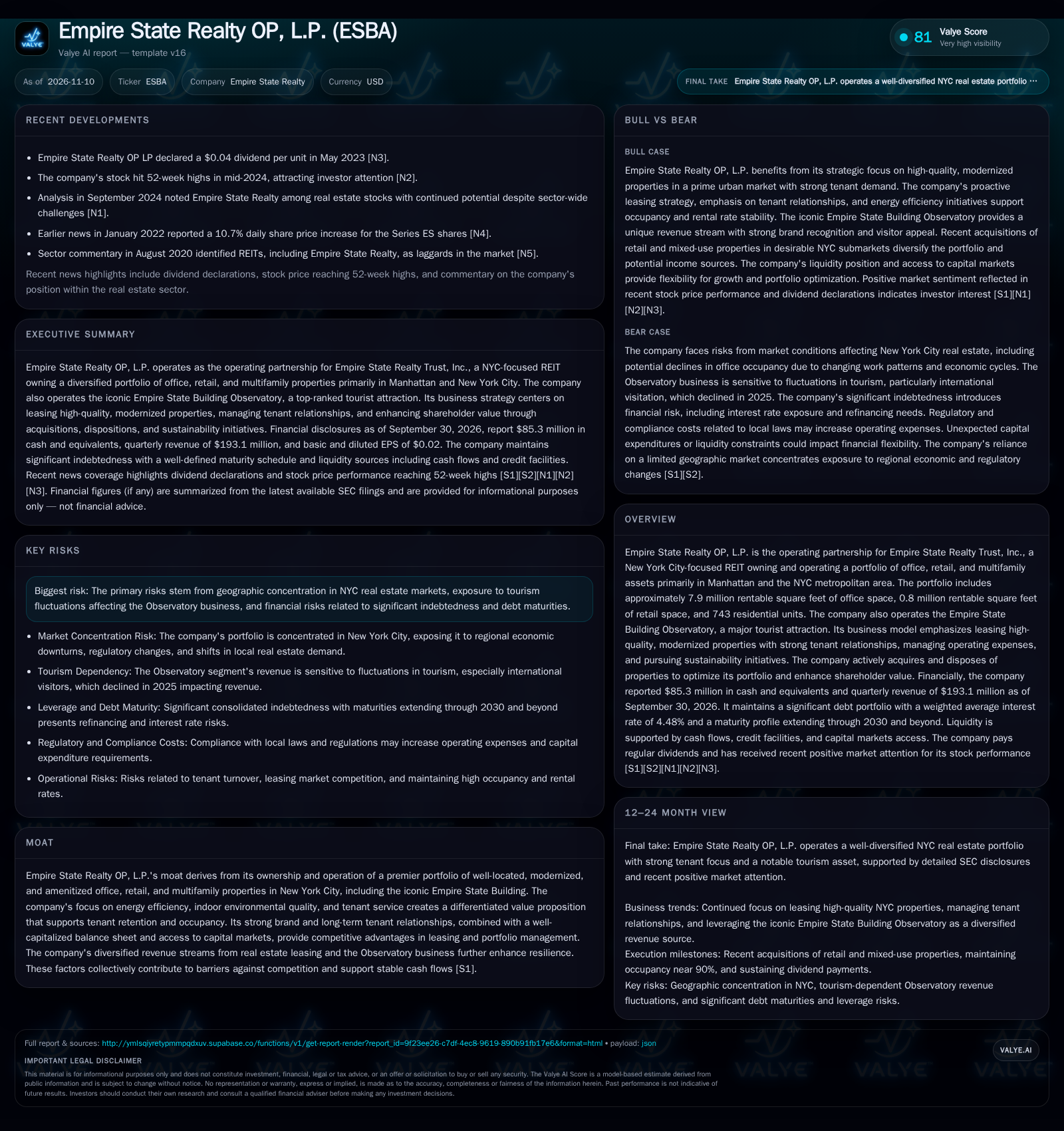
Empire State Realty OP, L.P. operates a concentrated portfolio of New York City office, retail, and multifamily assets anchored by the Empire State Building and its Observatory. With occupancy near 90% in Manhattan offices (excluding redevelopment properties), 2025 Observatory visitation of 2.3 million, quarterly revenue of $193.1 million as of September 2026, and $85.3 million in cash, the company balances robust urban asset positioning against significant debt and variable tourism trends [S1] [S2].
Empire State Realty OP, L.P. stands at the intersection of Manhattan’s enduring real estate appeal and the evolving realities of urban office and tourism markets. With a portfolio anchored by the Empire State Building and Observatory, the company’s recent operational and financial disclosures reveal both the resilience and concentration risks inherent to its NYC-centric model. As the business navigates occupancy stabilization, tourism variability, and a substantial debt load, its next phase will test whether iconic assets and portfolio discipline can drive durable returns in a shifting urban landscape.
Recent Performance: Occupancy, Observatory Traffic, and Capital Structure Dynamics
As of September 30, 2026, Empire State Realty OP, L.P. reported quarterly revenue of $193.1 million and held $85.3 million in cash and equivalents [S2]. The company’s Manhattan office portfolio (excluding redevelopment properties) maintained occupancy near 90%, reflecting the strength of its flight-to-quality leasing strategy in a competitive market [S1]. The Empire State Building Observatory drew approximately 2.3 million visitors in 2025—a decline from 2.6 million in 2024—largely attributed to reduced international tourism, though domestic traffic partially compensated [S1]. On the balance sheet, the company manages about $2.4 billion in consolidated indebtedness, with an average interest rate of 4.48% and maturities extending through 2030 and beyond [S1]. These facts frame a business balancing robust urban asset performance with exposure to tourism cycles and substantial financial leverage.
How Revenue Mix and Cost Structure Shape Returns
Empire State Realty OP, L.P.’s economics are fundamentally driven by two distinct but complementary engines: commercial real estate leasing and Observatory admissions. Office and retail leases are typically long-term, providing a base of recurring revenue with some inflation protection and opportunities for rental rate resets at expiration. Operating leverage is significant—fixed costs for building operations and debt service are high, so incremental leasing, especially of premium space, can meaningfully improve margins if market demand holds.
The Observatory is a high-margin, ticketed attraction that offers variable revenue, sensitive to tourism flows but relatively insulated from broader office market cycles. Because the Observatory operates by reservation only and emphasizes revenue per visitor, the business can flex pricing and manage capacity to optimize returns. However, labor, marketing, and security costs are semi-variable and can rise with visitation.
Capital requirements remain material: periodic renovations, sustainability upgrades, and tenant improvements are necessary to retain premium positioning and meet evolving regulatory standards. The company’s significant debt load introduces fixed interest costs, amplifying sensitivity to occupancy and rental rates. Access to credit and capital markets, as well as the ability to recycle capital through acquisitions and dispositions, are crucial to maintaining balance sheet flexibility and supporting growth.
Brand Power, Asset Quality, and the Reality of Urban Competition
Empire State Realty’s competitive moat rests partly on the iconic status and location of the Empire State Building, which not only anchors its portfolio but also supports a premium for both tenants and Observatory visitors. Its broader portfolio benefits from a consistent modernization strategy—energy efficiency, amenities, and tenant experience—positioning it favorably against older, less-invested stock in Manhattan.
However, the New York City office market remains intensely competitive, with supply-demand imbalances, ongoing remote/hybrid work adoption, and substantial new or repositioned space from peers and new developments. While flight to quality has benefited top-tier assets, the risk is that even modernized properties see slower leasing or greater concessions if macroeconomic or industry-specific pressures intensify.
The Observatory’s advantage is less easily replicated, but faces substitution risk from other NYC attractions and is dependent on global travel trends. Multifamily and retail assets provide some diversification, but these segments are also exposed to local economic cycles and shifting consumer behavior. The company’s geographic concentration, while supporting operational focus, exposes it to regional policy, tax, and economic volatility.
What Could Unlock Outperformance: Demand Resurgence and Efficient Capital Rotation
A favorable scenario would see continued flight to quality driving strong leasing volumes and rising effective rents, particularly as businesses recalibrate space needs and prioritize modern, amenity-rich environments. If Empire State Realty sustains occupancy near or above 90% while also achieving rent growth, the high fixed-cost structure would yield meaningful operating leverage and cash flow expansion.
On the Observatory side, a rebound in international tourism—driven by macroeconomic recovery, currency stabilization, or successful NYC marketing—could restore or exceed pre-pandemic visitation levels. Because the Observatory emphasizes revenue per visitor, even modest increases in high-spending tourist segments could disproportionately boost margins.
Asset recycling—timely sales of non-core properties and accretive acquisitions in high-growth submarkets—could further enhance portfolio quality and earnings stability. Confirmation would come from reported increases in occupancy, same-store NOI growth, higher Observatory ticket revenue, and successful refinancing or reduction of debt at favorable rates. Conversely, evidence of stagnant occupancy, weak rent growth, or persistent tourism softness would undermine this scenario.
Stability Anchored by Mixed Revenue Streams and Prudent Portfolio Management
The most plausible outcome is continued moderate leasing success in office and retail, with occupancy maintained near current levels and modest rent escalations offsetting operating cost inflation. The Observatory business remains resilient, with domestic visitation partially compensating for sluggish international recovery, stabilizing at or near 2025 levels.
Portfolio optimization—incremental asset sales and selective acquisitions—contributes to steady, if unspectacular, earnings and cash flow, while the company manages its debt maturities without major refinancing stress.
Downward deviation in any of these areas, especially if accompanied by widening office vacancy or Observatory underperformance, would challenge the base case.
How Adverse Shocks Could Expose Vulnerabilities: Concentration and Leverage Risks
A negative scenario could unfold if New York City office demand weakens further, driven by economic downturn, persistent remote work adoption, or new supply outpacing absorption. Under such conditions, even high-quality assets could see declining occupancy, increasing concessions, and downward pressure on rents, reducing base cash flow and exacerbating fixed-cost leverage.
If international tourism fails to recover or domestic visitation wanes—due to global macro shocks, geopolitical issues, or negative NYC-specific developments—the Observatory’s revenue could fall further, eroding one of the company’s highest-margin businesses. In parallel, unexpected capital expenditure requirements (such as major building retrofits or regulatory compliance) could strain liquidity.
The company’s $2.4 billion debt load would become more burdensome if refinancing occurs at higher rates or if access to credit tightens. Adverse conditions might necessitate asset sales at unattractive prices or even dividend reductions. Confirmation would come from declining occupancy, shrinking Observatory visitation, downward revisions to revenue guidance, or negative credit events such as covenant breaches or rating downgrades.
Milestones and Metrics That Will Test the Empire State Realty Thesis
Quarterly occupancy rates in the Manhattan office portfolio (excluding redevelopment properties), especially relative to peer benchmarks and pre-pandemic norms.
Year-over-year visitation and revenue per visitor trends for the Empire State Building Observatory, with particular attention to the mix of domestic versus international guests.
Same-store net operating income (NOI) growth rates across office, retail, and multifamily segments, if disclosed.
Timing, pricing, and nature of asset acquisitions and dispositions—whether they enhance average asset quality and income stability.
Progress in refinancing upcoming debt maturities, changes in the weighted average interest rate, and any shifts in credit facility utilization.
Trends in cash reserves and sources of liquidity, particularly in the face of capital expenditure needs or adverse market shocks.
Regulatory and compliance cost disclosures, including any new local law impacts or required capital outlays for sustainability or safety upgrades.
Disclaimer: This is research-only, informational analysis and not investment advice. It may include AI-generated interpretation and general industry context. Always verify important details using primary sources.

Comments