
FirstSun Capital Bancorp: Scaling Through M&A While Navigating Credit and Integration Complexity
FirstSun Capital Bancorp’s recent expansion—culminating in the completed acquisition of First Foundation Inc.—positions the company in key growth markets, but raises the stakes for credit oversight, operational integration, and competitive adaptation. The interplay of rising interest income, a diversified geographic and product mix, and the complexity of merger execution will shape sustainable earnings power.
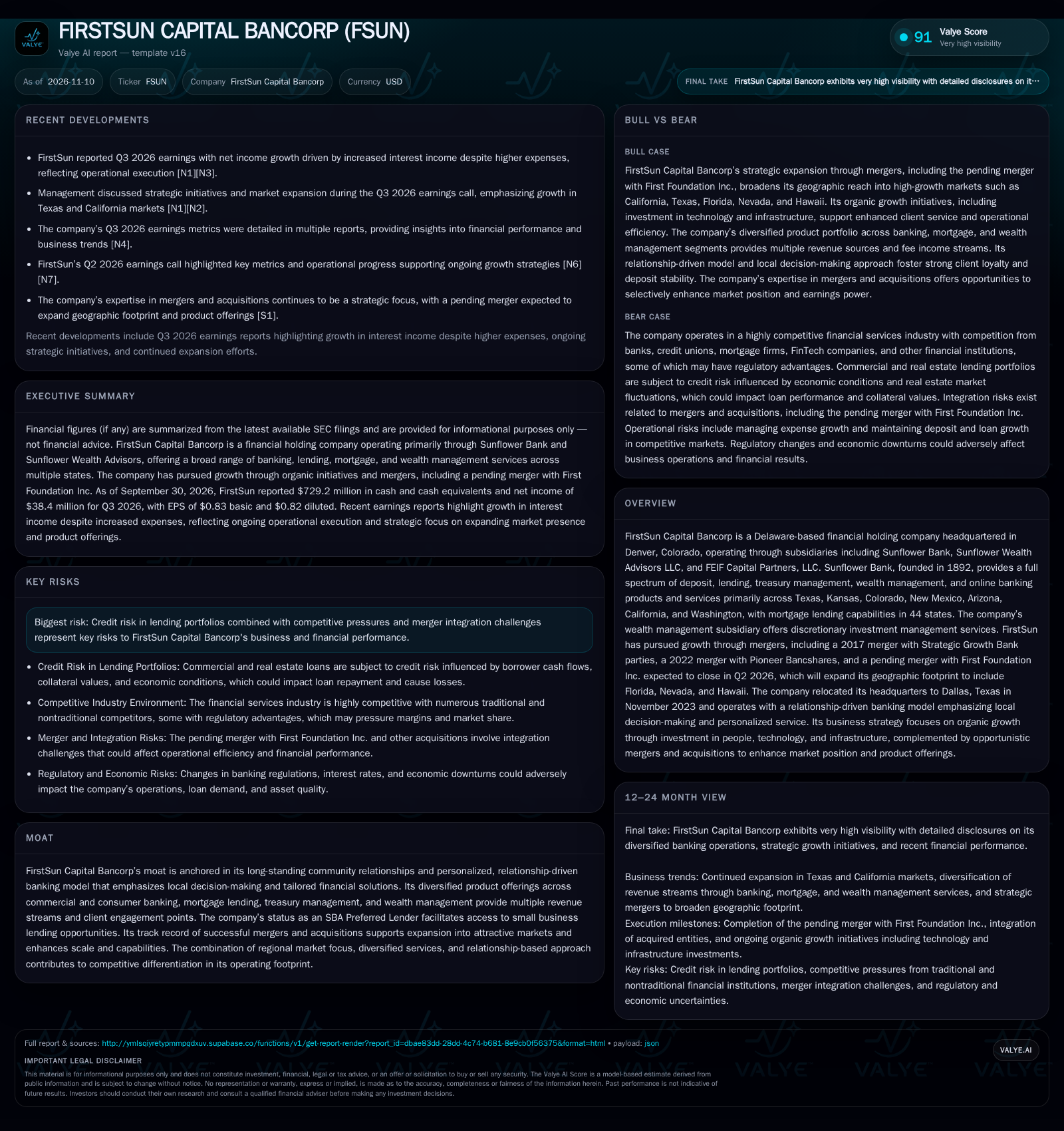
FirstSun Capital Bancorp has completed its acquisition of First Foundation Inc., extending its geographic reach and deposit base. Q3 2026 results show net income growth on higher interest income, even as expenses rise. The company’s relationship-driven banking and expanded footprint offer long-term opportunity, but integration, credit, and competitive risks remain pronounced. The sustainability of recent earnings growth will hinge on merger synergy realization, asset quality, and disciplined balance-sheet management. [S2] [N1] [N3]
FirstSun Capital Bancorp’s transformation from a regional player into a multi-state banking platform has accelerated with the completed First Foundation Inc. acquisition. The company’s Q3 2026 results reflect the immediate benefits of a larger deposit and loan base, as well as the pressures of higher operating expenses tied to integration and market expansion. As FirstSun seeks to leverage its relationship-driven model across a wider footprint, its ability to manage credit risk, realize merger synergies, and compete for deposits and loans in saturated markets will determine whether its recent growth can be sustained and translated into superior returns.
Recent Milestones: Merger Completion and Earnings Performance
In April 2026, FirstSun Capital Bancorp completed its acquisition of First Foundation Inc., merging First Foundation Bank into Sunflower Bank and extending its footprint into California, Florida, Nevada, and Hawaii. This transformative deal has materially increased the company’s scale, particularly in high-growth Western and Sun Belt markets. As of September 30, 2026, FirstSun reported $8.5 billion in total assets, $7.1 billion in deposits, and $6.6 billion in net loans held-for-investment. Q3 2026 net income rose to $38.4 million, with EPS of $0.83 basic and $0.82 diluted, supported by higher interest income but offset by increased noninterest expenses—a typical pattern during post-merger integration. The company reported cash and liquidity metrics for the period; these figures do not by themselves establish operating runway, investment capacity, financial flexibility, or financing capacity. [S2] [N1] [N3]
How Scale, Spread, and Fee Mix Shape FirstSun’s Earnings Profile
FirstSun’s revenue engine is built around a traditional banking spread model—net interest income from lending versus funding costs—augmented by fee-based income from mortgage origination, wealth management, and treasury services. The completed First Foundation acquisition boosts both sides of the balance sheet, with a larger deposit base to fund loans and a broader lending portfolio spanning commercial, real estate, and consumer segments. Historically, community and regional banks like FirstSun face tight net interest margins, with profitability hinging on disciplined credit underwriting and operating leverage achieved through scale.
Variable-rate loan portfolios can benefit from rising rates, but also increase credit risk if borrowers struggle with higher payments. Noninterest income from wealth management and mortgage origination adds diversification, but may fluctuate with asset values and housing cycles. The merger should, in theory, offer cost synergies via back-office consolidation and technology integration, but these savings often lag initial projections and are offset by upfront integration expenses. Capital needs will rise in tandem with asset growth, requiring prudent management of regulatory capital ratios and loan loss reserves—especially as the portfolio mix shifts and potential credit costs rise in newly integrated markets.
Community Banking Roots Meet an Expanding Competitive Arena
FirstSun’s relationship-driven, locally empowered banking model has differentiated it in legacy markets, relying on deep client ties and tailored service to drive deposit and loan growth. However, as the company expands into larger, more competitive states, it faces entrenched regional and national banks, as well as a growing cohort of fintechs and digital lenders. These rivals may offer more sophisticated digital platforms, aggressive pricing, or broader product sets, challenging FirstSun’s ability to win new customers while maintaining profitability.
The company’s status as an SBA Preferred Lender and its breadth in mortgage and wealth management services provide some insulation and cross-sell potential. Still, switching costs for banking clients remain modest, and deposit competition is acute—especially in rising-rate environments. The success of FirstSun’s multi-line sales approach and ability to translate its community-banking culture to new markets will be tested as it integrates First Foundation and seeks to capture operating synergies without sacrificing service quality or local agility.
If Integration Delivers: Synergy Realization and Market Share Gains
The most optimistic scenario for FirstSun hinges on a smooth, timely integration of First Foundation, rapid realization of cost synergies, and successful cross-selling of products to an expanded client base. If management can harmonize systems, retain key talent, and avoid major credit losses in acquired portfolios, the company could see a step-function improvement in efficiency and profitability. Revenue growth could be bolstered by leveraging Sunflower Bank’s relationship banking model across the new footprint, while expanded mortgage and wealth management offerings drive additional fee income.
Evidence confirming this scenario would include declining noninterest expense ratios post-integration, stable or improving credit metrics despite loan growth, and above-peer deposit and loan growth in newly entered markets. Further, if FirstSun can demonstrate rising noninterest income as a share of total revenue, this would suggest progress in building a more diversified, resilient earnings base and reducing reliance on spread income alone.
Sustained Growth, But Integration Costs and Credit Risks Temper Returns
The most plausible trajectory for FirstSun over the next 12-24 months is steady, if uneven, growth as the benefits of scale are gradually realized but partially offset by integration costs and elevated credit vigilance. Operating expenses are likely to remain above historical averages for several quarters as systems and personnel are consolidated. Credit costs could rise modestly, especially if economic or real estate conditions soften in any of the company’s expanded markets.
Success in this scenario would be evidenced by stable net interest margins, modest growth in fee income, and only moderate increases in nonperforming loans or charge-offs. Confirmation would come from management’s ability to maintain or improve efficiency ratios and capital buffers, while modestly expanding lending and deposit relationships in both legacy and acquired markets. Falsification would occur if integration drags on, costs remain high, or if credit deterioration outpaces revenue growth, eroding returns.
Integration Stumbles or Credit Losses Trigger Profitability Compression
A negative scenario would unfold if integration of First Foundation proves more disruptive or costly than anticipated, leading to prolonged expense pressure, loss of key personnel, or customer attrition. Should newly acquired loan portfolios experience higher-than-expected credit losses—perhaps due to idiosyncratic exposures or regional economic weakness—FirstSun could face both earnings pressure and heightened regulatory scrutiny.
Additional downside risks include deposit outflows as competition intensifies or as rate-sensitive clients seek higher yields elsewhere, forcing the company to pay up for funding or shrink its balance sheet. Evidence supporting this scenario would include rising nonperforming assets, sharp increases in provision for loan losses, persistent elevation in noninterest expense, or negative operating leverage. In this environment, capital preservation would become paramount, potentially limiting growth initiatives or triggering a strategic retrenchment.
What Will Test FirstSun’s Strategy and Profit Growth in the Next Phase
Progress on integration cost savings and timeline post-First Foundation merger—particularly trends in noninterest expense as a percentage of revenue.
Credit quality metrics, especially nonperforming loans, net charge-offs, and loan loss provision trends in both legacy and newly acquired loan books.
Deposit growth and retention rates in new and legacy markets, with attention to shifts in funding mix and cost of deposits.
Net interest margin evolution, especially as rate environments shift and competitive pressure on loan/deposit pricing intensifies.
Noninterest income growth from wealth management, mortgage origination, and treasury services; a useful metric would be fee income as a share of total revenue, if disclosed.
Efficiency ratio trends, indicating the balance between revenue growth and expense control as the combined organization matures.
Talent retention and turnover in key client-facing and operational roles post-merger, which would help test the thesis of seamless integration and relationship continuity.
Disclaimer: This is research-only, informational analysis and not investment advice. It may include AI-generated interpretation and general industry context. Always verify important details using primary sources.

Comments