
Exodus Movement: Diversification, Declining Engagement, and the Integration Stakes in Fintech and Crypto Payments
Exodus Movement, Inc. is navigating a strategic pivot from its core digital asset wallet business toward payment processing and card issuance, following the acquisitions of Monavate and Baanx. While payment revenues are up and product breadth has expanded, the company faces falling user engagement and the operational complexity of integrating newly acquired businesses amid a volatile crypto market.
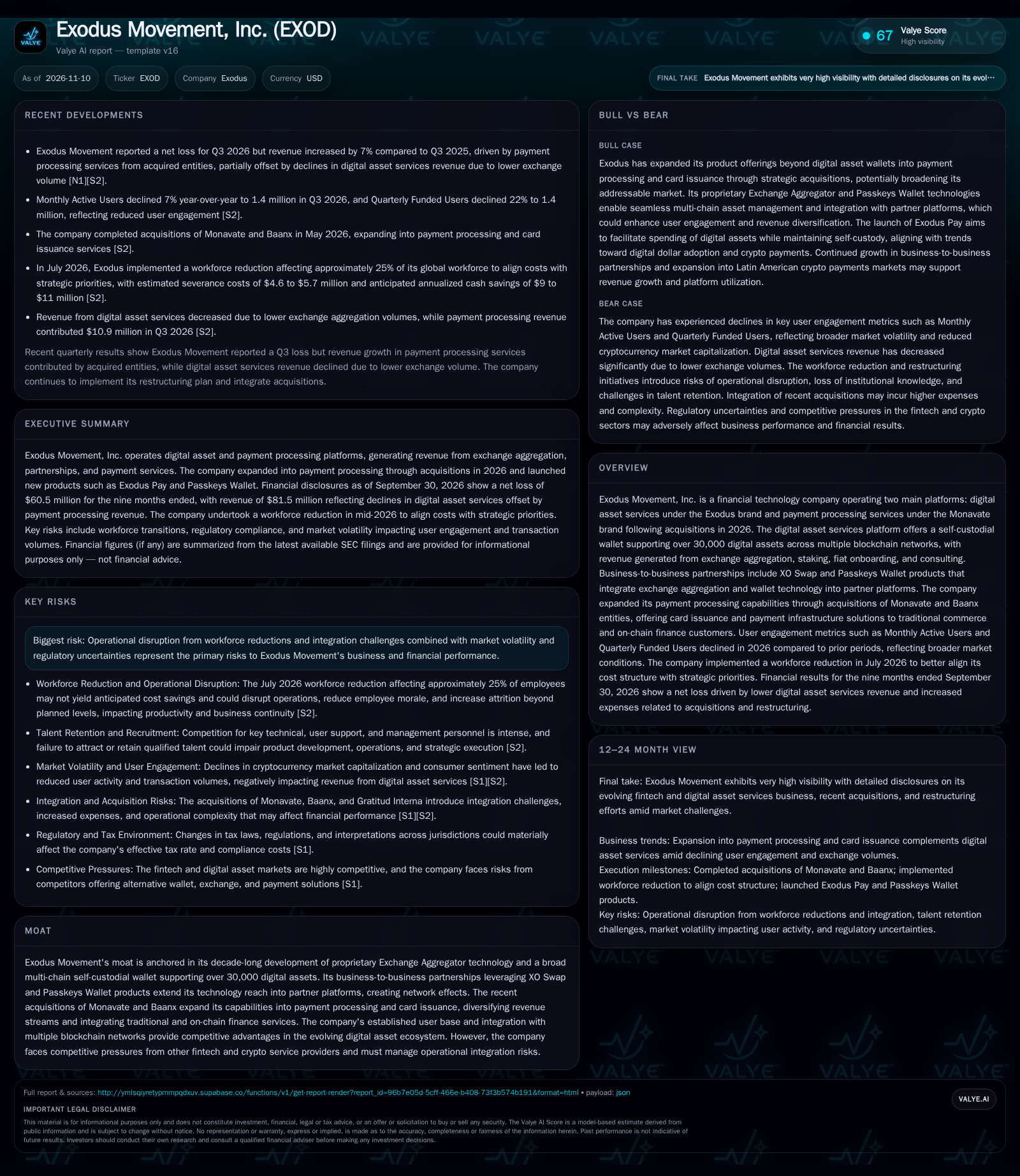
Exodus Movement’s expansion into payment processing and card issuance has boosted revenue but has not offset declines in digital asset services engagement or profitability. The company must successfully integrate acquisitions, stabilize user metrics, and execute on new product initiatives to achieve sustainable growth in a competitive and uncertain fintech environment. [S2] [N1]
Exodus Movement, Inc. stands at a crossroads as it seeks to transform from a digital asset wallet specialist into a broader fintech platform. Recent acquisitions have propelled the company into payment processing and card issuance, yielding revenue growth even as core user engagement and transaction volumes decline. With a significant workforce reduction and ongoing integration challenges, Exodus faces the dual test of revitalizing its legacy business and proving it can scale in the highly competitive and fast-evolving fintech landscape. The next phase will be defined by its ability to harmonize new and legacy operations, win back users, and capture value from a more diversified product suite.
Revenue Growth Masks Core Engagement Declines and Restructuring Challenges
For Q3 2026, Exodus Movement reported a 7% year-over-year revenue increase, reaching $81.5 million for the first nine months of the year, largely due to payment processing revenues following the acquisitions of Monavate and Baanx. However, the company posted a net loss of $60.5 million in the same period, reflecting higher expenses from integration and restructuring. User engagement metrics deteriorated sharply: Monthly Active Users and Quarterly Funded Users each fell to 1.4 million, down 7% and 22% year-over-year, respectively. In July 2026, Exodus reduced its global workforce by 25%, targeting $9–11 million in annualized cash savings, though this also incurred $4.6–$5.7 million in severance costs and introduces execution risk as integration proceeds. [S2] [N1]
How Exodus’s Revenue Model Is Shifting—and the Economic Stakes
Exodus’s pre-2026 economics were anchored in transaction-driven and fee-based digital asset wallet services, with revenue tied to exchange aggregation, staking, and consulting—highly sensitive to crypto market sentiment and transaction volumes. This model is characterized by high variable revenues and relatively low fixed infrastructure, but with limited pricing power and significant exposure to market cyclicality. Payment processing, via Monavate and Baanx, introduces a different revenue mix: recurring transaction fees from card issuance, merchant acquiring, and payment infrastructure for both traditional and on-chain finance. If integration succeeds, this segment could offer greater revenue stability and margin expansion through operating leverage—fixed platform costs amortized over higher transaction volumes. However, payment processing is also capital-intensive, with regulatory compliance, fraud management, and partner onboarding requiring ongoing investment. The company’s cost structure is in flux; the recent workforce reduction aims to improve operating leverage, but integration and restructuring costs are currently pressuring margins. The long-term economic question is whether payment revenues can scale faster than digital asset revenues decline, and whether margin expansion from operating leverage can be realized before competitive pricing compresses yields.
Competitive Dynamics in Digital Assets and Payments: Moat or Margin Pressure?
Exodus operates at the intersection of self-custodial digital asset wallets and payment processing, both crowded and fast-evolving sectors. Its proprietary Exchange Aggregator and broad multi-chain wallet offer integration depth and a differentiated self-custody value proposition, but user declines suggest these features alone are not retaining engagement. In payment processing, Exodus faces incumbent fintechs, neobanks, and crypto-native payment firms, many of which are larger, better capitalized, or have greater regulatory reach. The acquired Monavate and Baanx platforms bring established infrastructure and potential cross-sell opportunities but also expose Exodus to direct competition with global payment networks and embedded finance providers. Network effects may develop if Exodus can drive ecosystem integration—especially via Passkeys Wallet and XO Swap partnerships—but this remains unproven at scale. The company's ability to offer seamless fiat-crypto integration could be an edge, but only if user experience, compliance, and partner adoption outpace rivals. Competitive pressure is likely to keep pricing tight and customer acquisition costs high, particularly as regulatory scrutiny intensifies across both verticals.
If Integration Unlocks Synergies and Crypto Payments Gain Traction
The bull case for Exodus rests on successful integration of payment processing and wallet technology, leading to a rebound in user engagement and growth in business-to-business partnerships. If Exodus can leverage Monavate and Baanx to deliver seamless fiat and digital asset payments—especially through new products like Exodus Pay and Passkeys Wallet—there is potential for network effects and improved retention. Confirmation would come from a sustained recovery in Monthly Active Users, acceleration in partner integrations, and rising payment processing volumes outpacing legacy wallet declines. Expansion into Latin American crypto payments or new regulatory clarity on digital dollar adoption could further boost platform utilization. Operating leverage would be evident if revenue growth outpaces expense increases, leading to margin improvement and a return to profitability. Falsification would be evident if user metrics continue to erode, partnerships stall, or payment revenues plateau despite new product launches.
Stabilization Hinges on Execution, Not Just Market Recovery
The most plausible outcome is a period of transition in which Exodus stabilizes revenue through payment processing growth while digital asset services continue to face headwinds. User engagement may remain under pressure as broader crypto market volatility persists, but payment revenues could provide partial offset as integration progresses. The company will likely realize some cost savings from the workforce reduction, but restructuring and integration expenses may keep margins thin in the near term. Evidence supporting this scenario would include flat or modestly rising payment volumes, slow improvement in user metrics, and narrowing quarterly losses. If integration delays, regulatory setbacks, or competitive encroachment occur, Exodus could struggle to achieve scale or operational efficiency, resulting in continued net losses and muted top-line growth.
If User Attrition and Integration Costs Outpace Payment Growth
The adverse scenario unfolds if Exodus cannot arrest the decline in user engagement or if integration of acquired businesses proves costlier and more disruptive than anticipated. A continued drop in Monthly Active Users and transaction volumes would erode core wallet economics, while payment processing fails to scale or faces margin compression due to competition and regulatory cost. Operational disruption from workforce reductions—such as loss of institutional knowledge or productivity setbacks—could compound integration risks. Confirmation of this scenario would include ongoing declines in both digital asset and payment revenues, persistent or widening net losses, and negative trends in customer acquisition or retention. Regulatory action or new market entrants could further intensify these pressures, challenging the company’s ability to sustain its diversified strategy.
How Exodus Proves Out Its Diversification and Integration Thesis
Quarterly trends in Monthly Active Users and Quarterly Funded Users—if disclosed—will signal whether Exodus is stabilizing or losing engagement in its core wallet business.
Sequential and year-over-year growth in payment processing revenue and transaction volumes will reveal whether the acquired platforms are scaling as intended.
Gross margin progression, particularly in the payment segment, would clarify the degree of operating leverage and pricing power Exodus can achieve.
Updates on business-to-business partner integrations and adoption of XO Swap and Passkeys Wallet will demonstrate whether network effects are taking hold.
Actual realized cost savings from the July 2026 workforce reduction, compared to projected $9–11 million, will test management’s execution on restructuring.
Disclosures on integration milestones, such as unified platform launches or cross-selling between wallet and payment products, would evidence synergy realization.
Material regulatory actions, licensing progress, or compliance disclosures—especially in key markets—would inform risk management and competitive positioning.
Churn rates, customer acquisition costs, or retention metrics—if disclosed—would provide deeper insight into the sustainability of Exodus’s user and partner base.
Disclaimer: This is research-only, informational analysis and not investment advice. It may include AI-generated interpretation and general industry context. Always verify important details using primary sources.

Comments