
Xponential Fitness: Franchise Platform Ambitions Meet Execution and Liquidity Friction
The company’s future hinges on its ability to accelerate studio openings, drive franchisee economics, and manage liquidity while defending its position in a fragmented, trend-driven fitness market.
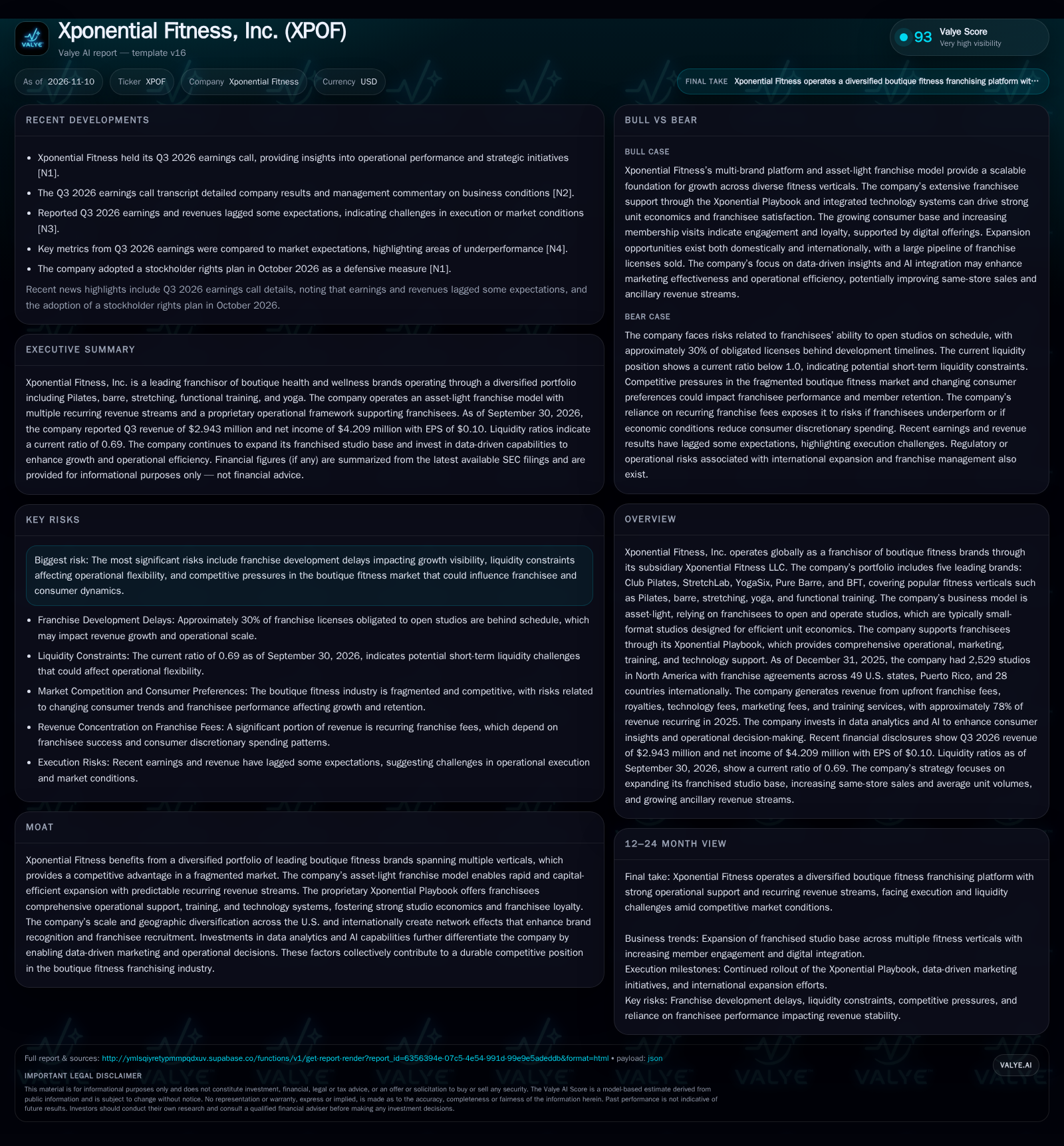
Xponential Fitness, a global franchisor of boutique fitness brands, operates an asset-light model with 78% recurring revenue and a diversified portfolio spanning Pilates, barre, stretching, yoga, and functional training. As of Q3 2026, the company faces headwinds: about 30% of contracted North American studios are behind on opening schedules, and its current ratio has dipped to 0.69. While its platform offers scale and support for franchisees, recent earnings lagged expectations and a stockholder rights plan has been adopted. [S2] [N3] [N1]
Xponential Fitness stands as one of the largest global franchisors in the boutique fitness landscape, leveraging a portfolio of well-known brands and an asset-light model designed for scalable, recurring revenue. As recent earnings lagged expectations and a stockholder rights plan was enacted, Xponential’s ability to convert its deep pipeline into durable growth while maintaining franchisee momentum and financial discipline is increasingly under scrutiny. The next phase for Xponential will likely be defined by its execution on franchisee support, cash discipline, and defense against intensifying competition.
Recent Developments Pressure Xponential’s Franchise Growth Narrative
Xponential Fitness reported Q3 2026 revenue of $2.943 million and net income of $4.209 million, with EPS of $0.10, but these results lagged market expectations according to recent earnings coverage. This underperformance has sharpened focus on the company’s ability to deliver on its growth promises. The most immediate operational issue is that approximately 30% of contracted franchise studios in North America are behind on development schedules, which threatens the conversion of sold licenses into active, revenue-generating sites. Finally, Xponential adopted a stockholder rights plan in October 2026, generally interpreted as a defensive posture in anticipation of external threats or heightened uncertainty. [S2] [N1] [N3]
Revenue Streams, Unit Economics, and the Asset-Light Franchise Model
Xponential’s business model is built on multiple, predictable revenue streams: upfront franchise fees, ongoing royalties (the largest and most recurring component), technology and marketing fees, and training revenues. Approximately 78% of 2025 revenue was recurring, anchored by royalty payments from franchisees. Because the company relies on franchisees for capital investment in studios, its model is asset-light, minimizing direct capital requirements and enhancing operating leverage as the network expands. Most studios operate in small footprints (1,500–2,500 sq. ft.), designed for efficient unit economics—lower buildout costs, faster breakeven, and potentially higher returns for franchisees if occupancy and pricing are optimized.
The company’s profitability depends on franchisee success. If franchisees underperform, royalty revenue and systemwide sales can stagnate or decline. The asset-light model limits direct exposure to rent and labor, but exposes Xponential to risk if franchisees delay openings or shutter locations. The company also invests in technology, data analytics, and its Xponential Playbook support system to drive franchisee performance and retention, with the potential for operating leverage as these investments scale. [S2]
Defending Share in a Fragmented, Trend-Driven Fitness Market
Xponential operates in a highly fragmented boutique fitness sector, competing with both independent studios and national chains that span Pilates, barre, yoga, stretching, and functional training. Its multi-brand approach enables cross-selling and mitigates single-concept risk, while its scale—2,529 studios and 5,371 global franchise licenses sold—confers some network advantages in marketing, technology, and procurement. The proprietary Xponential Playbook and investments in analytics and AI could further differentiate the platform by improving franchisee outcomes and consumer targeting.
However, barriers to entry in boutique fitness remain moderate; concepts can be replicated and consumer preferences shift rapidly. Xponential’s divestiture of brands like CycleBar and Rumble in 2025 suggests active portfolio management but may also reflect challenges in maintaining relevance across all verticals. Competitive pressure is likely to intensify as digital fitness platforms, hybrid models, and new wellness concepts proliferate. The real test is whether Xponential’s operational support and brand portfolio can drive franchisee profitability and retention better than rivals, especially as macroeconomic conditions pressure discretionary fitness spending.
Unlocking Franchise Pipeline Turns Latent Scale into Profitable Growth
If Xponential can accelerate the opening of its contracted studios—converting a significant portion of the 832 obligated but delayed North American sites into operating locations—systemwide royalty revenue could inflect upward, leveraging the company’s asset-light model for improved profitability. Effective deployment of the Xponential Playbook, data-driven marketing, and AI-enabled insights could help franchisees ramp faster, boost member acquisition, and increase average unit volumes. Expansion in international markets and ancillary revenue streams (such as branded digital content, retail, or partnerships) would further diversify and derisk the revenue base.
Evidence of this scenario would include a marked reduction in the backlog of delayed studio openings, accelerating same-store sales growth, rising royalty revenue as a share of total revenue, and improved franchisee retention. Margin expansion would likely accompany top-line growth if fixed platform investments scale efficiently. Confirmation would come from quarterly disclosures showing above-trend studio openings, higher systemwide sales, and positive franchisee economics.
Slow Conversion, Tight Liquidity, and Incremental Franchisee Growth
The most plausible trajectory is one where Xponential continues to expand its studio network, but at a slower pace than its contracted pipeline suggests. Franchisee delays persist for a material share of new studios, reflecting broader macro headwinds, financing friction at the franchisee level, or operational bottlenecks. Same-store sales and average unit volumes grow modestly, supported by ongoing investment in technology and operational support, but margin expansion is limited by the need to invest in franchisee performance and maintain corporate overhead.
Liquidity remains tight, constraining opportunistic investments or aggressive expansion, and the company may need to pursue new external financing if working capital pressure intensifies. Earnings growth is positive but muted, with recurring royalties providing a floor but not sufficient to drive a step-change in profitability. This scenario would be confirmed by continued reporting of delayed studio openings, incremental but unremarkable revenue growth, and persistent liquidity ratios below 1.0. Falsification would require either a sustained acceleration in studio openings or a deterioration in franchisee economics and unit closures.
Stalled Studio Openings and Liquidity Stress Erode Franchise Platform Value
In a negative scenario, franchisee execution falters: delayed studio openings persist or worsen, and some existing studios close or underperform amid weak consumer demand or competitive incursion. Royalty revenue stagnates or declines, exposing the limits of the asset-light model when underlying franchisee health deteriorates.
Adoption of the stockholder rights plan could signal external threats (e.g., activist pressure or acquisition risk), adding further distraction and uncertainty. Confirmation of this downside would come from rising franchisee churn, stalled or declining studio counts, negative same-store sales growth, and further deterioration in liquidity metrics. In this scenario, the company’s ability to defend its premium brand and platform narrative would be severely compromised.
Testing Xponential’s Franchise Platform: Milestones for Growth and Resilience
Quarterly net studio openings versus the contracted pipeline—especially reduction in the 30% backlog of delayed North American studios—would help confirm or refute the company’s ability to convert franchise sales into operating locations.
Same-store sales and average unit volume trends, if disclosed, are critical for gauging franchisee health and the impact of operational support investments.
Franchisee retention rates and churn, if available, would indicate whether the platform’s support ecosystem is driving loyalty and reducing closures.
Recurring revenue as a percentage of total revenue, particularly royalty streams, should be monitored for signs of durability or stress.
Liquidity evolution—tracking current and cash ratios, as well as any new debt or equity financings—will be central in assessing potential financial flexibility.
Tracking the pace and scale of international studio openings would help determine whether the company is successfully diversifying beyond North America.
Updates on the impact of the stockholder rights plan and any external strategic threats would provide context for potential corporate action or defensive maneuvers.
Disclaimer: This is research-only, informational analysis and not investment advice. It may include AI-generated interpretation and general industry context. Always verify important details using primary sources.

Comments