
VAALCO Energy: African Oil Focus, Operational Headwinds, and the Stakes of potential Financial Flexibility
The company’s ability to convert asset access into profitable, sustainable production will determine whether it can outgrow its current financial constraints.
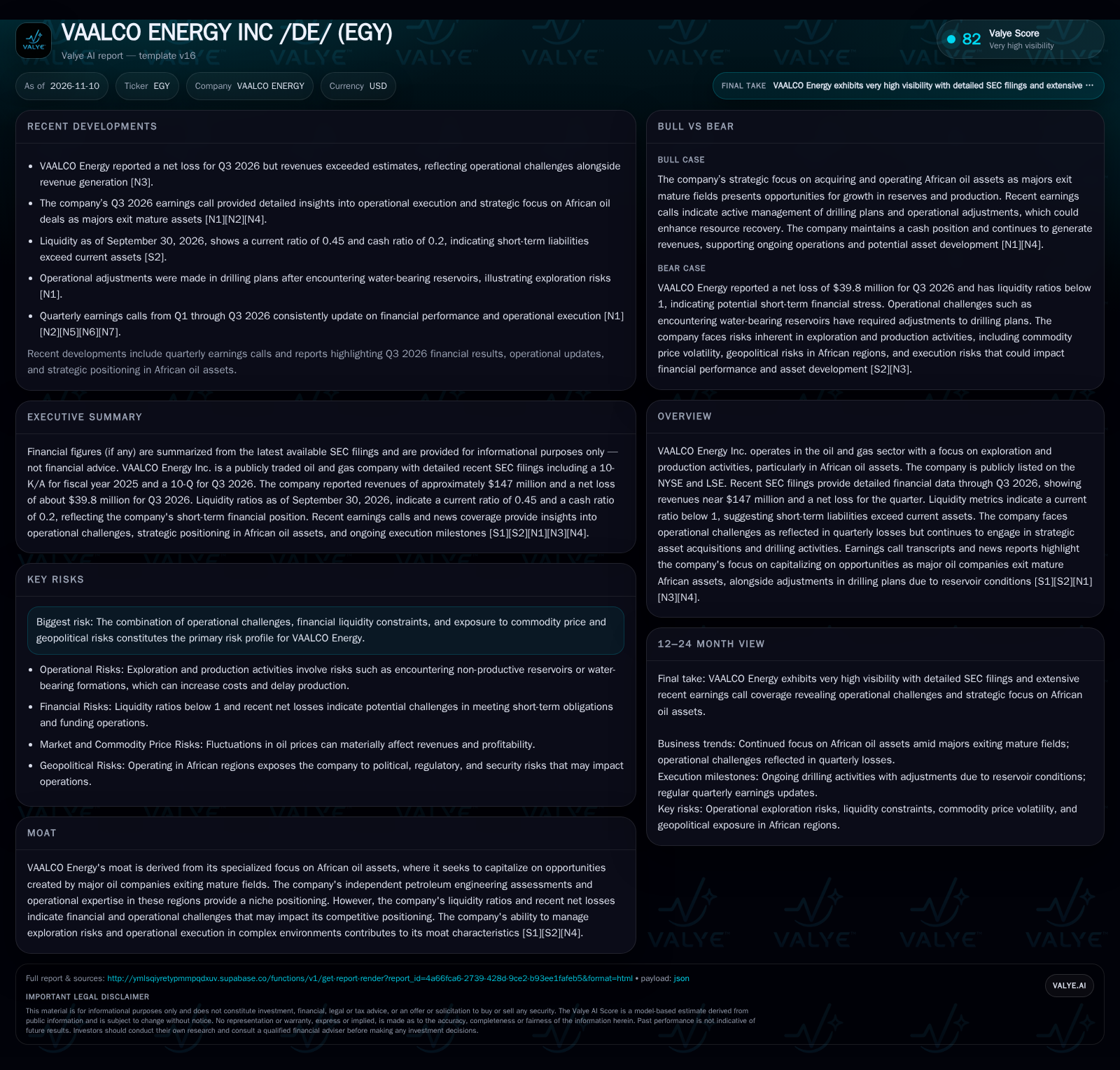
The company is pursuing growth by acquiring African oil assets abandoned by larger players, but operational difficulties—such as encountering water-bearing reservoirs—have hampered performance. [S2] [N3] [N4]
VAALCO Energy’s latest results highlight a fundamental tension: the company is generating robust oil revenues from its African asset base, yet continues to post losses amid significant operational and financial pressures.
Latest Results Underscore Revenue Generation Amid Tight Liquidity
VAALCO Energy reported Q3 2026 revenues of $146.98 million, exceeding estimates, but posted a net loss of $39.84 million and negative earnings per share of -$0.38. As of September 30, 2026, the company held $51.31 million in cash and cash equivalents, with current assets totaling $116.87 million against current liabilities of $259.47 million—a current ratio of 0.45 and a cash ratio of 0.2. These figures signal that while the company is able to generate significant top-line revenue, it is simultaneously facing acute short-term financial stress, with liabilities far outstripping liquid assets. Operationally, the company has had to adjust drilling plans after encountering water-bearing reservoirs, reflecting execution risk in its asset base. [S2] [N1] [N3]
The interplay between revenue generation and liquidity constraints highlights a critical operational-financial feedback loop. When drilling plans encounter unexpected challenges such as water-bearing reservoirs, not only do direct costs escalate, but the timing of cash flows shifts, potentially delaying revenue realization. This dynamic can exacerbate short-term liquidity pressures, especially when fixed overheads and debt servicing obligations remain constant. Hence, the company's ability to anticipate and mitigate operational risks through adaptive project management and contingency planning becomes pivotal in maintaining financial stability during periods of technical setbacks.
How Asset-Heavy Oil Production Economics Shape VAALCO’s Risk-Reward Profile
VAALCO’s core business model is classic upstream oil and gas: it invests significant capital in acquiring, developing, and operating oil fields, primarily in Africa. Revenue is driven by oil volumes produced and realized prices, both of which are highly sensitive to field performance and global commodity markets. Fixed costs—such as field infrastructure, drilling, and regulatory compliance—are high, and variable costs (including labor, maintenance, and logistics) scale with production. This structure creates strong operating leverage: small increases in production or oil prices can disproportionately improve margins, but setbacks in drilling or weak oil prices can quickly erode profitability.
The company’s strategy to acquire mature assets from majors may offer low entry costs and untapped upside, but it also brings higher technical risk and potential for increased remediation or redevelopment expenses. Drilling failures, such as encountering water-bearing formations, can lead to sunk costs and delayed cash flow. In this capital-intensive environment, liquidity and access to external financing are critical—especially given that operational setbacks can coincide with large near-term payables or debt maturities. Without robust free cash flow, VAALCO may need to rely on asset sales, joint ventures, or dilutive capital raises if financial pressures persist.
Given the capital-intensive nature of upstream oil production, the timing and scale of capital expenditures relative to cash inflows are crucial determinants of financial health. VAALCO’s model implies a sensitivity to oil price fluctuations that can amplify both upside and downside outcomes. For instance, a favorable oil price environment may accelerate payback periods on redevelopment investments, improving liquidity and enabling further asset optimization. Conversely, prolonged price weakness can restrict reinvestment capacity and increase reliance on external financing, which may come at higher cost or dilute existing equity. Therefore, the company's risk profile is closely tied to its operational agility and potential financial flexibility in managing this capital cycle.
Niche Focus in African Oil: Advantage or Exposure?
VAALCO’s competitive edge lies in its specialized focus on African oil assets—particularly mature fields that larger oil majors are divesting. This niche allows the company to acquire assets at potentially attractive valuations and leverage operational expertise tailored to complex, late-life reservoirs. However, this strategy also exposes VAALCO to heightened geopolitical, regulatory, and operational risks that can be less predictable or more severe than in more developed markets.
The relevant competitor set includes other independent E&P companies and regional specialists targeting similar African opportunities. While VAALCO may benefit from being a nimble operator able to move quickly on distressed or overlooked assets, it lacks the scale and diversified portfolio of larger players that can buffer shocks or sustain prolonged downturns. The exit of majors could also mean less infrastructure support, higher local costs, and greater scrutiny from host governments. The question is whether VAALCO’s expertise and risk tolerance can consistently translate into superior resource recovery and cost control relative to peers.
The niche focus on mature African fields introduces a complex risk-reward calculus shaped by geopolitical and infrastructural factors. While asset valuations may be depressed due to perceived risks, the absence of major operators can create operational voids that nimble independents like VAALCO can exploit through localized expertise and streamlined decision-making. However, this advantage depends on the company's capacity to navigate regulatory environments, secure reliable logistics, and maintain social license to operate amid evolving host country dynamics. Failure in any of these areas could erode competitive positioning and constrain the ability to scale or replicate successful redevelopments across the portfolio.
Unlocking Value from Asset Turnaround and Efficient Field Redevelopment
The most favorable scenario for VAALCO is one in which its focused acquisition strategy yields underappreciated reserves and production growth, outpacing both the technical challenges and the legacy liabilities of mature fields. If the company can successfully redevelop acquired assets—improving recovery rates, lowering lifting costs, and minimizing operational disruptions—it could generate sufficient free cash flow to repair its balance sheet and reinvest in further growth.
Confirmation would come from a sustained uptick in production volumes, declining unit operating costs, and a return to operating profitability—even in a moderately volatile oil price environment. Counterfactuals—such as persistent cost overruns or production disappointments—would undermine the upside case.
Navigating Operational Volatility with Constrained Financial Options
The most plausible trajectory is that VAALCO continues to operate within a challenging balance of producing steady revenue from its African assets, while managing intermittent operational disruptions and tight liquidity. The company may achieve periods of profitability if oil prices are supportive and field performance is stable, but would remain vulnerable to unexpected costs, adverse reservoir outcomes, or external shocks.
The base case envisions ongoing drilling and redevelopment activities, punctuated by occasional setbacks that require plan adjustments and incremental capital. Liquidity remains a persistent constraint, with the company forced to carefully sequence expenditures and possibly seek external financing or partnerships to bridge cash flow gaps. Confirmation would come from stable production, modest improvement in financial metrics, and the absence of acute solvency events. Deterioration in any of these areas or a material drop in oil prices would challenge even this middle-ground scenario.
Liquidity Crunch Forcing Strategic Retrenchment or Dilution
The principal downside risk is that operational setbacks—such as further drilling failures, unexpected reservoir issues, or cost overruns—combine with stagnant or declining oil prices to exacerbate VAALCO’s liquidity shortfall. In this scenario, the company’s current asset and cash levels prove insufficient to meet near-term obligations, forcing urgent measures.
This could include asset sales at unfavorable terms, highly dilutive equity offerings, or distressed debt financing. In an adverse scenario, creditors or joint venture partners could demand concessions, or the company could be forced to scale back operations, missing out on future asset opportunities.
Thesis-Defining Milestones: What Will Determine VAALCO’s Next Chapter?
Quarterly production volumes by asset, as disclosed, to track operational momentum and the effectiveness of redevelopment efforts.
Unit operating costs per barrel—if disclosed—would clarify whether efficiency improvements are being realized in acquired fields.
Changes in the current ratio and cash position in subsequent filings, indicating whether liquidity is stabilizing or deteriorating.
Updates on drilling outcomes, particularly the frequency and severity of non-productive wells or water-bearing encounters.
Disclosure of any new asset acquisitions, joint ventures, or divestitures, which could signal strategic flexibility or distress.
Any mention of covenant breaches, emergency financings, or significant changes in payables/receivables, as early warning signs of financial strain.
External developments in African regulatory or security conditions that could impact field access, costs, or production reliability.
Disclaimer: This is research-only, informational analysis and not investment advice. It may include AI-generated interpretation and general industry context. Always verify important details using primary sources.

Comments