
P3 Health Partners: Emerging Profitability Tempered by Preferred Stock and Payor Concentration Risks
P3 Health Partners has achieved a swing to profitability and raised guidance for 2026, signaling operational momentum in its value-based care model targeting Medicare Advantage.
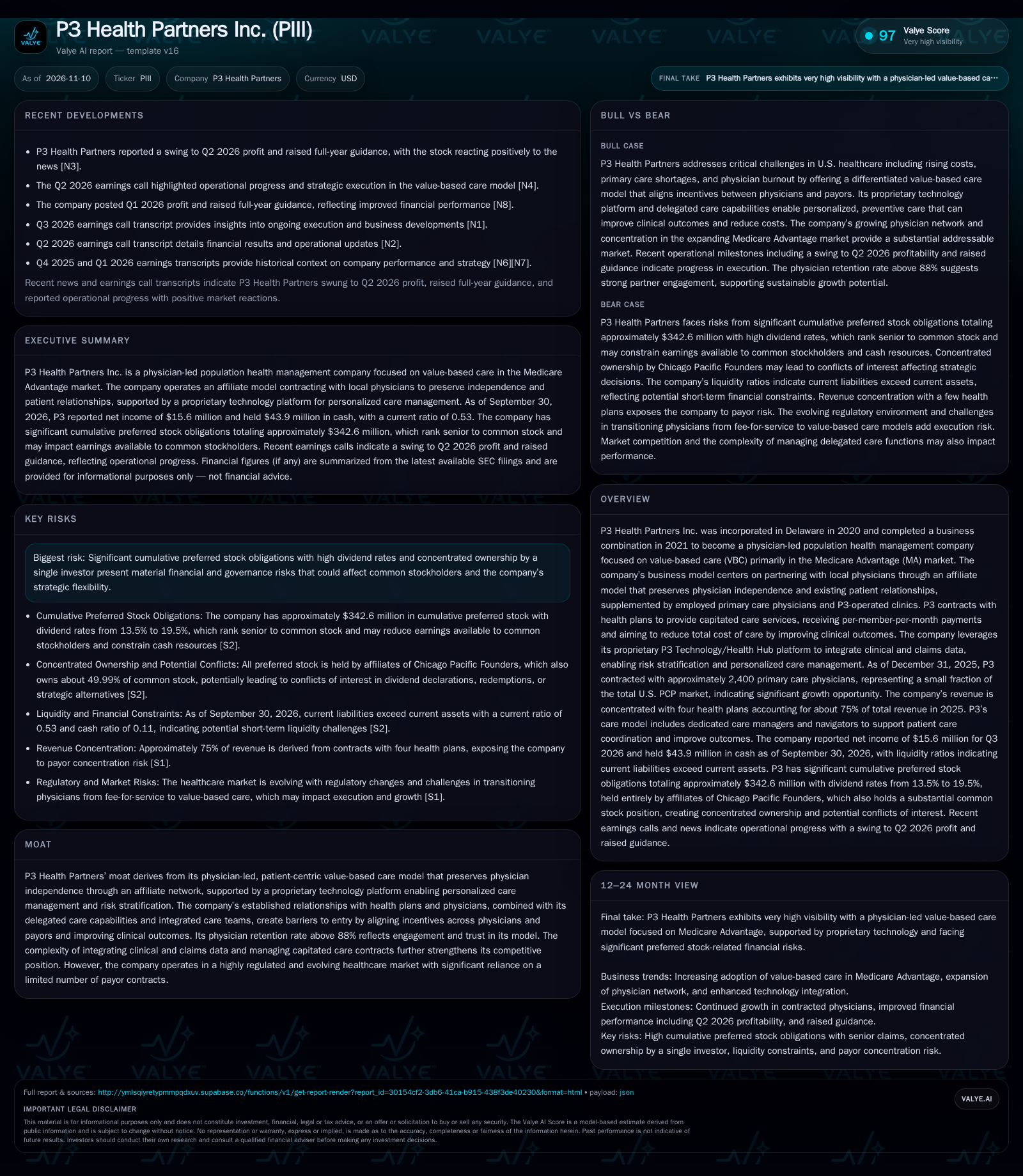
P3 Health Partners has demonstrated improved operational performance, swinging to net income in recent quarters and raising its full-year guidance for 2026. The durability of its model will hinge on margin expansion, payor diversification, and resolving capital structure constraints. [S1] [S2] [N3] [N8]
P3 Health Partners stands at a pivotal juncture: after years of investing in its physician-led, value-based care model, the company has turned the corner to profitability and raised its 2026 outlook. Yet beneath these operational gains lie structural risks—most notably, a capital structure dominated by high-cost preferred stock and a heavy reliance on a handful of payors. As Medicare Advantage continues to expand and the healthcare system seeks cost-effective solutions, P3's ability to scale its technology-driven model while managing financial constraints and concentrated ownership will define its trajectory over the next two years.
Profitability Gains and Capital Structure Shape Immediate Outlook
P3 Health Partners posted net income of $15.6 million for Q3 2026, with both basic and diluted EPS positive, marking a turnaround after prior periods of unprofitability. This swing to profit was accompanied by raised full-year guidance and positive investor sentiment, as reflected in recent market reactions. However, the company's balance sheet remains pressured: as of September 30, 2026, P3 held $43.9 million in cash and equivalents, with current assets of $216.0 million versus current liabilities of $406.6 million, resulting in a current ratio of just 0.53. Most notably, P3 has $342.6 million in cumulative preferred stock obligations with dividend rates ranging from 13.5% to 19.5%, all held by affiliates of Chicago Pacific Founders, which also owns nearly half the common stock. This capital structure creates both financial strain and concentrated governance, directly impacting the cash available to common shareholders and the company’s strategic flexibility. [S2] [N3] [N8]
The interplay between P3’s profitability and its capital structure introduces a complex dynamic that influences strategic decision-making. While operational profitability signals underlying business strength, the heavy burden of preferred dividends effectively limits the company’s free cash flow, constraining reinvestment or shareholder returns. This creates a scenario where management must carefully balance growth initiatives against near-term liquidity pressures. Furthermore, the concentrated ownership of preferred shares by a single investor group may influence governance decisions, potentially prioritizing dividend preservation over aggressive expansion or restructuring efforts. The company’s ability to navigate these tensions will be critical to sustaining momentum beyond the immediate profitability milestone.
Capturing Medicare Advantage Margins Through P3’s Capitated Care Approach
P3’s economics are built around capitated contracts with payors, primarily in the Medicare Advantage (MA) segment. The company receives per-member-per-month (PMPM) payments in exchange for managing the total cost and quality of care for a defined population. This model incentivizes P3 to invest in preventive care, patient engagement, and care coordination—seeking to reduce avoidable hospitalizations and manage chronic conditions more efficiently than the traditional fee-for-service approach.
The affiliate physician model allows P3 to scale its network without the full fixed costs of direct employment, while its proprietary P3 Technology/Health Hub platform enables risk stratification and personalized care interventions. If the company can consistently improve medical cost ratios and capture shared savings, incremental revenue should fall largely to the bottom line given the fixed nature of technology and administrative overhead. However, the economics are sensitive to medical loss ratio (MLR) management, contract terms with payors, and the ability to maintain or increase PMPM rates. The capital-light affiliate model may aid operating leverage, but high preferred dividends dilute the benefit to common shareholders unless the capital structure is addressed.
The capitated care model’s success fundamentally depends on the company’s ability to accurately predict and manage healthcare utilization patterns within its covered populations. This requires sophisticated data analytics and risk adjustment capabilities to ensure that PMPM payments align with actual patient needs and cost profiles. If P3 can refine its risk stratification algorithms and enhance provider engagement through its technology platform, it may reduce variability in medical costs and improve predictability of outcomes. However, such improvements are contingent on continuous data integration from diverse sources and timely clinical interventions, which may require ongoing investment and operational discipline. Additionally, the company’s reliance on affiliate physicians introduces variability in care delivery consistency, which could affect medical cost ratios if not effectively managed.
Physician, Technology, and Payor Dynamics Create Mixed Competitive Position
P3 seeks to differentiate itself by preserving physician independence through its affiliate model, which may allow it to attract and retain PCPs in a market facing physician shortages and burnout. Its proprietary technology platform for data integration and patient risk stratification could provide an edge in care coordination and outcomes if it drives better performance than legacy systems.
Nonetheless, the company’s moat is not insurmountable. The U.S. value-based care landscape is crowded, with competitors ranging from large integrated health systems and insurer-owned physician groups to other tech-enabled primary care platforms. The reliance on just four health plans for 75% of revenue introduces significant counterparty risk—any adverse change in these contracts could quickly impact P3’s top line. Furthermore, as value-based care matures, payors may seek to renegotiate terms, and rival platforms may offer similar—or more integrated—solutions, eroding P3’s bargaining power.
Unlocking Shareholder Value Through Margin and Network Expansion Hinges on Capital Resolution
The most favorable scenario for P3 involves expanding its physician network, increasing the number of covered lives, and demonstrating consistent improvement in medical cost management. If the company can drive down MLR through effective care coordination and personalized interventions, greater operating leverage from the affiliate model and technology platform could translate into higher margins. A successful renegotiation, refinancing, or conversion of preferred stock would relieve the dividend burden, freeing up cash for reinvestment or common shareholder returns.
Confirmation of this scenario would require continued sequential earnings growth, evidence of margin expansion (e.g., declining MLR or rising PMPM economics), and a reduction in preferred obligations—either through buybacks, refinancing at lower rates, or conversion to common equity. Announcements of new payor contracts or geographical expansion would further validate the growth thesis.
Margin expansion through network growth and operational efficiency is also sensitive to external market factors such as regulatory policies and competitive responses. For instance, favorable adjustments in Medicare Advantage reimbursement methodologies or incentives for value-based care adoption could enhance P3’s revenue potential and margin profile. Conversely, if competitors introduce more integrated care models combining primary care with specialty and ancillary services, P3 may need to adapt its affiliate model or invest further in technology to maintain differentiation. The timing and scale of network expansion must therefore be aligned with evolving market conditions to optimize returns. Moreover, successful capital restructuring would not only reduce dividend burdens but could also improve credit metrics, enabling access to lower-cost financing for growth initiatives.
Most Likely Path Involves Consistent Execution Within Structural Limits
The company remains exposed to payor concentration risk, and while operational improvements may incrementally enhance margins, the capital structure likely prevents significant value accrual to common shareholders without a major refinancing event.
Evidence for this scenario would be sustained positive net income, stable or improving physician retention, and modest but steady increases in contracted lives. However, the persistence of preferred stock obligations and lack of diversification in health plan relationships would suggest that upside is capped unless these issues are directly addressed.
Loss of Payor Contracts, Margin Squeeze, or Capital Issues Pose Significant Risks
A negative scenario emerges if P3 loses one or more major payor contracts, faces adverse changes in reimbursement rates, or encounters rising medical costs that it cannot offset through care management. In such a case, revenue could decline sharply, while fixed costs—including high preferred dividends—would remain, amplifying losses to common shareholders. Tight liquidity, as indicated by the current ratio of 0.53, could force the company to raise dilutive capital or restructure under unfavorable terms.
Downside confirmation would come from contract losses, a spike in MLR, negative operating cash flow, or further deterioration in liquidity metrics. Delays or failures to refinance or renegotiate preferred obligations would exacerbate the risk, while regulatory headwinds or competitive encroachment could accelerate negative outcomes.
Key Developments and Performance Measures Will Influence P3’s Value-Based Care Potential
Sequential growth in net income and margin expansion, particularly as measured by improvements in medical loss ratio (MLR) or PMPM economics, would help validate operational leverage.
Progress in reducing preferred stock obligations—through buyback, conversion, or refinancing—would directly impact free cash flow available to common shareholders.
New payor contracts or diversification of revenue sources would reduce concentration risk and improve long-term revenue visibility.
Expansion in the number of contracted physicians and covered lives (if disclosed) would signal successful network growth and market penetration.
Trends in physician retention rates above the current 88% threshold would indicate ongoing engagement and satisfaction with the affiliate model.
Regulatory changes affecting Medicare Advantage reimbursement or value-based care adoption could materially alter the addressable market or economics for P3.
Disclaimer: This is research-only, informational analysis and not investment advice. It may include AI-generated interpretation and general industry context. Always verify important details using primary sources.

Comments