
Impact Biomedical: Merger-Driven Restructuring Meets Persistent Financial Strain
Impact Biomedical is undergoing a high-stakes transformation through a series of mergers and reverse stock splits, aiming to reposition itself as a pharmaceutical innovation platform.
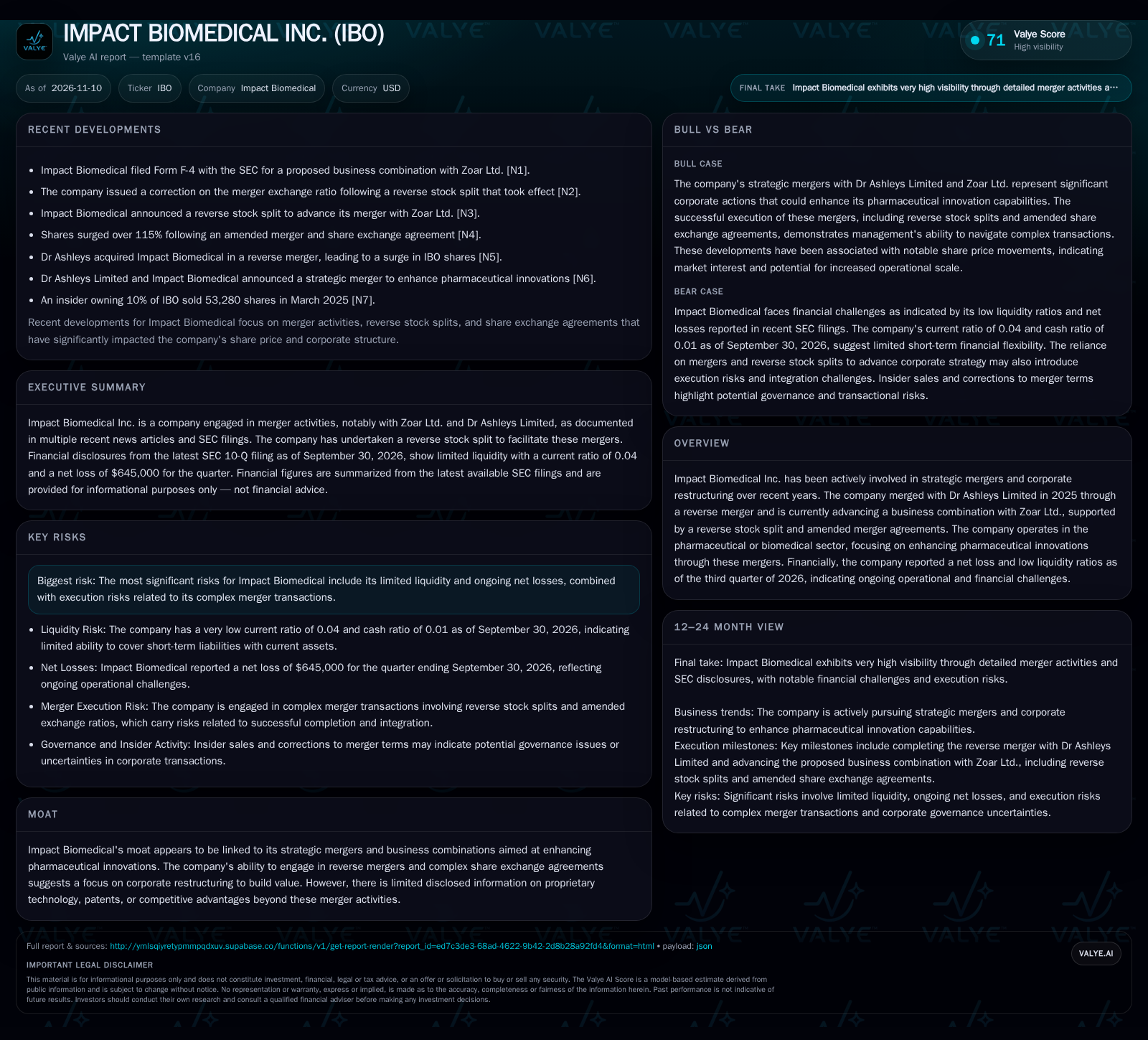
Impact Biomedical is pursuing a merger with Zoar Ltd., following its reverse merger with Dr Ashleys Limited, as part of an ambitious bid to scale its pharmaceutical innovation capabilities. The outcome hinges on whether these transactions can unlock commercialization opportunities and secure new capital or partners before balance-sheet realities force further restructuring or asset sales. [S2] [N1] [N5]
Impact Biomedical Inc. is at a pivotal crossroads, defined by a cascade of corporate transactions and mounting financial stress. Having completed a reverse merger with Dr Ashleys Limited and now pursuing a business combination with Zoar Ltd., the company is betting its future on the ability to aggregate and commercialize biomedical innovations through partnerships and licensing. The next several quarters will reveal whether Impact Biomedical can pivot from transactional momentum to operational viability.
Merger Activity Intensifies as Liquidity Crisis Deepens
Impact Biomedical's current situation is dominated by two major merger transactions: the completed reverse merger with Dr Ashleys Limited in 2025 and an advancing business combination with Zoar Ltd., underpinned by a reverse stock split and amended exchange agreements. These actions are intended to reposition the company within the pharmaceutical innovation ecosystem and attract greater operational and financial resources. This acute liquidity shortfall signals that without rapid external capital infusion or accelerated milestone payments from licensing, the company’s ability to operate as a going concern is in question. Persistent net losses, with a quarterly deficit of $645,000, further amplify the urgency for successful execution of the merger strategy. [S2] [N1] [N2] [N3] [N5]
Licensing-Driven Model Hinges on Partner Uptake and Milestones
Impact Biomedical’s business model is predicated on the discovery, patenting, and out-licensing of biomedical and pharmaceutical technologies to third-party developers and commercial partners. The company’s assets include proprietary compounds such as Linebacker™ (targeting oncology and inflammatory disorders), Equivir™ (antiviral and supplement applications), Laetose™ (metabolic and anti-inflammatory), and a suite of 'functional fragrances' with antimicrobial potential. Several of these assets are licensed to ProPhase Laboratories for development and commercialization, with the prospect of future milestone and royalty payments. [S2]
The economics of this model are highly leveraged to successful out-licensing and subsequent partner-driven product development. Upfront milestone payments and downstream royalties could, in theory, provide high-margin revenue with modest incremental costs once a technology is licensed. However, the timing, magnitude, and certainty of such payments are inherently unpredictable in early-stage biopharma—especially without disclosed commercial terms, minimum payments, or committed development timelines. In the absence of recurring product sales or services, Impact Biomedical’s fixed costs and cash burn are only partially offset by sporadic licensing revenue, making the company acutely sensitive to delays or failures in partner commercialization. The need for ongoing R&D, IP protection, and deal negotiation further contributes to negative operating leverage in periods of limited deal flow.
Strategic Partnerships and Technology Breadth Versus Resource Constraints
Impact Biomedical’s potential competitive edge lies in its portfolio of proprietary biomedical technologies and its ability to structure partnerships and licensing agreements with established players in pharmaceuticals and consumer health. The company’s approach is to be an innovation aggregator and IP originator, leveraging external partners for capital-intensive late-stage development and commercialization. This model, if successful, could allow Impact Biomedical to punch above its weight in terms of scientific impact and market reach.
However, this strategy faces formidable counterforces. The pool of potential partners is highly selective, with most pharmaceutical companies demanding robust preclinical or clinical validation before committing substantial resources. In addition, the market for in-licensing early-stage technologies is intensely competitive, with academic institutions, biotech startups, and public research consortia all vying for attention. Impact Biomedical’s acute liquidity constraints may also undermine its bargaining power, making it difficult to negotiate favorable licensing terms or to invest in the data generation necessary to attract top-tier partners. Execution risk is further compounded by insider share sales and corrections to merger terms, which may signal governance or transactional uncertainty. [N2] [N7]
Unlocking Value Through Successful Merger Integration and Partner Commercialization
The most bullish scenario for Impact Biomedical is one in which the Zoar Ltd. merger closes smoothly, consolidating assets, management, and access to new capital or partner networks.
The upside is amplified if one or more licensed assets achieve meaningful clinical or commercial milestones, triggering royalty streams or additional partner interest. Confirmation of this scenario would come from 8-K filings or press releases announcing material payments, new licensing deals, or expanded partnerships, as well as evidence of cost rationalization or improved balance-sheet metrics post-merger. A surge in disclosed deal flow or the announcement of strategic investors would further validate the thesis that the merger strategy is unlocking latent value.
Prolonged Restructuring Amid Ongoing Cash Burn and Uncertain Commercialization
The most likely near-term outcome is a continuation of merger-driven restructuring and active deal negotiation, but with persistent cash burn and limited revenue visibility. Under this scenario, the Zoar Ltd. combination proceeds, but integration takes time and immediate financial relief is limited. Licensing and partnership discussions may yield incremental progress, but without material milestone payments, the company continues to operate under severe financial strain.
SEC filings noting 'going concern' warnings or the need for bridge financing would further confirm that operational viability remains in doubt without a step-change in external interest or partner conversion. The scenario could persist for several quarters, with the company’s fate increasingly tied to external events and counterparty decisions.
Liquidity Exhaustion Triggers Forced Asset Sales or Restructuring
In the adverse scenario, Impact Biomedical’s inability to secure new capital or material licensing payments leads to a liquidity crisis that can no longer be bridged by merger activity or incremental cost-cutting. With a current ratio of 0.04 and a negligible reported cash balance, the company may be forced to sell assets at distressed prices, cede control to creditors, or enter formal restructuring.
Confirmation of this trajectory would include default on payables, the announcement of asset sales under duress, or the filing of bankruptcy protection. The absence of any new licensing agreements or partner funding, combined with further delays or complications in closing the Zoar Ltd. merger, would signal a deteriorating outlook.Insider transaction activity was reported in the cited source; this activity does not by itself establish insider confidence.
Milestones That Will Determine the Sustainability of Impact Biomedical’s Strategy
Closure of the Zoar Ltd. merger and any disclosure of post-merger capital infusion, operational integration, or new board appointments.
Announcements of material licensing agreements or upfront milestone payments from existing or new partners (especially with ProPhase Laboratories or other disclosed counterparties).
Quarterly liquidity and current ratio trends, as reported in SEC filings, to detect any improvement or further deterioration.
Disclosures of 'going concern' warnings, bridge financing, or asset sales in financial statements or press releases.
Insider sales, management turnover, or changes in board structure, especially in proximity to key merger or financing events.
Progress reports or regulatory filings related to the development or commercialization of key technology assets (if disclosed).
Any further corrections, amendments, or delays affecting the terms or closing timeline of the Zoar Ltd. merger.
Disclaimer: This is research-only, informational analysis and not investment advice. It may include AI-generated interpretation and general industry context. Always verify important details using primary sources.

Comments