
Casella Waste Systems: Profitability Pressures, Liquidity Constraints, and the Strategic Stakes of Diversified Waste Services
Casella Waste Systems reported Q3 2026 revenues of $559.2 million but posted a net loss and negative EPS, with liquidity ratios below 1.0 raising short-term cash concerns.
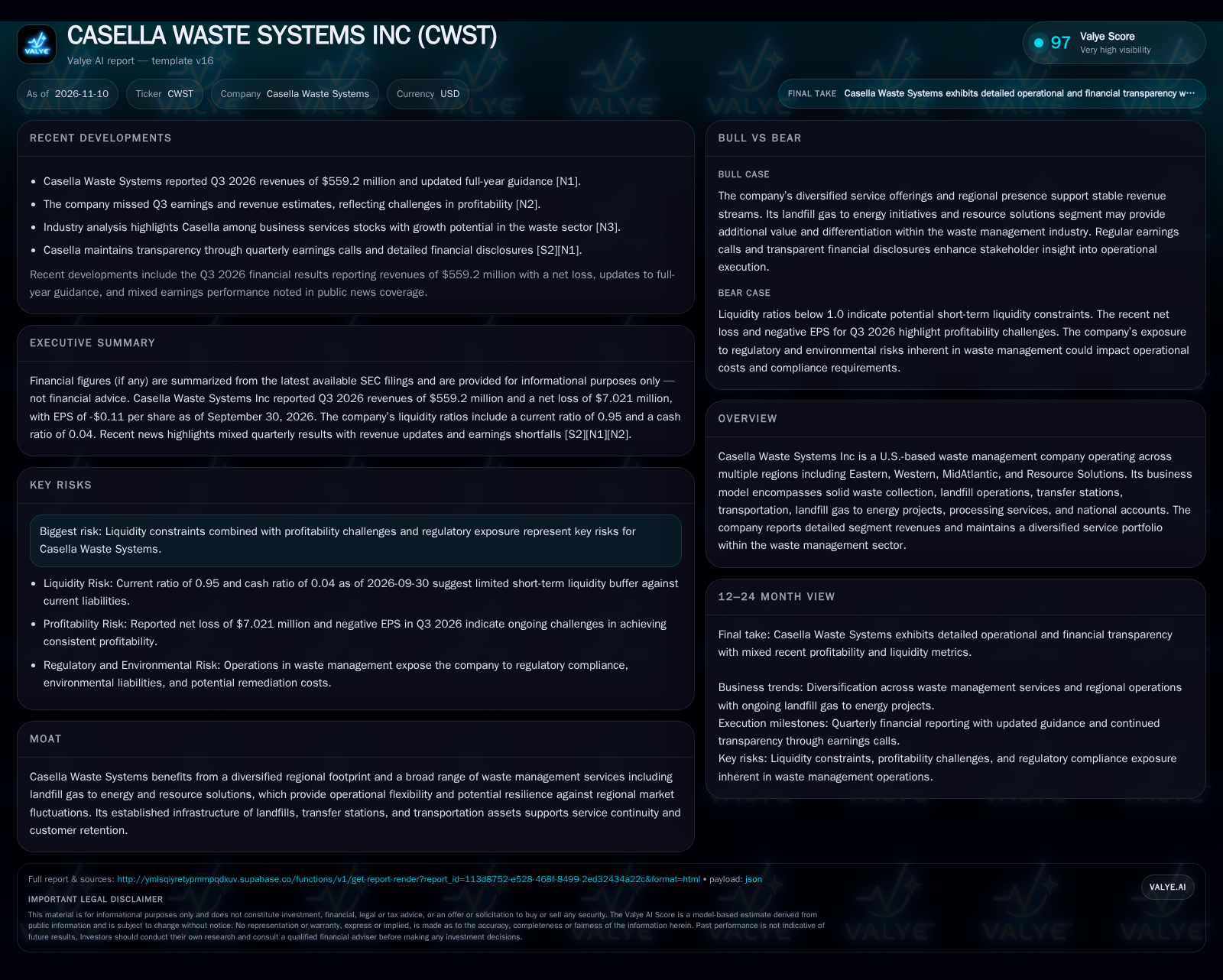
Casella Waste Systems reported Q3 2026 revenues of $559.2 million but posted a net loss and negative EPS, with liquidity ratios below 1.0 raising short-term cash concerns. While its broad service mix and landfill gas to energy initiatives offer diversification, ongoing profitability and regulatory risks remain central to the investment thesis. The company’s future will hinge on its ability to convert operational scale and environmental projects into improved margins and sustainable cash flow [S2] [N1] [N2].
Casella Waste Systems stands at a crossroads in 2026, as the company’s Q3 results reveal the duality of its business model: broad regional operations and service diversification on one side, and mounting profitability and liquidity pressures on the other. With revenues of $559.2 million but a net loss and negative EPS, Casella’s ability to weather short-term financial headwinds will likely determine whether its investments in landfill gas to energy and resource solutions yield durable long-term value. The next phase for Casella will test whether operational scale and environmental innovation can overcome balance-sheet constraints and sector-wide cost and regulatory headwinds [S2] [N1] [N2].
Recent Financial Results Signal Pressure Points and Strategic Crossroads
Casella Waste Systems reported Q3 2026 revenues of $559.2 million, but the bottom line turned negative, with a net loss of $7.021 million and EPS of -$0.11, falling short of market expectations [S2] [N1] [N2]. This quarterly performance marks a period where topline growth is not translating into sustainable profits, underlining the company’s ongoing struggle with margin compression and cost headwinds.
[S2]
Casella’s operations span solid waste collection, landfill management, transfer stations, transportation, landfill gas to energy, and resource solutions, positioning the company as a diversified regional player. However, the near-term financial pressures could constrain its ability to fully capitalize on these growth avenues.
How Casella’s Diversified Platform Converts Volume into Value—And Where Economics Falter
Casella’s revenue model is built on a blend of collection fees, landfill tipping charges, transfer and transportation services, and ancillary streams like landfill gas to energy and resource solutions. The company’s geographic reach across several U.S. regions helps smooth local volatility and enables some pricing power, particularly in markets where landfill capacity is scarce or regulatory hurdles deter new entrants.
The economic engine of traditional solid waste management is typically driven by route density (lowering per-unit collection costs) and vertical integration (capturing margin at each step from pickup to disposal). However, capital intensity is high: landfills require significant upfront investment, ongoing environmental compliance, and periodic remediation. Margins are sensitive to fuel, labor, and regulatory costs, and pricing power is often constrained by municipal contracts or competitive bidding.
Casella’s expansion into landfill gas to energy and resource solutions reflects a search for higher-margin, less commoditized revenue, but these segments often require additional capital outlay and face uncertain regulatory or subsidy regimes. If these initiatives scale, they could improve blended margins and diversify cash flow.
Assessing Casella’s Regional Moat and the Threat from Larger Players and Substitutes
Casella’s competitive advantage derives from its established infrastructure—landfills, transfer stations, and collection networks—across multiple regions. This footprint creates local barriers to entry, as permitting new landfills is expensive, time-consuming, and politically fraught. In its core geographies, Casella may benefit from customer stickiness due to limited disposal alternatives and the logistical complexity of switching providers.
However, the waste management sector is dominated by larger, better-capitalized national players and a persistent base of local competitors. Larger peers enjoy greater economies of scale, lower cost of capital, and broader asset bases to weather downturns or invest in new technologies. In addition, regulatory or technological shifts—such as advances in recycling, circular economy mandates, or waste-to-energy alternatives—could erode the value of traditional landfill-centric models over time.
Casella’s push into landfill gas to energy and resource solutions offers some differentiation, but the commercial mechanics and long-term profitability of these segments remain to be proven at scale. The question is whether Casella can leverage its regional density and diversified services to maintain pricing, defend share, and unlock new revenue streams faster than costs and compliance burdens rise.
If Environmental Solutions Scale and Costs Stabilize, Margin Expansion Becomes Plausible
A favorable scenario for Casella involves successfully scaling its landfill gas to energy and resource solutions businesses, leading to higher-margin, recurring revenue streams that complement its core waste operations. If regulatory incentives for clean energy persist or expand, Casella could benefit from premium pricing or long-term contracts tied to renewable energy generation.
Operationally, if Casella can increase route density, optimize landfill utilization, and control labor and fuel costs, fixed-cost leverage could drive margin improvement even at modest revenue growth rates. This would require disciplined capital allocation and a focus on integrating new projects without overextending the balance sheet.
Evidence supporting this scenario would include sustained revenue growth in environmental segments, improved gross and operating margins, positive EPS, and stabilization or improvement in liquidity ratios. Announcements of new municipal or commercial contracts for resource solutions, or successful renewals at attractive terms, would further validate the thesis.
Casella Works to Balance Diversification with Margin Discipline Amid Sector Headwinds
The most plausible trajectory for Casella is a period of financial and operational discipline, as management seeks to stabilize margins and navigate liquidity constraints while maintaining its diversified service offering. Modest growth in core solid waste and transfer operations is likely, supported by regional demand and existing customer relationships.
Landfill gas to energy and resource solutions may contribute incremental revenue, but are unlikely to offset near-term cost inflation, wage pressures, and compliance expenses without scale and execution gains. Continued transparency through earnings calls and guidance updates will likely be used to manage stakeholder expectations and signal incremental progress.
Confirmation of this scenario would come from gradual improvement in profitability metrics (narrowing losses, approaching breakeven EPS), steady or slightly improved liquidity ratios, and stable or growing segment revenues. Prolonged stagnation in margins or repeated guidance cuts would challenge the base case.
Liquidity Erosion and Cost Pressures Could Trigger Operational Retrenchment or Dilution
If Casella’s current liquidity constraints persist or worsen—due to continued net losses, cost inflation outpacing price increases, or unexpected regulatory or environmental liabilities—the company could face the need to curtail growth investments, divest assets, or seek external financing under unfavorable terms.
In this scenario, the company’s ability to fund landfill gas to energy and resource solutions projects would be compromised, stalling potential margin expansion and leaving core waste operations exposed to competitive or regulatory shocks. A deteriorating balance sheet could increase borrowing costs, limit flexibility, and potentially dilute existing shareholders through capital raises.
Falsification of this downside would be indicated by stabilization or improvement in liquidity ratios, return to positive EPS, and demonstrated cost control. Confirmation would come from further declines in cash and equivalents, widening losses, asset sales, or announcements of emergency financing or covenant breaches.
Milestones and Metrics That Will Define Casella’s Next Chapter
Sustained improvement in gross and operating margins, especially if accompanied by reduced net losses or a return to positive EPS [S2].
Revenue growth and margin contribution from landfill gas to energy and resource solutions segments, if disclosed, to test the scalability of these initiatives.
Announced or renewed municipal/commercial contracts for resource solutions or environmental services, which would support recurring revenue and pricing power.
Capital expenditure levels and project pipeline updates, to assess whether growth investments are being maintained or deferred.
Cost inflation trends, particularly in labor, fuel, and compliance, as these directly impact profitability and cash flow.
Regulatory developments—such as new state or federal mandates for waste management, recycling, or renewable energy—that could alter cost structure or revenue opportunities.
Management commentary on capital allocation priorities and any indication of planned asset sales, external financing, or strategic partnerships.
Disclaimer: This is research-only, informational analysis and not investment advice. It may include AI-generated interpretation and general industry context. Always verify important details using primary sources.

Comments