
Rackspace Technology: Betting on AI-Driven Cloud Amid Persistent Liquidity Strains
Rackspace Technology is doubling down on AI-powered managed cloud services and sovereign cloud offerings, seeking relevance in an intensely competitive landscape.
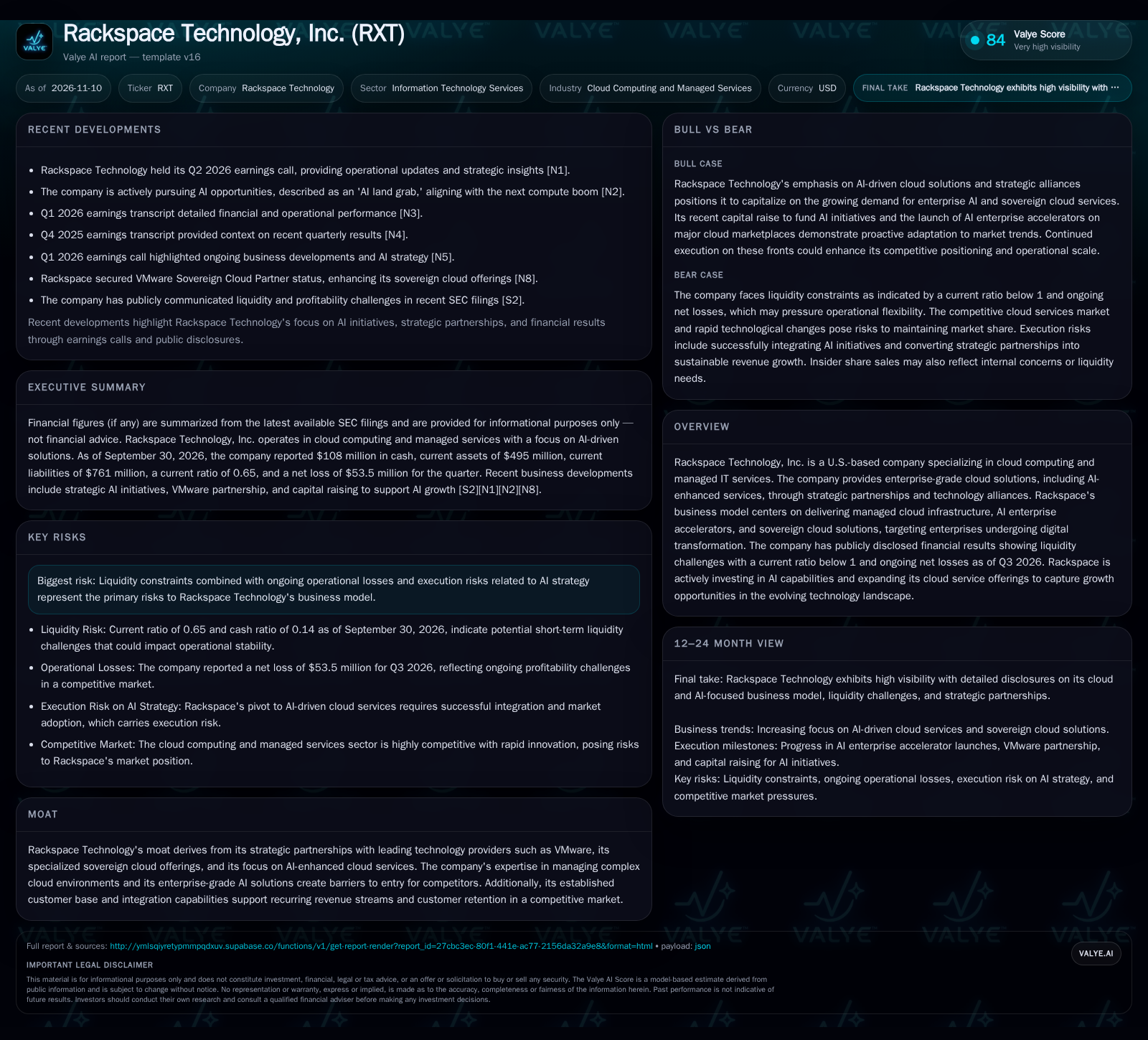
Rackspace Technology is actively pivoting toward AI enterprise solutions and sovereign cloud services, highlighted by new strategic partnerships and capital raises to fund these initiatives. The balance between executing its AI strategy and managing financial risk will determine whether Rackspace can carve out a defensible niche in the evolving cloud market. [S2] [N2] [N8]
Rackspace Technology stands at a strategic crossroads: the company is investing heavily in AI-powered managed cloud solutions and sovereign cloud offerings, aiming to participate in the next cycle of enterprise IT transformation. Rackspace’s ability to balance execution on its AI strategy with urgent financial realities is now central to its investment case.
Liquidity Strain and AI Ambitions Define Rackspace’s Present
As of September 30, 2026, Rackspace Technology reported cash and equivalents of $108 million, current assets of $495 million, and current liabilities of $761 million—yielding a current ratio of 0.65 and a cash ratio of just 0.14. The company posted a net loss of $53.5 million for the quarter, with EPS of -$0.21. These figures underscore acute liquidity pressure and ongoing unprofitability. In response, Rackspace raised $250 million through a stock sale, explicitly to fund AI initiatives and support strategic pivots. Recent developments include the launch of AI enterprise accelerators and the attainment of VMware Sovereign Cloud Partner status, signaling a bet on high-value, differentiated cloud offerings. [S2] [N2] [N8]
The timing and scale of Rackspace's capital raise to fund AI initiatives suggest a strategic inflection point, where the company must rapidly transition from legacy managed services to AI-enhanced offerings to maintain relevance. This pivot requires not only technological innovation but also a recalibration of sales and delivery models, which can be resource-intensive and complex. The liquidity strain places a premium on execution speed and operational discipline, as delays or missteps could exacerbate financial pressures. The company reported cash and liquidity metrics for the period; these figures do not by themselves establish operating runway, investment capacity, financial flexibility, or financing capacity.
AI Services and Managed Cloud: Where Value Could Be Created—or Lost
Rackspace’s business model centers on managed cloud services, enterprise AI solutions, and specialized offerings like sovereign cloud. Revenue is likely a mix of recurring managed service contracts, project-based AI deployments, and value-added integration with partner platforms. Margins in managed IT services have historically been pressured by labor intensity and competition, but AI-enhanced offerings could deliver higher margins if Rackspace can standardize delivery, drive automation, and secure premium pricing from enterprise clients.
The company’s recent capital raise suggests that substantial investment is needed to fund product development, partnerships, and go-to-market efforts—especially in AI, where talent and infrastructure costs are significant. Fixed costs in R&D and platform integration may create operating leverage, but only if scale and retention improve. A key unknown is whether AI accelerators and sovereign cloud solutions can command pricing power and offset the commoditization seen in basic cloud infrastructure services.
The interplay between recurring revenue streams and project-based AI deployments will be central to Rackspace's margin trajectory. Recurring managed service contracts typically provide predictable cash flow but often at lower margins due to commoditization and labor costs. In contrast, AI deployments, if successfully standardized and automated, could yield higher margins but may initially require significant upfront investment and customization. Achieving scale in AI services could unlock operating leverage by spreading fixed R&D and platform costs over a larger revenue base. However, this hinges on client adoption rates and the company’s ability to reduce delivery complexity through automation and reusable AI components.
The competitive dynamics in AI talent acquisition and retention also influence Rackspace’s cost structure and innovation pace. Given the scarcity and high cost of skilled AI professionals, the company must balance investing in top-tier talent with developing scalable platforms that reduce dependence on manual labor. Strategic partnerships, such as those with platform vendors, could mitigate some talent risks by leveraging external innovation and infrastructure. However, reliance on partners introduces execution risk related to alignment of incentives and integration complexity, which could impact time-to-market and customer satisfaction.
Competing for Relevance: Rackspace’s Place in a Crowded Cloud Landscape
The cloud and managed services market is dominated by hyperscalers and large systems integrators, with additional competition from specialized regional players. Rackspace’s differentiation relies on its ability to deliver tailored AI solutions and sovereign cloud services, leveraging partnerships with vendors like VMware. This focus could attract enterprise clients with regulatory or data-sovereignty concerns, but hyperscalers are also expanding in this direction, and switching costs remain moderate for most managed services.
Rackspace’s long-standing expertise in complex, multi-cloud environments and its ability to integrate across platforms provide some insulation, but these are not insurmountable barriers. Success will depend on whether its AI offerings deliver measurable business outcomes for clients and whether its partner ecosystem translates into stickier, higher-value relationships. Insider share sales, while not uncommon, may also reflect internal caution about near-term prospects. [S2] [N8]
Rackspace's differentiation through sovereign cloud services addresses a niche but growing market segment driven by regulatory compliance and data sovereignty requirements. This specialization can create higher switching costs and client stickiness if the company can demonstrate superior security, compliance certifications, and localized support. However, hyperscalers are increasingly investing in sovereign cloud capabilities, potentially eroding this advantage over time. Rackspace’s success in this domain will depend on its ability to rapidly innovate and customize solutions while maintaining cost competitiveness, which may require continuous investment in compliance infrastructure and partnerships.
If AI Accelerators Gain Traction, Revenue Mix and Margins Could Shift
The most favorable scenario is that Rackspace’s AI enterprise accelerators and sovereign cloud solutions gain rapid adoption among enterprise customers, driving a mix shift toward higher-margin, recurring services. The $250 million capital injection could accelerate product development, sales enablement, and partnership integration, resulting in improved operating leverage as fixed costs are spread over a growing base.
Evidence supporting this scenario would include: a clear uptick in new enterprise AI contracts, rising average contract values, improved gross margins, and a sustained reduction in net losses. Additional signals would be customer references for successful AI deployments, expansion of the VMware partnership to new verticals, and public disclosure of multi-year, recurring AI service contracts. Confirmation would come if quarterly results demonstrate sequential revenue growth and positive operating cash flow attributable to AI-driven offerings.
Base Case: Incremental Progress Amid Ongoing Financial Pressure
In a base scenario, Rackspace achieves modest traction with its AI and sovereign cloud offerings, but adoption is gradual and competitive pricing pressures persist. Revenue growth may be offset by continued investment needs and the high cost of talent and infrastructure, resulting in ongoing net losses and limited margin expansion.
The company could see some benefit from its partnerships and AI accelerators, but these may not be sufficient to materially change its financial trajectory in the near term. The base case would be characterized by incremental improvements in product mix and customer engagement, but without a decisive inflection in profitability or cash generation.
Liquidity Crisis or Execution Missteps Could Trigger Strategic Retrenchment
If AI initiatives fail to gain traction or if competitive pressures erode pricing and volumes in core services, Rackspace could face a downward spiral of declining revenue, persistent losses, and worsening liquidity.
A failure to convert partnerships and accelerators into material revenue could force Rackspace to cut costs aggressively, retrench from growth initiatives, or seek additional dilutive capital raises. Confirmation of this scenario would include negative operating cash flow, missed revenue targets, additional insider sales, layoffs, or asset divestitures. In the extreme, sustained liquidity shortfalls could prompt strategic alternatives such as asset sales, restructuring, or M&A overtures from larger industry players.
What Will Prove Rackspace’s AI Bet—Or Reveal Its Limits?
Quarterly sequential revenue growth in AI and sovereign cloud services, if disclosed, would indicate traction for new offerings.
Gross margin and operating margin trends—especially any improvement attributable to AI or higher-value services—would help confirm unit economics.
Disclosure of large, multi-year AI enterprise contracts or renewals would signal recurring revenue visibility.
Updates on cash flow from operations and changes in cash/cash equivalents will clarify liquidity trajectory.
Further capital raises, insider sales, or debt covenant disclosures would reveal financial stress or management confidence.
Customer testimonials or case studies demonstrating business impact from AI accelerators would help validate the value proposition.
Expansion of the VMware partnership into additional geographies or industry verticals would be a positive signal for partnership leverage.
Layoffs, restructuring announcements, or asset sales (if reported) would suggest execution challenges and liquidity-driven retrenchment.
Disclaimer: This is research-only, informational analysis and not investment advice. It may include AI-generated interpretation and general industry context. Always verify important details using primary sources.

Comments