
GCM Grosvenor: Scaling Alternatives, Fee Stability, and AI-Driven Operational Evolution
AUM growth, robust fundraising, and the integration of AI tools define GCM Grosvenor’s current landscape, but the durability of its fee model and the risks of operational innovation remain central to the long-term thesis.
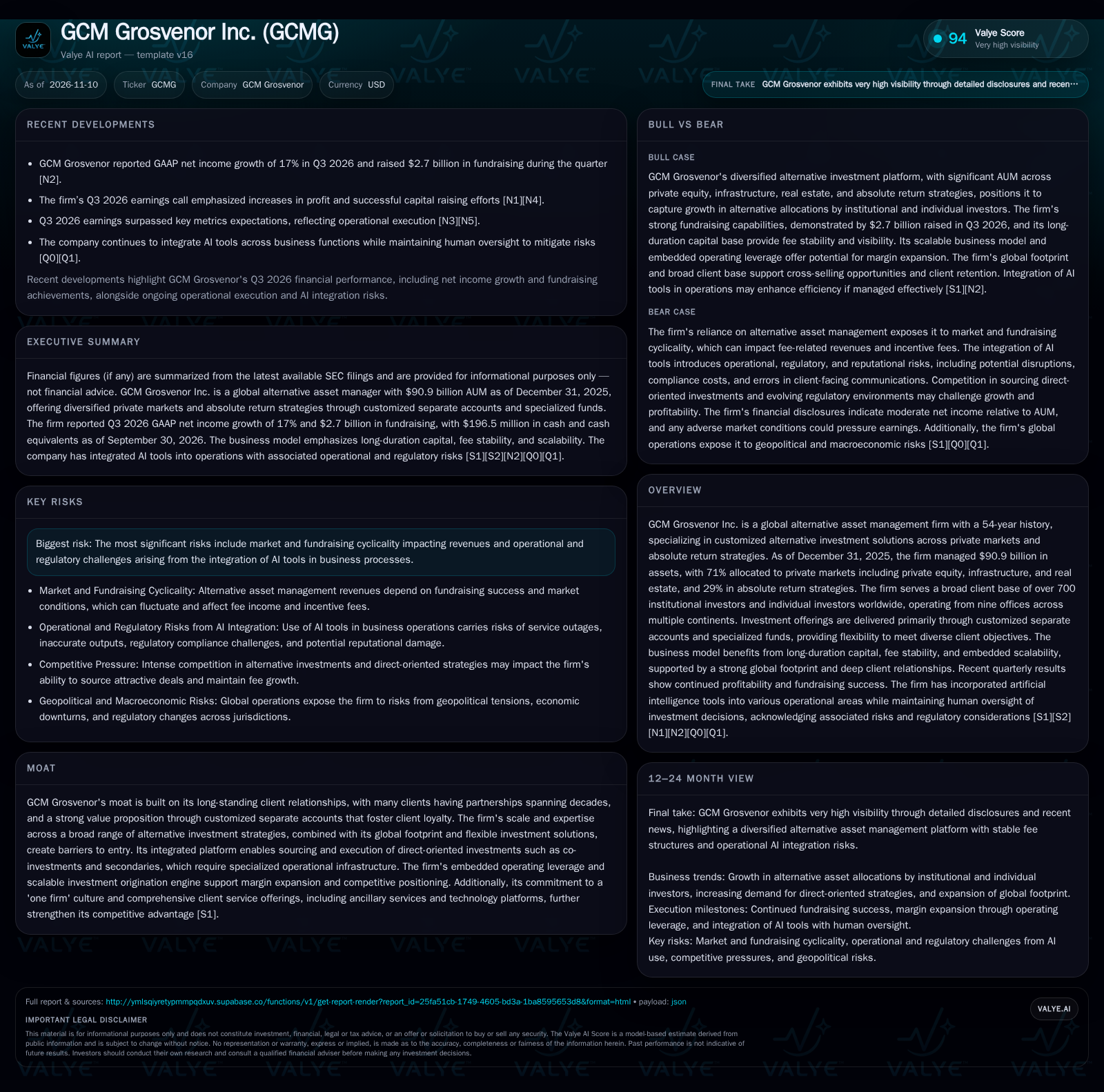
GCM Grosvenor reported $90.9B in AUM as of December 2025, with 71% in private markets. Q3 2026 saw 17% net income growth and $2.7B in fundraising, underscoring fundraising momentum and fee visibility. The business model is built on long-duration capital and customized accounts, but faces cyclical and operational risks—especially as AI tools are further integrated. The path forward hinges on sustaining fundraising, expanding margins, and managing regulatory and competitive pressures from both traditional and tech-driven peers. [S1] [S2] [N2]
GCM Grosvenor’s recent operational and financial results reaffirm its status as a scaled global alternative asset manager, with $90.9 billion AUM and a platform heavily weighted toward private markets. The firm’s latest quarter saw meaningful net income growth and robust fundraising—critical signals of ongoing client engagement and market relevance. However, as the company integrates AI across its business functions and contends with intensifying competition for alternative allocations, the central questions shift to the sustainability of its fee model, margin trajectory, and the effectiveness of risk controls in an evolving operational environment. The durability of its franchise will be measured by its ability to combine scale, customization, and innovation while navigating the inherent cyclicality and complexity of the alternatives space. [S1] [S2] [N2]
Recent Fundraising Momentum and Earnings Growth Define the Near-Term Landscape
As of December 31, 2025, GCM Grosvenor managed $90.9 billion in assets, with 71% in private markets—including $32.9 billion in private equity, $18.7 billion in infrastructure, and $7.2 billion in real estate—while $26.8 billion was allocated to absolute return strategies [S1]. In Q3 2026, the firm posted GAAP net income growth of 17% and raised $2.7 billion in new client commitments [N2]. These results highlight strong fundraising execution and suggest ongoing demand for alternative investments, even amid a complex macro environment. Management fees for the year ended 2025 totaled $426 million, supporting the thesis of fee stability anchored by a long-duration capital base [S1]. The integration of AI tools into business operations, while maintaining human oversight on investment decisions, signals a commitment to operational efficiency but also introduces new regulatory and operational risks.
How GCM Grosvenor’s Revenue Model Harnesses Scale, Duration, and Customization
GCM Grosvenor’s economics rely on the management of third-party capital through customized separate accounts and specialized funds, with 71% and 29% of AUM respectively as of December 31, 2025 [S1]. These structures are generally designed to provide recurring management fees—$426 million in 2025—while aligning with institutional clients’ needs for tailored solutions and partnership continuity. The fee model is supported by the stickiness of long-duration capital, which enhances visibility and cushions short-term market volatility. Operating leverage is embedded: as AUM grows, incremental costs for servicing additional capital or launching add-on products are modest, enabling potential margin expansion if fundraising outpaces expense growth.
Variable economics hinge on incentive fees from performance, which can introduce cyclicality, but the large base of management fees provides a stable foundation. Capital needs are relatively light for an asset manager of this scale—reflected by $196.5 million in cash and cash equivalents as of September 30, 2026—since the business does not require heavy balance sheet investment to grow [S2]. AI-driven efficiencies could further compress marginal costs, but this is counterbalanced by the potential for new compliance, oversight, and technology spending as the operational landscape evolves.
Barriers to Entry, Client Stickiness, and the Race for Direct Investment Edge
GCM Grosvenor’s competitive position is underpinned by a 54-year operating history, deep multi-decade client relationships, and a global footprint spanning nine offices [S1]. The ability to deliver highly customized separate accounts fosters client loyalty and high retention, which is difficult for smaller or less specialized managers to replicate. Scale also provides access to a broader universe of private deals and enhances negotiating leverage with fund sponsors and service providers.
However, the landscape for alternatives is intensely competitive, with large global asset managers, direct investment platforms, and niche specialists all vying for institutional and high-net-worth allocations. The race to source direct-oriented investments—such as co-investments and secondaries—places a premium on sourcing networks, due diligence capabilities, and speed. Technological adoption, including AI, may accelerate operational workflows but is unlikely by itself to create a durable moat unless it drives superior investment outcomes, mitigates risk, or materially reduces costs. Regulatory scrutiny is also intensifying, particularly for firms integrating advanced technology into client-facing and compliance-critical processes.
Margin Expansion and Fee Growth If Fundraising and AI-Driven Efficiencies Compound
A favorable scenario unfolds if GCM Grosvenor sustains its recent fundraising pace—such as the $2.7 billion achieved in Q3 2026—while successfully leveraging AI-driven operational efficiencies to compress costs. If institutional and individual investor allocations to alternatives continue to rise, the firm’s customized separate account platform could attract new mandates, increasing fee-paying AUM. Operating leverage would then translate incremental revenue into higher margins, particularly if performance fees also trend positively in a benign market environment.
Evidence confirming this scenario would include sustained or accelerating net inflows, margin expansion outpacing peer averages, and clear disclosures of cost savings or workflow improvements attributable to AI initiatives. Additional confirmation could come from new client wins, especially in emerging geographies or investor segments, and from industry recognition of GCM Grosvenor’s technology-enabled service model.
Core Business Stability Amid Cyclical Flows and Progressive Operational Change
The most plausible trajectory is one of steady, if moderate, AUM and revenue growth, with episodic fundraising success offset by periodic redemptions or slower commitment cycles. Management fees remain the economic anchor, with incremental contributions from performance fees in strong years. AI integration yields modest productivity gains but also requires ongoing investment in compliance, oversight, and staff training, tempering the net cost benefit.
Confirmation of this scenario would come from stable or gradually rising management fee revenue, continued client retention rates, and a steady cadence of fundraising announcements that track with historical norms. Disconfirming evidence would include a pronounced drop in net inflows, margin compression due to rising compliance costs, or client attrition linked to operational execution or service quality issues.
Fundraising Slowdown, Margin Pressure, and Operational Disruption from AI Risks
The adverse scenario materializes if capital flows into alternatives slow, either from macroeconomic shocks, increased competition, or changing investor preferences. This would pressure net inflows and reduce the base on which management fees are earned. At the same time, if AI integration leads to operational errors, regulatory breaches, or reputational events, the firm could face elevated compliance costs, potential fines, or even client losses.
Evidence supporting this scenario would include sharp declines in fundraising, a drop in management fees, negative headlines around operational failures or compliance lapses, and rising expense ratios. Additional confirmation could come from regulatory actions targeting technology use in asset management or from publicized client departures linked to service disruptions.
Testing the Durability of GCM Grosvenor’s Fee Model and Operational Execution
Sustained net inflows and the rate of new client commitments relative to redemptions or runoff would help test the resilience of fundraising momentum.
AUM mix shifts—such as increased allocations to higher-fee private markets strategies or growth in customized separate accounts—would signal success in capturing premium mandates.
Management fee growth and margin trends, especially relative to disclosed operating leverage, are critical for assessing the scalability of the business.
Any disclosures of cost savings or productivity improvements directly attributed to AI initiatives would help validate the operational efficiency thesis.
Regulatory developments or compliance incidents tied to technology integration would be important for monitoring operational and reputational risk.
Client retention rates and the duration of client relationships, if disclosed, would provide insight into the stickiness and competitive defensibility of the platform.
Performance fee variability and its contribution to overall profitability would help gauge sensitivity to market cycles.
Disclaimer: This is research-only, informational analysis and not investment advice. It may include AI-generated interpretation and general industry context. Always verify important details using primary sources.

Comments