
Viant Technology: AI-Driven Ad Platform Navigates Cookie-Less Future and Execution Hurdles
Viant Technology’s programmatic advertising platform, powered by proprietary identity resolution and AI, is positioned to benefit from the industry’s shift away from cookies. Yet recent earnings misses and dependence on agency relationships highlight the execution and adoption risks that will determine whether the company can translate its technical strengths into durable growth.
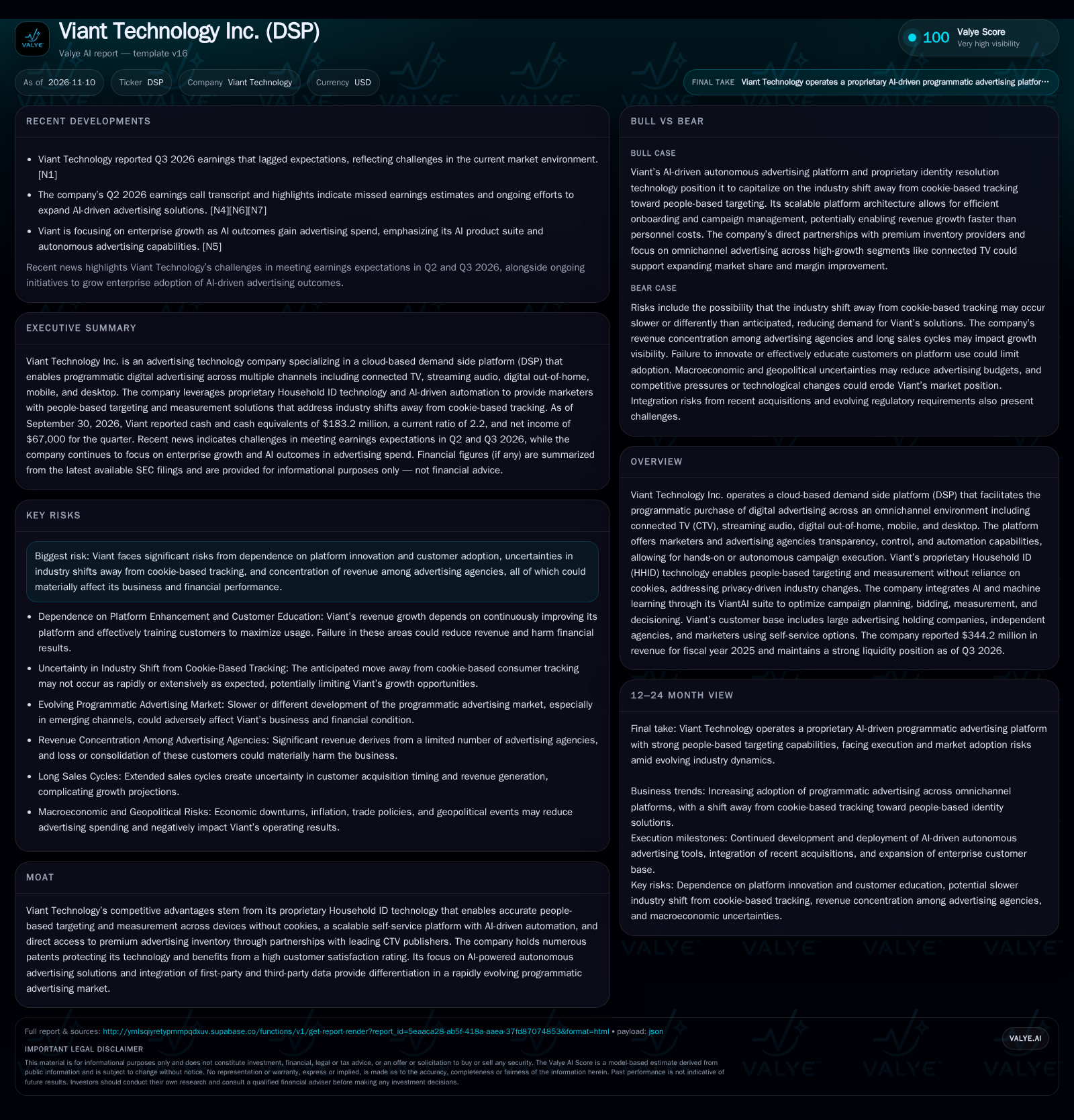
Viant Technology operates a cloud-based demand side platform (DSP) for programmatic advertising, leveraging proprietary Household ID and AI-driven automation to address privacy-driven shifts away from cookies. While its differentiated tech positions it for industry tailwinds in omnichannel and connected TV, recent earnings shortfalls and a reliance on agency customers underscore challenges in execution and adoption. The company’s ability to scale enterprise uptake of its AI suite—and to convert privacy and automation trends into sustained revenue and margin gains—remains the core question for investors. [S1] [S2] [N1] [N4] [N5] [N6] [N7]
Viant Technology stands at a pivotal juncture as the digital advertising ecosystem accelerates its move away from cookie-based tracking. With a cloud-based DSP, proprietary identity resolution, and a growing suite of AI-powered automation tools, Viant is structurally aligned with the industry’s evolving needs—particularly as marketers demand privacy-compliant, omnichannel solutions. However, recent underperformance relative to earnings expectations and ongoing reliance on agency clients highlight the company’s operational and adoption challenges. The company’s ability to leverage its technical differentiation into sustainable revenue growth and margin expansion, while navigating industry uncertainty, is the core question facing stakeholders. [S1] [S2] [N1] [N4] [N5] [N6] [N7]
Recent Earnings Misses and Platform Differentiation Define the Moment
Viant Technology reported $344.2 million in revenue for fiscal 2025, but Q2 and Q3 2026 earnings lagged expectations, with Q3 net income essentially flat at $67,000 and EPS of $0.00. [S1] [S2] [N1] [N4] [N6] [N7] This disappointing near-term performance comes despite the company’s technical strengths: its proprietary Household ID (HHID) technology enables privacy-compliant, people-based targeting without cookies, and its ViantAI automation suite is designed to optimize campaign outcomes across CTV, mobile, and other formats. The company reported cash and liquidity metrics for the period; these figures do not by themselves establish operating runway, investment capacity, financial flexibility, or financing capacity. [S1] [S2] The operating environment is shaped by the accelerating industry shift to programmatic, cookie-less advertising—a trend Viant is well positioned to address, but where adoption and execution risks remain visible.
How Viant Could Translate Platform Innovation into Profitable Scale
Viant’s business model monetizes programmatic ad spend routed through its DSP, earning revenue from platform usage, media transaction fees, and potentially value-added services for campaign planning and measurement. The company’s ability to capture a larger share of omnichannel budgets hinges on its proprietary HHID technology and ViantAI automation, both of which may allow for higher campaign efficiency and differentiated targeting in a privacy-centric world.
If customers migrate to self-service and autonomous campaign management, Viant could see improved gross margins as software-driven processes scale faster than headcount or service costs—a classic source of operating leverage in SaaS-like ad tech. However, the mix between self-service and managed service, as well as the degree to which AI automation displaces manual processes, will determine the realized margin improvement. The platform’s support for real-time bidding, private marketplace, and programmatic guaranteed transactions offers flexibility, but also exposes Viant to the volatility of media pricing and advertiser budgets.
The company’s capital requirements are relatively modest for a software platform, with most investment focused on R&D, data infrastructure, and maintaining premium inventory partnerships. However, customer acquisition costs can be high given the need to educate and onboard clients, especially as privacy and measurement demands evolve. The key economic question is whether Viant can achieve sufficient scale and retention to offset these costs, and whether the transition to AI-driven, cookie-less programmatic will accelerate or stall.
Can Proprietary Identity and AI Offset Agency Reliance and Market Shifts?
Viant’s core competitive advantage is its HHID technology, which enables people-based targeting and measurement without cookies—a capability increasingly valued as browsers restrict third-party tracking and privacy regulation tightens. The integration of AI for campaign automation (via ViantAI) positions the platform as a potential leader among DSPs seeking to deliver both efficiency and compliance.
However, the programmatic advertising landscape is intensely competitive. Viant faces major DSP rivals, vertically integrated ad tech stacks, and emerging walled gardens that bundle inventory, data, and targeting. Large holding companies and agencies, which constitute a significant portion of Viant’s revenue, may exert pricing pressure or demand custom integrations, complicating margin expansion. The company’s direct partnerships with premium CTV publishers provide differentiated inventory access, but similar relationships are being pursued by competitors.
A structural vulnerability is Viant’s revenue concentration among agency clients, which creates exposure to client consolidation and long sales cycles. The pace at which advertisers embrace cookie-less, AI-driven solutions—and whether Viant can win enterprise-level deals outside the agency ecosystem—will shape its long-term market position.
If AI-Driven Identity Solutions Become the Default, Viant’s Platform Could Outpace the Market
The most favorable scenario for Viant is one in which the industry’s shift away from cookies accelerates, and marketers urgently seek privacy-compliant, people-based targeting at scale. In this environment, Viant’s HHID and ViantAI automation become essential tools, driving rapid enterprise adoption and enabling the company to capture a disproportionate share of programmatic spend—especially across high-growth channels like CTV and digital out-of-home.
If confirmed by a surge in self-service customer onboarding, higher platform usage by enterprise clients, and a mix shift toward autonomous campaign management, Viant could see operating leverage materialize in improved EBITDA margins and sustained revenue growth. Evidence for this scenario would include: public customer wins from major brands (not just agencies), disclosure of rising retention rates or net revenue expansion, and demonstration that AI-driven measurement tools are becoming table stakes for advertisers. Conversely, if privacy changes stall or competitors replicate Viant’s identity solutions, the thesis would be weakened.
Adoption Grows Unevenly as Execution and Agency Dynamics Temper Gains
The most plausible near-term outcome is that Viant benefits from ongoing, but uneven, adoption of cookie-less and AI-driven programmatic advertising. The company’s technical differentiation helps it retain existing customers and win some new business, but enterprise penetration remains gradual amid long sales cycles and the inertia of agency procurement processes.
Financially, this would likely manifest as mid-single-digit revenue growth, with margin improvement muted by ongoing investment in platform enhancements and customer education. Agency concentration continues to create some volatility, and while Viant’s liquidity position remains stable, earnings momentum is constrained by the pace of market change and the need to prove out the full value of its AI suite.
This scenario would be confirmed if Viant’s revenue growth tracks or slightly outpaces industry programmatic spend, but without a breakout in customer count or margin. Evidence against this scenario would be either rapid loss of major agency contracts (downside) or a step-change in enterprise/brand adoption (upside).
Slow Industry Shift and Agency Pressures Undermine Platform Growth
In a less favorable scenario, the shift away from cookie-based tracking is slower or fragmented, reducing the urgency for marketers to adopt Viant’s identity and AI-driven solutions. Agencies consolidate spend with larger, vertically integrated platforms, or opt for in-house solutions, eroding Viant’s revenue base and negotiating leverage.
Execution risk compounds if Viant struggles to differentiate its offering, fails to educate or onboard customers effectively, or if regulatory changes introduce new complexity. Financially, this could result in flat or declining revenue, margin compression, and potential customer churn, especially among key agency clients.
Evidence confirming this scenario would include: reported loss of major agency relationships, declining platform usage metrics (if disclosed), or further earnings misses without corresponding gains in self-service or enterprise adoption. A rebound in cookie-based tracking or delays in privacy regulation would also undermine Viant’s core value proposition.
What Will Determine If Viant’s Platform Converts Differentiation into Durable Growth?
Quarterly disclosure of self-service platform adoption rates and the proportion of revenue from autonomous/AI-driven campaigns, if disclosed, would clarify the pace of operational leverage and enterprise uptake.
Customer concentration metrics (top five or ten customer share of revenue), as reported, will reveal the company’s exposure to agency consolidation and the risk of major client losses.
Retention and net revenue expansion rates for existing clients—especially among enterprise and non-agency customers—would help test whether Viant is successfully deepening relationships and cross-selling new platform capabilities.
The number and scale of direct partnerships with premium CTV publishers, as disclosed, would indicate Viant’s ability to secure differentiated inventory and maintain competitive relevance.
Disclosure of R&D and platform enhancement spending, relative to revenue, would shed light on the company’s ongoing investment in innovation and its capacity to keep pace with evolving market needs.
Gross margin and adjusted EBITDA trends, particularly in relation to mix shifts between managed and self-service business, will signal whether the platform is capturing scale benefits.
Updates on regulatory and privacy developments, and management commentary on the impact of these changes on customer demand, will be crucial in gauging the sustainability of Viant’s identity-driven strategy.
Disclaimer: This is research-only, informational analysis and not investment advice. It may include AI-generated interpretation and general industry context. Always verify important details using primary sources.

Comments