
Sentient Brands Holdings: Early-Stage CPG Ambitions Meet Liquidity Constraints and Execution Stakes
Sentient Brands Holdings is positioning itself as a multi-brand CPG platform targeting wellness, sustainability, and emergency preparedness.
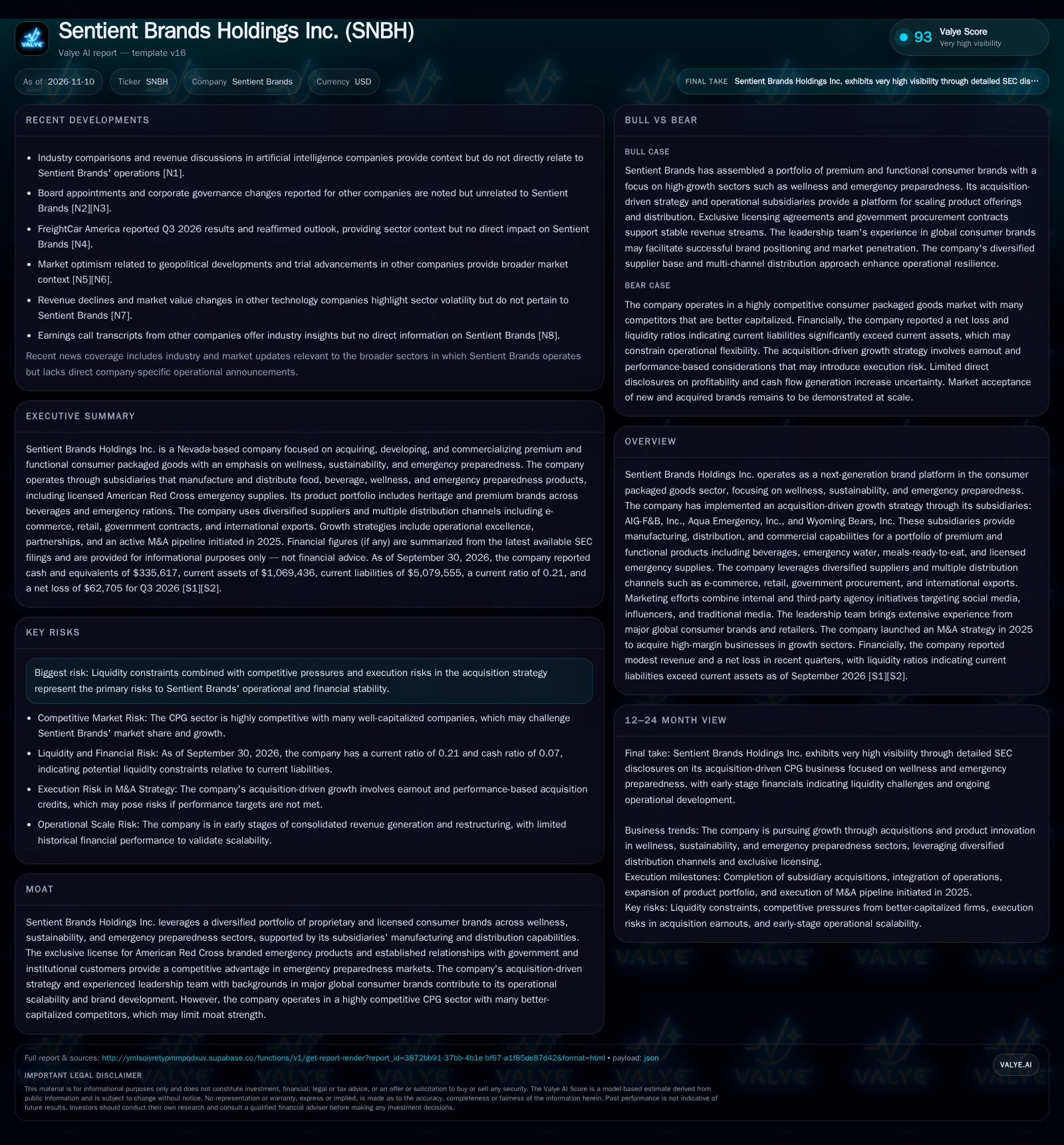
Sentient Brands Holdings reported its first consolidated operating revenues and continues to pursue an acquisition-driven strategy in wellness and emergency preparedness. Despite a diversified product line and exclusive licensing for American Red Cross emergency supplies, the company’s liquidity ratios remain deeply negative and net losses persist. The next phase hinges on operational integration, revenue scaling, and resolving near-term financial constraints [S1] [S2].
Sentient Brands Holdings is attempting to build a next-generation consumer packaged goods (CPG) platform by combining heritage beverage brands, premium wellness products, and exclusive emergency rations under a single operating structure. The company’s first consolidated revenues and new M&A strategy signal ambition, but severe liquidity shortfalls, persistent losses, and the complexities of integrating multiple acquisitions pose significant hurdles. Whether Sentient Brands can convert its product and channel breadth into sustainable growth will depend on its ability to execute operational improvements, monetize exclusive licenses, and access new capital before financial constraints become existential.
Recent Revenue Gains and Liquidity Shortfalls Define Sentient Brands’ Operating Reality
Sentient Brands Holdings reported $465,211 in revenue for Q2 2026 and a net loss of $62,705 in Q3, marking its first period of consolidated operating revenue since integrating its subsidiaries [S2]. These results are accompanied by a cash position of $335,617 and current assets of $1,069,436 against current liabilities of $5,079,555, yielding a current ratio of 0.21 and a cash ratio of 0.07 as of September 30, 2026 [S2]. This severe working capital deficit underscores the urgency for operational improvements or external financing. The company’s M&A strategy, initiated in Q3 2025, adds further execution complexity as it seeks to scale through acquisition rather than organic growth [S1].
How Sentient Brands’ Portfolio Model Could Scale—And Where Economics May Break Down
Sentient Brands’ business model is predicated on acquiring, developing, and commercializing premium and functional CPG brands, with a mix of in-house manufacturing, licensed products, and third-party distribution [S1]. Product economics likely vary widely: premium beverages (Original New York Seltzer, Arctic Frost vodka) may offer higher gross margins if brand equity drives pricing power, while emergency rations (notably those licensed from the American Red Cross) could trade margin for volume via government procurement or institutional channels.
The company’s multi-channel distribution—spanning e-commerce, retail, wholesale, government contracts, and international exports—offers optionality but also operational complexity. Fixed costs are embedded in manufacturing (through AIG-F&B), marketing (internal and agency-driven), and brand development, while variable costs scale with volume and distribution reach. The company reported cash and liquidity metrics for the period; these figures do not by themselves establish operating runway, investment capacity, financial flexibility, or financing capacity.
The M&A-driven strategy seeks to shortcut organic scaling, but integrating disparate brands and supply chains is capital- and management-intensive. Earnout and performance-based acquisition terms may create contingent liabilities or require further cash outlays if targets are met. The company’s current financial posture limits its ability to pursue aggressive growth or weather operational setbacks without external financing.
Exclusive Licenses and Niche Positioning Versus Scale-Driven CPG Titans
Sentient Brands operates in a hyper-competitive CPG environment, where global incumbents and well-capitalized niche players dominate shelf space, digital channels, and procurement relationships. The company’s exclusive American Red Cross license for emergency rations provides a unique entry point into government and institutional markets, offering a degree of differentiation that is not easily replicated [S1]. However, such licensing advantages may be narrow, and pricing in emergency preparedness is frequently dictated by bid processes and volume commitments.
The broader portfolio—premium beverages and wellness products—faces entrenched competition from both legacy CPG giants and agile direct-to-consumer upstarts. While the leadership team’s experience with brands like Disney and Walmart may help navigate brand development and retail access, Sentient Brands’ limited capital base restricts its ability to outspend rivals on marketing or inventory. Diversified suppliers and contingency arrangements reduce single-point-of-failure risk, but do not by themselves confer pricing power or high retention unless the brands achieve meaningful consumer resonance.
Substitution threats remain high: consumers are not locked in, and switching costs are minimal outside of institutional contracts. The company’s ability to build recurring, higher-margin revenue streams will depend on demonstrating product quality, brand recall, and consistent fulfillment—areas where early-stage CPG platforms often struggle against better-resourced competitors.
Unlocking Value Through Rapid Integration and Licensing Monetization
A bullish scenario for Sentient Brands would see the company successfully integrate its recent acquisitions, leveraging operational synergies across manufacturing, marketing, and distribution. The exclusive American Red Cross license could drive outsized growth in the emergency preparedness segment if government contracts or institutional customers scale up orders, providing recurring, high-volume business.
If the company can secure bridge financing or working capital support, it could capitalize on the multi-channel distribution strategy—expanding e-commerce penetration and winning shelf space in retail and wholesale channels. Strong execution would translate into positive operating leverage: fixed costs spread over a growing revenue base, improved gross margins from scale, and eventual stabilization or reversal of net losses.
Confirmation of this scenario would come from accelerating revenue growth, improved gross margins, and evidence of recurring procurement contracts or renewals in the emergency preparedness vertical. Additional signals would include successful acquisition integration (e.g., reduced SG&A as a percent of sales), new capital raises at favorable terms, and public disclosure of multi-year government or institutional agreements.
Navigating Integration Hurdles While Managing Tight Liquidity
The most probable trajectory for Sentient Brands is a period of slow, uneven revenue growth as the company works to integrate its acquired brands and stabilize operations. Liquidity constraints may force management to prioritize cash-generating lines or seek emergency funding, potentially on dilutive or disadvantageous terms. The company is likely to face ongoing net losses until it can meaningfully scale its premium beverage and emergency preparedness segments.
Margins may remain compressed as the company competes on price in crowded categories, and any operational missteps or delays in acquisition integration could further sap momentum.
Evidence supporting this scenario would include continued modest revenue growth, stable or slightly improving margins, and periodic capital raises or bridge financings. Falsification would require a dramatic shift in revenue trajectory, significant new procurement wins, or a clear path to positive cash flow from operations.
Liquidity Crunch and Integration Failures Could Trigger Restructuring or Asset Sales
In a negative scenario, Sentient Brands’ acute liquidity shortfall becomes unsustainable before operational improvements or external capital can be secured. Integration challenges—such as cost overruns, supply chain disruptions, or underperforming acquisitions—could compound losses and erode any remaining reported cash balance.
If the company is unable to monetize its exclusive licenses, win meaningful procurement contracts, or generate sufficient organic growth, it may be forced to seek asset sales, enter restructuring, or dilute existing shareholders through distressed financings. The risk of delisting or bankruptcy would rise if current liabilities cannot be addressed through improved cash flow or external support.
This scenario would be confirmed by accelerating net losses, further deterioration in liquidity ratios, missed procurement or distribution milestones, and public disclosures of going-concern warnings, asset divestitures, or creditor negotiations.
Testing Sentient Brands’ Thesis: Execution, Revenue Quality, and Potential Financial Flexibility
Quarterly revenue growth by product line and channel (e-commerce, retail, government, export) would clarify where momentum is building and which segments are driving performance, if disclosed.
Gross margin trends by business segment would reveal whether scale or mix improvements are translating into better unit economics.
Disclosure of contract wins, especially multi-year government or institutional procurement agreements for emergency rations, would validate the licensing thesis.
Updates on acquisition integration costs and realized synergies (e.g., SG&A as a percentage of sales) would help gauge management’s ability to deliver on promised efficiencies.
Cash flow from operations and bridge financing events will indicate whether the company can fund growth internally or is reliant on external capital.
Changes in supplier or distributor relationships—such as exclusive distribution deals or loss of key partners—could materially affect revenue visibility and margin structure.
Any going-concern language, covenant breaches, or restructuring disclosures in SEC filings would signal acute financial risk.
A useful metric would be recurring revenue percentage—especially from government or institutional contracts—to test the stickiness of the business model.
Disclaimer: This is research-only, informational analysis and not investment advice. It may include AI-generated interpretation and general industry context. Always verify important details using primary sources.

Comments