
Orrstown Financial Services: Profitable Franchise, Dividend Continuity, and the Strategic Stakes of Regional Banking
The question is whether its profitability and investor engagement can withstand economic cycles and competitive pressures, given limited disclosure on liquidity and market positioning.
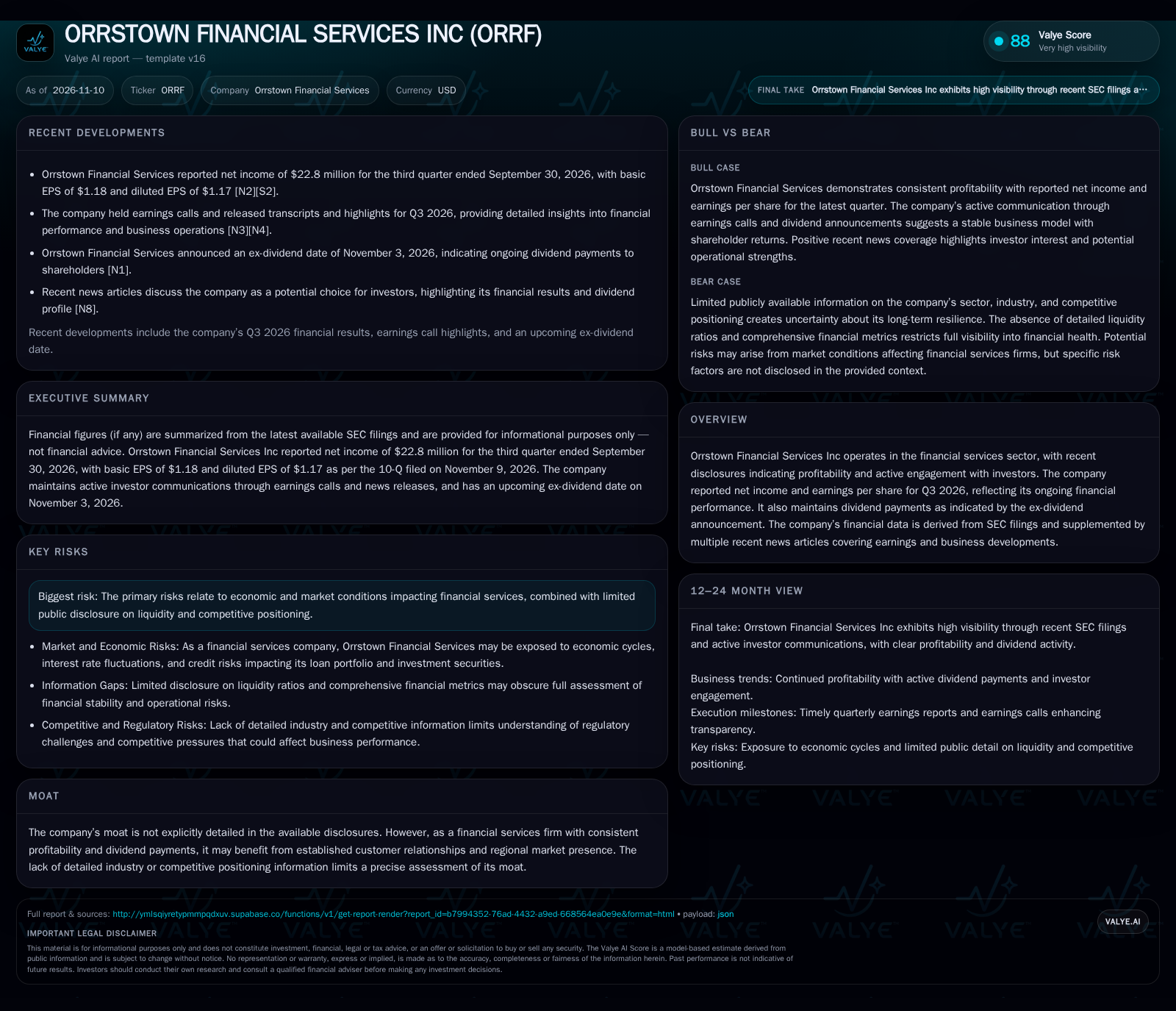
Orrstown Financial Services delivered $22.8 million in net income for Q3 2026 and continues to pay dividends, reflecting profitability and shareholder orientation. The company's visibility through earnings communications is high, but public details on liquidity and competitive differentiation remain sparse. The core question is whether this performance is sustainable amid broader financial-sector uncertainties and potential competitive or regulatory shifts.[N2] [S2] [N1]
Orrstown Financial Services Inc’s latest quarter underscores both its profitability and its strategic orientation toward shareholder returns, reporting $22.8 million in net income and maintaining dividend payments. As a regional financial services provider, Orrstown’s future hinges on its ability to navigate credit cycles, competitive threats, and regulatory change while sustaining its current operating momentum.[N2] [S2] [N1]
Recent Profitability and Dividend Actions Define Orrstown’s 2026 Position
Orrstown Financial Services reported net income of $22.8 million for the third quarter of 2026, translating to basic and diluted EPS of $1.18 and $1.17, respectively.[N2] [S2] This level of earnings demonstrates that the company is operating profitably in the current environment. The company reported cash and liquidity metrics for the period; these figures do not by themselves establish operating runway, investment capacity, financial flexibility, or financing capacity. [N1] [N3] [N4]
How Orrstown Generates Value: Core Banking Economics, Cost Structure, and Capital Needs
As a regional financial services provider, Orrstown’s primary revenue streams likely derive from net interest income (the spread between interest earned on loans and paid on deposits) and fee-based services such as wealth management, mortgage origination, or transaction processing. The profitability reported in Q3 implies that interest margins or fee income are currently sufficient to cover operating costs and credit expenses.[N2] [S2] However, the company’s cost structure is expected to include fixed expenses related to branch operations, technology infrastructure, and regulatory compliance, while variable costs scale with transaction volume and credit provisioning.
Dividend payments suggest that Orrstown is generating sufficient free cash flow, or at least distributable profits, to return capital to shareholders. Nevertheless, the capital intensity of banking means that maintaining adequate regulatory capital ratios is essential, especially during periods of loan growth or in the face of rising credit losses. Without disclosed liquidity or capital ratios, it is unclear how much flexibility the company retains for expansion, investment, or absorbing unexpected shocks. If credit quality deteriorates or interest margins compress, the fixed-cost base could pressure operating leverage and limit dividend capacity.
The business model’s resilience is therefore highly contingent on prudent credit risk management, stable funding costs, and the ability to adapt pricing in response to market shifts. Any significant shift in deposit costs, loan demand, or credit quality could materially alter the company's economics.
Furthermore, the interplay between interest rate cycles and Orrstown's asset-liability management is critical for sustaining profitability. In a rising rate environment, the bank could benefit from expanding net interest margins if loan repricing outpaces deposit cost increases. However, if deposit rates rise faster due to competitive pressures or market conditions, margin compression could occur. The duration mismatch between assets and liabilities, if significant, may expose the company to interest rate risk, influencing both earnings volatility and capital adequacy. Effective hedging strategies and dynamic balance sheet management are therefore essential to mitigate such risks and preserve financial stability.
Competitive Landscape: Regional Banking Dynamics, Substitution Threats, and Differentiation
Orrstown’s competitive environment is shaped by the regional banking sector, where rivals include other community banks, regional banks, credit unions, and increasingly, digital-first financial platforms. Traditional advantages in this space often stem from local market knowledge, established customer relationships, and tailored service offerings. However, the lack of detailed public disclosure on Orrstown’s market footprint, customer mix, or product differentiation makes it difficult to gauge the company’s specific edge.
Competitive counterforces are intensifying as fintech entrants, larger regional banks, and national institutions compete aggressively on both rates and digital convenience. If Orrstown lacks a distinctive digital offering or specialized lending niche, it risks margin compression and customer attrition. On the other hand, a strong local presence, sticky relationships, or unique service bundles could provide switching frictions and support retention.
The cited source reports dividend-related activity; that disclosure alone does not establish dividend-policy continuity, management confidence, or a material constraint on capital flexibility. The question remains whether Orrstown can sustain its position as competitive dynamics evolve and regulatory requirements increase.
Another dimension shaping Orrstown’s competitive positioning involves regulatory capital requirements and compliance costs, which have disproportionately impacted smaller regional banks. Increased regulatory scrutiny often necessitates investments in risk management systems and personnel, potentially raising the fixed-cost base. If Orrstown can leverage scale efficiencies or adopt technology to streamline compliance, it may maintain cost competitiveness. Conversely, lagging in these areas could erode profitability relative to larger peers or more agile fintech competitors. Thus, the company’s strategic choices around operational efficiency and regulatory adaptation directly influence its ability to sustain competitive differentiation.
What It Would Take for Orrstown to Outperform: Credit Quality, Deposit Growth, and Digital Leverage
A favorable scenario for Orrstown would involve continued benign credit conditions, allowing the company to maintain low loan losses and stable net interest margins. If the regional economy remains healthy and interest rates stabilize, Orrstown could see deposit growth and increased lending activity, further supporting earnings and dividend continuity.
Upside could also be driven by successful digital transformation—if Orrstown invests in or partners with digital platforms to enhance customer experience and efficiency, it could defend market share against fintech challengers and larger banks. Expansion into higher-margin fee businesses, or selective acquisitions in adjacent markets, would further boost profitability and franchise value.
Conversely, a spike in credit losses, deposit outflows, or stagnating revenue would falsify the upside narrative.
Most Likely Trajectory: Steady Operations Amid Sectoral Headwinds
The most plausible outcome is that Orrstown continues to operate profitably, but with modest growth constrained by sector-wide challenges such as margin compression, heightened regulatory scrutiny, and competition from both traditional and digital players. The company is likely to maintain dividend payments as long as core earnings remain stable and capital ratios are adequate.
Operational execution will hinge on prudent loan underwriting, cost control, and retention of core deposit relationships. The lack of disclosed liquidity or asset quality data creates uncertainty, but absent evidence of deterioration, a stable performance with incremental growth appears most likely.
Signs of stress would include declining earnings, dividend cuts, or a sudden spike in non-performing assets (if disclosed).
How Adverse Cycles Could Undermine Performance: Credit, Rates, and the Limits of Scale
A negative scenario would be triggered by a downturn in regional economic conditions, leading to increased credit losses and pressure on net interest margins. Rising deposit costs or an inverted yield curve could further squeeze profitability, while heightened competition for both loans and deposits could erode market share and pricing power.
If Orrstown’s loan book is concentrated in vulnerable sectors or geographies, a localized downturn could amplify losses. Inadequate digital capabilities could accelerate customer attrition to more agile competitors. Regulatory changes demanding higher capital or liquidity buffers would further constrain flexibility and potentially force dividend reductions.
Evidence confirming downside risk would include a sharp drop in net income or EPS, dividend suspension or cuts, rising non-performing loan ratios, or disclosures of material funding or liquidity stress. The absence of detailed loan portfolio or liquidity disclosures in public filings is itself a risk factor, as it limits early warning signals.
Signals That Will Shape Orrstown’s Resilience and Value Creation Potential
The company reported profitability for the period.
Deposit and loan growth rates (if disclosed): Expansion or contraction here would reveal competitive standing and local market health.
Credit quality metrics, such as non-performing loans or charge-offs (if disclosed): Deterioration would increase risk to earnings and capital.
Net interest margin and funding cost trends (if disclosed): Compression here would directly impact profitability.
Digital platform enhancements or customer adoption metrics: Progress would indicate competitive adaptation; stagnation could signal vulnerability.
Management commentary on competitive and regulatory dynamics: Provides context for strategic positioning and risk management.
Disclaimer: This is research-only, informational analysis and not investment advice. It may include AI-generated interpretation and general industry context. Always verify important details using primary sources.

Comments