
ERP OPERATING LTD PARTNERSHIP: High Revenue, Deep Losses, and the Implications of Extreme Opacity
ERP OPERATING LTD PARTNERSHIP reported nearly $1.2 billion in quarterly revenue but posted a net loss exceeding $735 million, with minimal cash reserves and no public disclosure of its business activities or industry. This extreme lack of transparency demands a focus on structural economics, risk mechanisms, and the plausible drivers behind such striking headline figures.
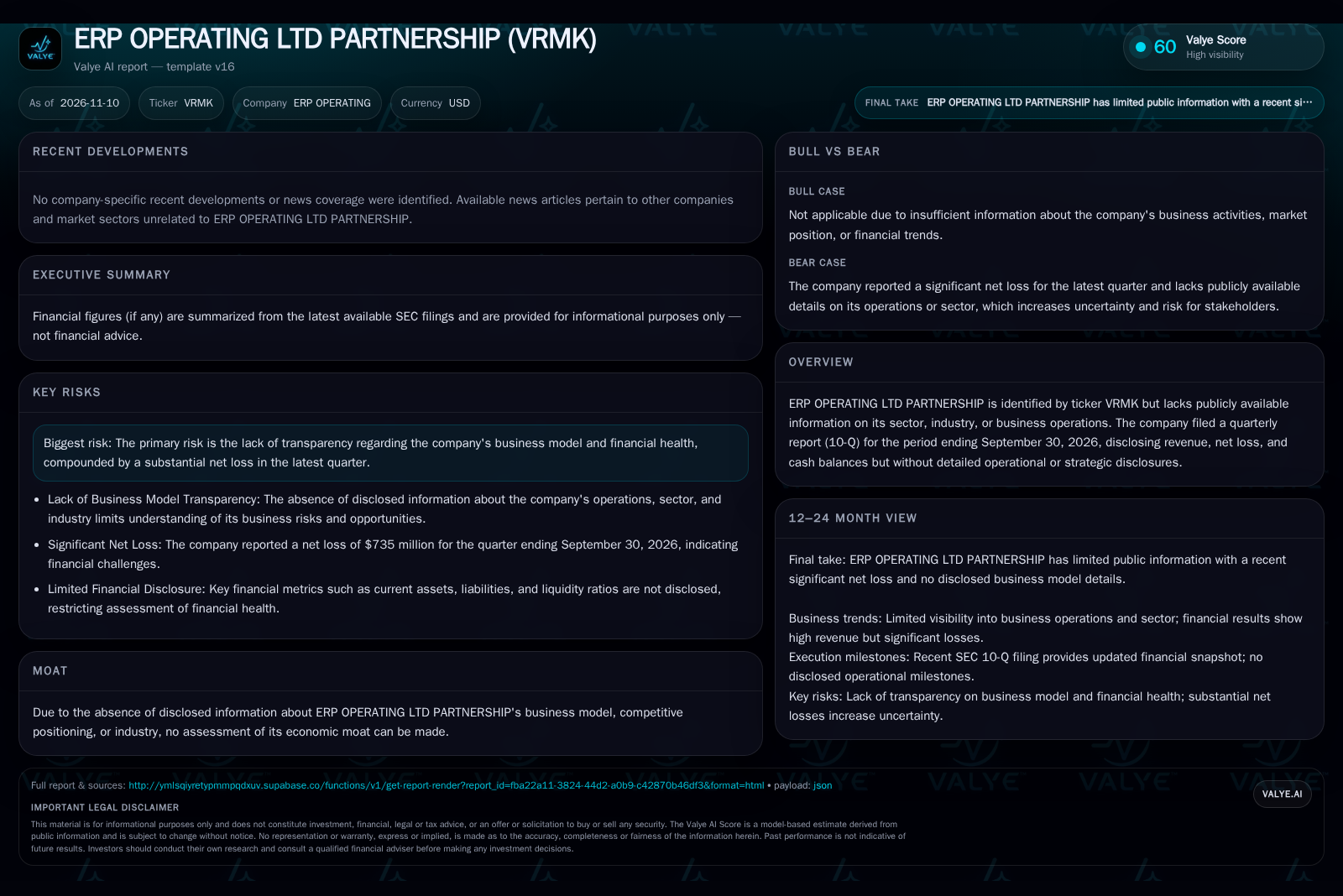
ERP OPERATING LTD PARTNERSHIP (VRMK) reported $1.2 billion in revenue and a $735 million net loss for Q3 2026, but provides no details on its operations, sector, or business model. The combination of high revenue, significant losses, and minimal cash raises questions about business sustainability, capital intensity, and risk, with the lack of disclosure heightening uncertainty around its future trajectory. [S1]
ERP OPERATING LTD PARTNERSHIP presents one of the most opaque profiles among large-revenue reporting entities, disclosing nearly $1.2 billion in quarterly revenue alongside a staggering $735 million net loss, yet providing no public information on its sector, business activities, or operational strategies. In such a vacuum, investors and analysts must focus on the possible economic structures and risk mechanisms that could drive these headline figures—while recognizing that extreme opacity itself is a material risk factor. [S1]
Material Facts: Revenue Scale, Deep Losses, and the Black Box
For the quarter ending September 30, 2026, ERP OPERATING LTD PARTNERSHIP reported revenue of $1,195,484,000 and a net loss of $735,148,000. Cash and cash equivalents stood at $111,876,000 at quarter-end. No information is available regarding the company’s sector, industry, business model, or operational structure. The absence of operational disclosure, combined with the magnitude of both revenue and losses, makes this company a high-risk proposition with no apparent pathway to validation or falsification of its business model through public sources. [S1]
Without segment or business-line detail, it is impossible to determine whether these figures reflect a rapidly scaling business, a distressed asset, or a highly cyclical/compressed-cost industry.
Interpreting Economics Without a Map: What Could Drive High Revenue and Severe Losses?
In the absence of operational detail, the combination of high revenue and deep losses could result from several underlying economic structures:
Heavy Fixed-Cost Model: The company may operate in a sector requiring large up-front investments (e.g., real estate, infrastructure, or capital-intensive technology platforms), where depreciation, amortization, or interest expense drive large accounting losses despite positive gross margins. In such models, negative net income can persist even during periods of high top-line growth if scale or utilization has not been achieved.
Low-Margin, High-Volume Business: The revenue scale could reflect a commodity or pass-through business (such as distribution or logistics) with razor-thin margins. If costs are not tightly controlled, or if the company is forced to compete aggressively on price, net losses can quickly mount.
Transitional or Distressed Asset: A company in the midst of restructuring, asset write-downs, or business model pivots may report high revenue but even higher non-cash or restructuring charges, leading to large net losses. This is plausible if the company is unwinding legacy commitments or absorbing impairment costs.
Competitive Dynamics in the Dark: Potential Peers and Positioning Mechanisms
With no information on ERP OPERATING LTD PARTNERSHIP’s sector or business line, competitive analysis can only be approached through generic archetypes. If the company operates in a capital-intensive industry—such as real estate, infrastructure, telecom, or heavy manufacturing—its competitive position would typically be determined by asset scale, cost of capital, and operational efficiency. In contrast, a technology or platform business would rely more on network effects, intellectual property, or integration reach.
If the company is a distributor or logistics provider, competition is often based on scale, cost structure, and service reliability, with price-driven rivalry and low switching costs. Should ERP OPERATING be a distressed asset or restructuring entity, its ability to reposition would depend on management execution and access to new capital rather than traditional competitive advantages.
The absence of disclosure about customers, channels, or recurring revenue mechanisms means that any claim of pricing power, customer lock-in, or moat is purely hypothetical. The only certain competitive disadvantage is the opacity itself: without transparency, the company likely faces a higher cost of capital, limited access to public markets, and diminished stakeholder trust.
If Losses Are Transitional: What Would Signal a Path to Structural Profitability?
The most favorable scenario is that ERP OPERATING LTD PARTNERSHIP’s substantial net losses are transitional—driven by up-front investments, temporary restructuring, or growth-stage spending. If the underlying business has positive unit economics, the company could turn profitable as it scales, rationalizes costs, or completes its investment phase.
Confirmation of this scenario would require future disclosure of segment profitability, operating margin improvement, or evidence of sustainable gross margins. A reduction in net loss relative to revenue, positive operating cash flow, or detailed commentary on business model transitions would support a thesis of normalization and eventual profitability.
Falsification would occur if future filings show persistent or widening losses without explanation, negative gross margins, or continued high cash burn with no path to break-even. In the absence of disclosure, any improvement in cash position or net income trend—if reported—would be the only externally visible signals.
Sustained Opacity: A Business That Remains Unverifiable and High Risk
The most plausible scenario, given current practices, is that ERP OPERATING LTD PARTNERSHIP continues to operate with minimal public disclosure, reporting headline revenue and loss figures but providing no visibility into business model, sector dynamics, or strategic intent. In this scenario, the company may persist as a large but structurally unprofitable or distressed entity, unable or unwilling to access public capital markets or attract long-term institutional investors.
This scenario would be confirmed by continued high revenue and large losses, with quarterly reports lacking segmentation, operational commentary, or liquidity details. The company’s risk premium would remain elevated, and its valuation would likely be discounted heavily due to the inability to validate future cash flows or strategic positioning.
A deviation from this scenario would require a material increase in transparency—such as the release of business-line details, management commentary, or strategic updates—enabling stakeholders to analyze the true economics and risks of the business.
Structural Losses and Funding Exhaustion: The Risks of a Black Box Model
The adverse scenario is that ERP OPERATING LTD PARTNERSHIP’s losses are structural, not transitional: the business may be fundamentally unprofitable, with negative gross margins or a permanently unsustainable cost base.
This scenario would be confirmed by deteriorating cash balances, lack of improvement in net loss, or disclosure of financing difficulties (such as missed payments, covenant breaches, or emergency capital raises). In extreme cases, the company could face insolvency or delisting if it cannot secure additional funding or achieve a credible turnaround.
The absence of any operational or strategic disclosure makes it impossible for external stakeholders to anticipate or respond to emerging risks, further compounding the downside by eroding trust and limiting recapitalization options.
Testing the Thesis: Concrete Markers for Risk, Sustainability, and Model Transparency
Quarterly trend in net loss as a percentage of revenue: Sustained improvement or worsening would help indicate whether losses are transitional or structural. [S1]
Disclosure of business model, sector, or operating segments: Any release would fundamentally alter the risk profile and enable more granular analysis.
Cash flow from operations (if disclosed): Positive or improving cash flow would suggest sustainability beyond headline net income figures.
Changes in cash and cash equivalents: Rapid deterioration would signal potential funding distress; stability or improvement would suggest reduced risk. [S1]
New financing or capital-raising events: The terms, frequency, and scale of such events would indicate the company’s ability to secure ongoing funding.
Evidence of asset sales, restructuring charges, or impairment write-downs: These would suggest distress or business model pivots.
Any management commentary, investor presentations, or regulatory filings that detail operational strategy or risk factors: The presence or absence of such disclosures would directly affect stakeholder confidence and analysis.
Disclaimer: This is research-only, informational analysis and not investment advice. It may include AI-generated interpretation and general industry context. Always verify important details using primary sources.

Comments